Committee advances bill expanding "foreign law" definition to include religious tribunals; ACLU warns of First Amendment risk
March 18, 2026 | 2026 Legislature Arizona, Arizona
This article was created by AI summarizing key points discussed. AI makes mistakes, so for full details and context, please refer to the video of the full meeting. Please report any errors so we can fix them. Report an error »
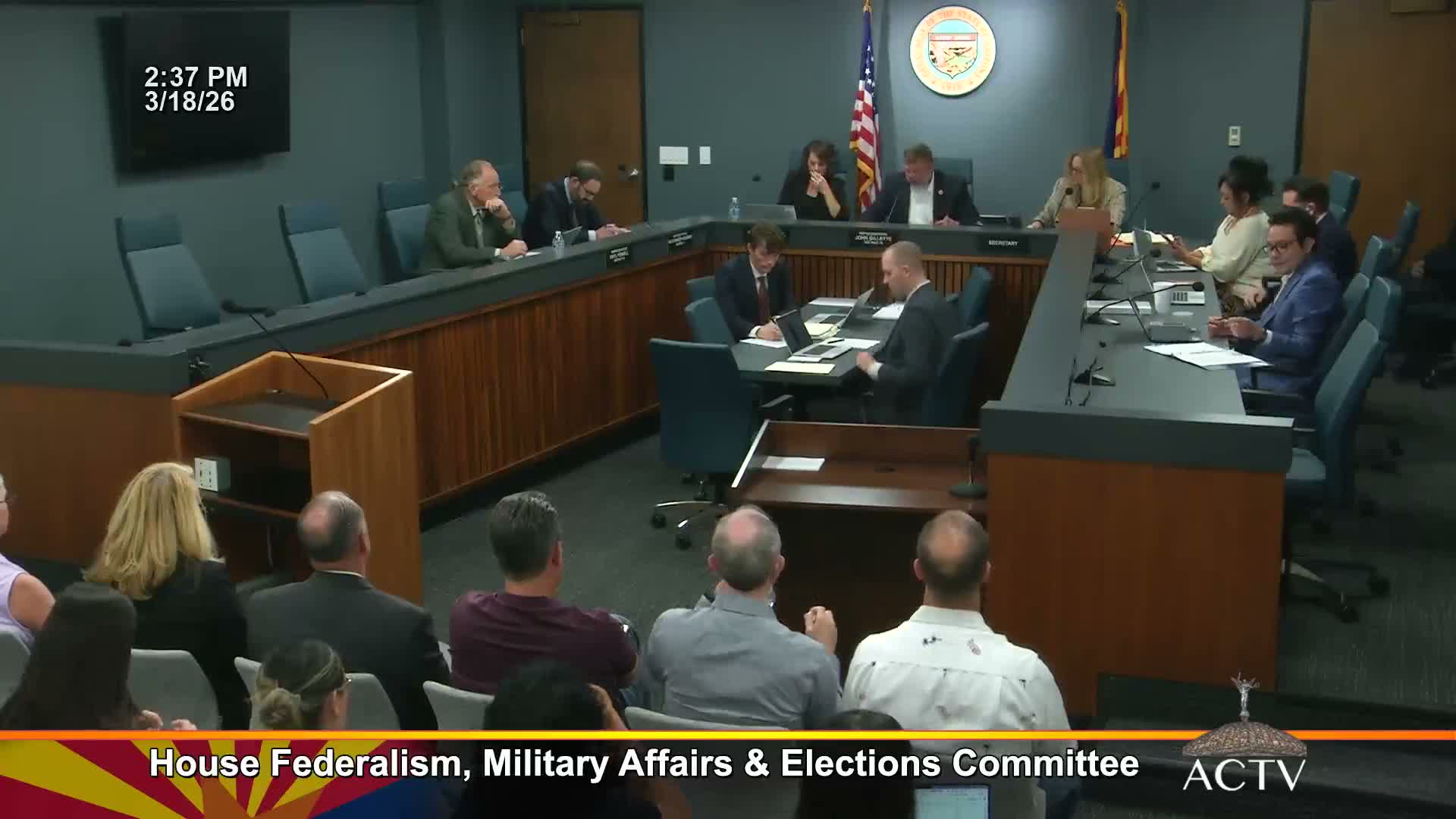
Senate Bill 10-18, which the committee recommended do-pass, would expand Arizona's definition of "foreign law" to cover adjudicative outcomes from private, arbitral or religious tribunals and add enforcement tools including mandatory judicial review, attorney general civil authority, protected reporting and civil penalties for coercion into arbitration.
The sponsor, Senator Sham, told the committee the bill is intended to ensure no adjudicated foreign or private outcome "is enforced in Arizona if it violates fundamental constitutional rights," and to provide "real enforcement" so unconstitutional rules are not informally enforced here. "It uses a neutral fundamental liberties test," the sponsor said, and "applies equally to foreign law, private arbitration, and informal or religious tribunals."
Opponents, led by Marilyn Rodriguez of the ACLU of Arizona, urged the committee to reject the language, saying the bill "is a copycat measure" seen around the country that wrongly singles out Islam and advances a narrative that Sharia is incompatible with U.S. law. Rodriguez argued the measure echoes the discredited "American Laws for American Courts" model and said a federal appeals court struck down an Oklahoma ban for singling out Islam; she warned the proposal would likely trigger First Amendment and Free Exercise challenges. "This proposal would not protect American values. It replaces religious freedom with religious fear," Rodriguez said.
Supporters and some public commenters described real harms they said can arise when private or religious adjudications produce outcomes contrary to constitutional protections. One public commenter, Marissa Caldwell, who said she observed logic-and-accuracy testing in Maricopa County, stressed concerns about coercion and described the bill as a way to protect victims who feel unable to raise objections in court.
Committee members repeatedly debated whether current statutes (including Arizona Revised Statutes sections discussed during the hearing) already prevent enforcement of unconstitutional foreign-law outcomes and whether the bill would be purely symbolic or would produce new legal effects. Representative Collinan asked whether existing definitions would already cover Sharia; Rodriguez and others said courts can still be put in the position of rejecting cases only after harm has occurred and that the bill adds proactive enforcement tools.
By roll call, the committee recorded four ayes and three nays and advanced the bill with a due-pass recommendation.
Next steps: SB 10-18 will move from this committee to the floor, where members may further amend the text or the sponsors may refine enforcement language to address constitutional concerns.
The sponsor, Senator Sham, told the committee the bill is intended to ensure no adjudicated foreign or private outcome "is enforced in Arizona if it violates fundamental constitutional rights," and to provide "real enforcement" so unconstitutional rules are not informally enforced here. "It uses a neutral fundamental liberties test," the sponsor said, and "applies equally to foreign law, private arbitration, and informal or religious tribunals."
Opponents, led by Marilyn Rodriguez of the ACLU of Arizona, urged the committee to reject the language, saying the bill "is a copycat measure" seen around the country that wrongly singles out Islam and advances a narrative that Sharia is incompatible with U.S. law. Rodriguez argued the measure echoes the discredited "American Laws for American Courts" model and said a federal appeals court struck down an Oklahoma ban for singling out Islam; she warned the proposal would likely trigger First Amendment and Free Exercise challenges. "This proposal would not protect American values. It replaces religious freedom with religious fear," Rodriguez said.
Supporters and some public commenters described real harms they said can arise when private or religious adjudications produce outcomes contrary to constitutional protections. One public commenter, Marissa Caldwell, who said she observed logic-and-accuracy testing in Maricopa County, stressed concerns about coercion and described the bill as a way to protect victims who feel unable to raise objections in court.
Committee members repeatedly debated whether current statutes (including Arizona Revised Statutes sections discussed during the hearing) already prevent enforcement of unconstitutional foreign-law outcomes and whether the bill would be purely symbolic or would produce new legal effects. Representative Collinan asked whether existing definitions would already cover Sharia; Rodriguez and others said courts can still be put in the position of rejecting cases only after harm has occurred and that the bill adds proactive enforcement tools.
By roll call, the committee recorded four ayes and three nays and advanced the bill with a due-pass recommendation.
Next steps: SB 10-18 will move from this committee to the floor, where members may further amend the text or the sponsors may refine enforcement language to address constitutional concerns.
View the Full Meeting & All Its Details
This article offers just a summary. Unlock complete video, transcripts, and insights as a Founder Member.
✓
Watch full, unedited meeting videos
✓
Search every word spoken in unlimited transcripts
✓
AI summaries & real-time alerts (all government levels)
✓
Permanent access to expanding government content
30-day money-back guarantee
