Environmental groups warn of lost public review as committee advances bill easing siting for co-located power plants
March 18, 2026 | 2026 Legislature Arizona, Arizona
This article was created by AI summarizing key points discussed. AI makes mistakes, so for full details and context, please refer to the video of the full meeting. Please report any errors so we can fix them. Report an error »
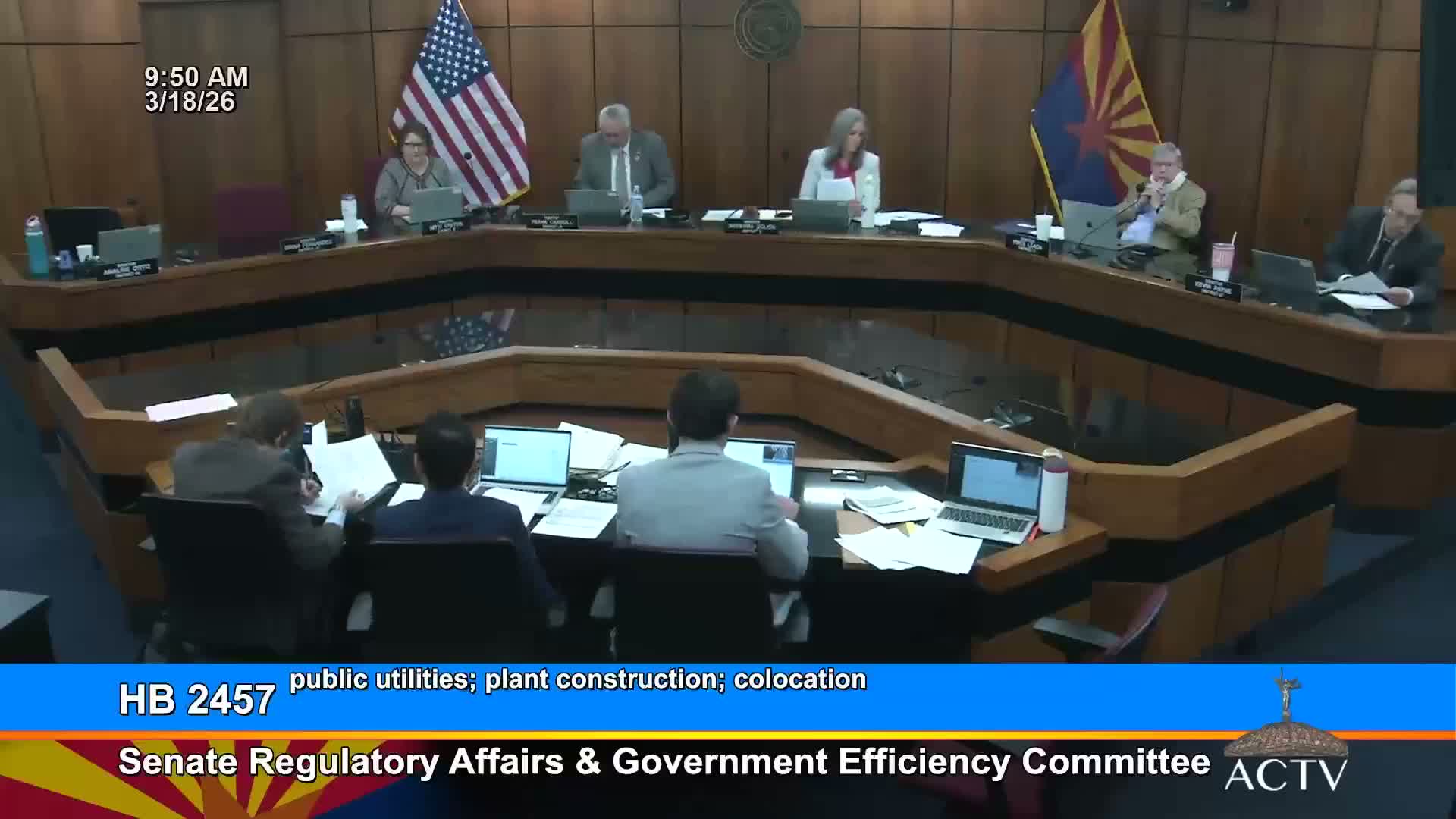
Sponsor described House Bill 2457 as a narrowly drawn change to allow utilities to construct a new plant co-located with an extra-high-load-factor customer after 30 days' written notice to the Arizona Corporation Commission and a local public-comment session — without filing for a Certificate of Environmental Compatibility (CEC) — provided zoning entitlements are in place and the utility is a public service corporation.
Sandy Bahren, director for the Sierra Club's Arizona chapter, testified in opposition and urged rejection. Bahren warned the bill would “short circuit important public review and transparency” and listed components considered in the CEC process such as impacts to fish and wildlife, noise, communication interference, and technical practicability. She said the CEC process allows discovery and cross-examination and multiple public-comment opportunities that the bill would effectively curtail.
David Morris of Americans for Prosperity testified in support, arguing that the state needs more generation and that permitting timeframes for new plants are long; he said the bill would streamline siting without eliminating safeguards in other processes.
Senator Epstein offered an extended explanation of her no vote, citing constituent opposition to nearby data centers and a desire to preserve public voice and scrutiny; the committee recorded a 4–2 vote with one not voting and gave HB2457 a due-pass recommendation.
Sandy Bahren, director for the Sierra Club's Arizona chapter, testified in opposition and urged rejection. Bahren warned the bill would “short circuit important public review and transparency” and listed components considered in the CEC process such as impacts to fish and wildlife, noise, communication interference, and technical practicability. She said the CEC process allows discovery and cross-examination and multiple public-comment opportunities that the bill would effectively curtail.
David Morris of Americans for Prosperity testified in support, arguing that the state needs more generation and that permitting timeframes for new plants are long; he said the bill would streamline siting without eliminating safeguards in other processes.
Senator Epstein offered an extended explanation of her no vote, citing constituent opposition to nearby data centers and a desire to preserve public voice and scrutiny; the committee recorded a 4–2 vote with one not voting and gave HB2457 a due-pass recommendation.
Don't Miss a Word: See the Full Meeting!
Go beyond summaries. Unlock every video, transcript, and key insight with a Founder Membership.
✓
Get instant access to full meeting videos
✓
Search and clip any phrase from complete transcripts
✓
Receive AI-powered summaries & custom alerts
✓
Enjoy lifetime, unrestricted access to government data
30-day money-back guarantee
