Parkways warns $11 million first‑year cost as Senate debates allowing personal E‑ZPasses on multiple vehicles
March 09, 2026 | 2026 Legislature WV, West Virginia
This article was created by AI summarizing key points discussed. AI makes mistakes, so for full details and context, please refer to the video of the full meeting. Please report any errors so we can fix them. Report an error »
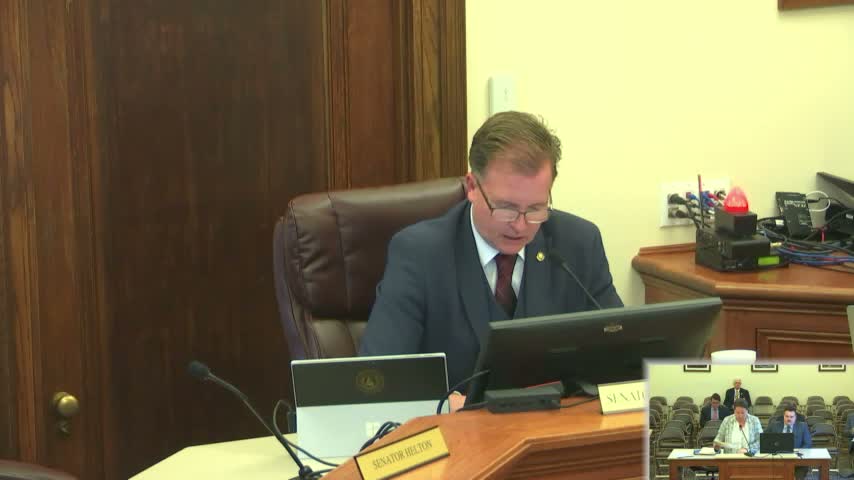
The Senate Transportation Infrastructure Committee spent the bulk of its March 4, 2026 meeting on House Bill 4563, a proposal to allow personal E‑ZPass transponders to be registered to an account and transferable among up to five enrolled vehicles of the same class owned by the account holder.
Committee counsel explained the measure’s intent and said the House sent the bill with a fiscal note now posted for review. Parkways Executive Director Chuck Smith and Chief Financial Officer Samuel Polley told the committee the authority lacks a back‑office enforcement system that would be needed to verify up to five vehicles for each personal transponder under codified law.
Smith said the personal single‑fee discount costs $27.50 a year (plus the transponder cost) and that a little over 75% of toll revenue comes from non‑West Virginia travelers. He testified the Parkways conservatively estimates annual lost revenue of about $1,700,000 if personal transponders can be used across multiple vehicles and forecast roughly 8,000,000 additional transaction checks at roughly $1.13 per check — contributing to a first‑year implementation and review cost estimate of about $11,000,000. “So in all, first year, you’re looking at $11,000,000 probably in that range,” Smith said.
CFO Samuel Polley told the committee that while the Parkways captures plate images on all passages, those images are reviewed by staff only when a transponder read triggers an anomaly; the authority currently does not have an automated, high‑confidence back office that can reliably match plates to transponder enrollments. Polley warned that without human review the system’s low confidence levels could generate many incorrect bills and public complaints. “Without that human review…we feel very confidently that we’re gonna start sending out a lot of bills to people and anger a lot of West Virginia and out‑of‑state residents,” Polley said.
Sponsor Delegate Eric Brooks, who traveled from the House to testify, said the proposal is intended to provide convenience for frequent local users and suggested a narrow amendment to avoid immediately requiring the Parkways to read every plate at toll plazas while preserving the bill’s intent. Several senators pressed for a second reference to the Committee on Finance to resolve fiscal and bond‑covenant questions; Senator Randolph asked the chair to speak with the finance chairman and, with no objection, the chair agreed to pursue that referral.
The committee recessed until relevant committee meetings concluded.
Committee counsel explained the measure’s intent and said the House sent the bill with a fiscal note now posted for review. Parkways Executive Director Chuck Smith and Chief Financial Officer Samuel Polley told the committee the authority lacks a back‑office enforcement system that would be needed to verify up to five vehicles for each personal transponder under codified law.
Smith said the personal single‑fee discount costs $27.50 a year (plus the transponder cost) and that a little over 75% of toll revenue comes from non‑West Virginia travelers. He testified the Parkways conservatively estimates annual lost revenue of about $1,700,000 if personal transponders can be used across multiple vehicles and forecast roughly 8,000,000 additional transaction checks at roughly $1.13 per check — contributing to a first‑year implementation and review cost estimate of about $11,000,000. “So in all, first year, you’re looking at $11,000,000 probably in that range,” Smith said.
CFO Samuel Polley told the committee that while the Parkways captures plate images on all passages, those images are reviewed by staff only when a transponder read triggers an anomaly; the authority currently does not have an automated, high‑confidence back office that can reliably match plates to transponder enrollments. Polley warned that without human review the system’s low confidence levels could generate many incorrect bills and public complaints. “Without that human review…we feel very confidently that we’re gonna start sending out a lot of bills to people and anger a lot of West Virginia and out‑of‑state residents,” Polley said.
Sponsor Delegate Eric Brooks, who traveled from the House to testify, said the proposal is intended to provide convenience for frequent local users and suggested a narrow amendment to avoid immediately requiring the Parkways to read every plate at toll plazas while preserving the bill’s intent. Several senators pressed for a second reference to the Committee on Finance to resolve fiscal and bond‑covenant questions; Senator Randolph asked the chair to speak with the finance chairman and, with no objection, the chair agreed to pursue that referral.
The committee recessed until relevant committee meetings concluded.
Don't Miss a Word: See the Full Meeting!
Go beyond summaries. Unlock every video, transcript, and key insight with a Founder Membership.
✓
Get instant access to full meeting videos
✓
Search and clip any phrase from complete transcripts
✓
Receive AI-powered summaries & custom alerts
✓
Enjoy lifetime, unrestricted access to government data
30-day money-back guarantee
