Senate committee gives due‑pass to bill increasing penalty for third‑party interference with arrests amid free‑speech concerns
March 18, 2026 | 2026 Legislature Arizona, Arizona
This article was created by AI summarizing key points discussed. AI makes mistakes, so for full details and context, please refer to the video of the full meeting. Please report any errors so we can fix them. Report an error »
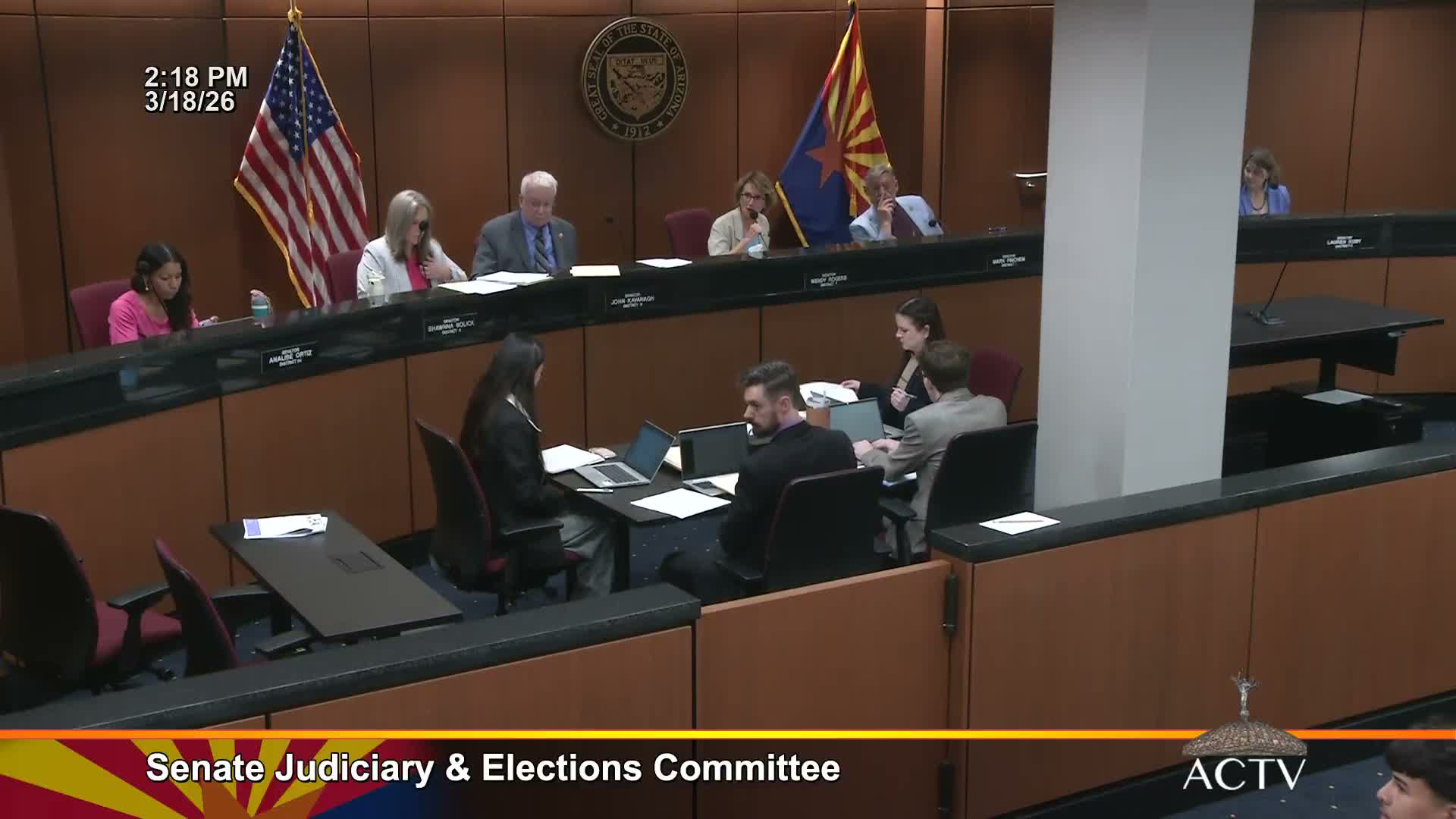
House Bill 28‑11 — proposed language to make it a class‑5 felony to knowingly obstruct, impair or hinder a lawful arrest — received a due‑pass recommendation from the Senate Judiciary & Elections Committee after a contentious hearing.
The bill’s principal outside proponent, Brad Miller of the Pinal County Attorney’s Office, told the committee the change is needed to address violent third‑party interference with arrests. "HB 28‑11 closes this loophole," Miller said, citing FBI and local data about officers being shot at and attacked. He said prosecutors would retain discretion and that the measure distinguishes third‑party obstruction from resisting arrest by the person being arrested.
Opponents — including Pamela Hicks, a volunteer attorney with the Arizona Attorneys for Criminal Justice, and Caitlin Contreras of the ACLU of Arizona — urged caution. Hicks argued the conduct targeted by HB 28‑11 already falls under statutes such as hindering prosecution or resisting arrest and warned the new felony could duplicate existing law. "We do believe that this law is duplicative," Hicks said. Contreras warned the measure could be used to criminalize everyday, protected behavior: "This bill could make it a crime to engage in First Amendment‑protected activity, including filming officers," she said, arguing the language risks chilling public documentation of law‑enforcement actions.
Several senators pressed both sides on legal distinctions. Committee members heard explanations that resisting arrest targets the arrestee while the proposed change addresses third‑party actors; proponents said prosecutorial discretion and early‑disposition processes would still allow reductions in appropriate cases. Opponents repeatedly raised concerns about over‑criminalization and potential misuse in protests and civil‑liberties contexts.
After discussion and brief debate, the committee voted to recommend HB 28‑11 be given a due‑pass recommendation. The committee record shows members on both sides explained their votes, with proponents citing officer safety and opponents stressing civil‑liberties risks.
The bill as reported will proceed to the next floor action and may be revised by sponsors or in later floor debate.
The bill’s principal outside proponent, Brad Miller of the Pinal County Attorney’s Office, told the committee the change is needed to address violent third‑party interference with arrests. "HB 28‑11 closes this loophole," Miller said, citing FBI and local data about officers being shot at and attacked. He said prosecutors would retain discretion and that the measure distinguishes third‑party obstruction from resisting arrest by the person being arrested.
Opponents — including Pamela Hicks, a volunteer attorney with the Arizona Attorneys for Criminal Justice, and Caitlin Contreras of the ACLU of Arizona — urged caution. Hicks argued the conduct targeted by HB 28‑11 already falls under statutes such as hindering prosecution or resisting arrest and warned the new felony could duplicate existing law. "We do believe that this law is duplicative," Hicks said. Contreras warned the measure could be used to criminalize everyday, protected behavior: "This bill could make it a crime to engage in First Amendment‑protected activity, including filming officers," she said, arguing the language risks chilling public documentation of law‑enforcement actions.
Several senators pressed both sides on legal distinctions. Committee members heard explanations that resisting arrest targets the arrestee while the proposed change addresses third‑party actors; proponents said prosecutorial discretion and early‑disposition processes would still allow reductions in appropriate cases. Opponents repeatedly raised concerns about over‑criminalization and potential misuse in protests and civil‑liberties contexts.
After discussion and brief debate, the committee voted to recommend HB 28‑11 be given a due‑pass recommendation. The committee record shows members on both sides explained their votes, with proponents citing officer safety and opponents stressing civil‑liberties risks.
The bill as reported will proceed to the next floor action and may be revised by sponsors or in later floor debate.
View the Full Meeting & All Its Details
This article offers just a summary. Unlock complete video, transcripts, and insights as a Founder Member.
✓
Watch full, unedited meeting videos
✓
Search every word spoken in unlimited transcripts
✓
AI summaries & real-time alerts (all government levels)
✓
Permanent access to expanding government content
30-day money-back guarantee
