Votes at a glance: committee advances a package of bills on corrections, records, elections and public safety
March 18, 2026 | 2026 Legislature Arizona, Arizona
This article was created by AI summarizing key points discussed. AI makes mistakes, so for full details and context, please refer to the video of the full meeting. Please report any errors so we can fix them. Report an error »
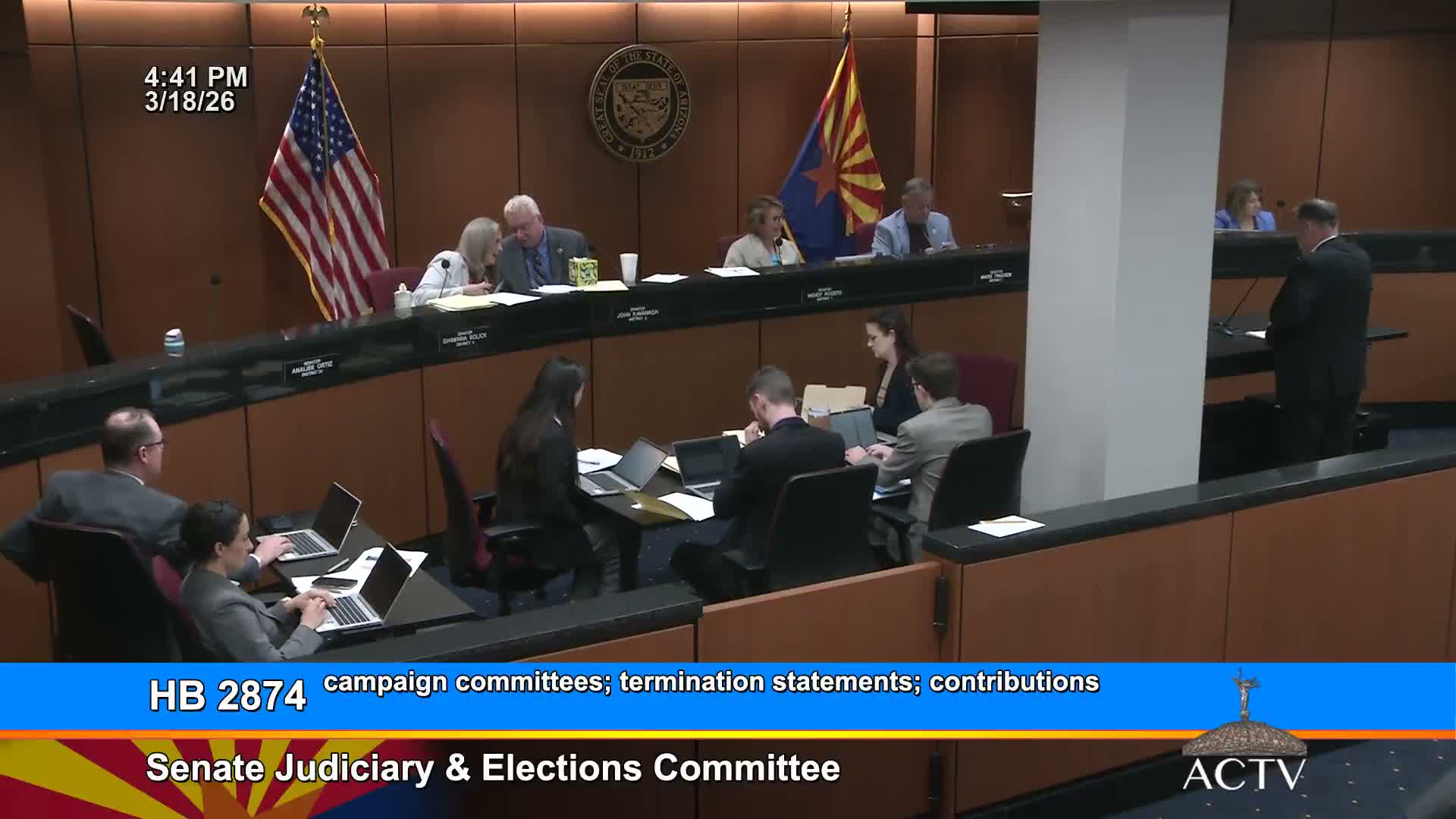
The Senate Judiciary & Elections Committee considered a broad slate of bills and took votes on many items. Key outcomes and short summaries follow.
- HB 2665 (Cade’s Law): Due‑pass recommendation after emotional family testimony (see separate article).
- HB 2857: Due‑pass recommendation. The bill allows the Arizona Department of Corrections, Rehabilitation & Reentry (ADCRR) to store inmate medical records electronically and dispose of physical copies where records are kept electronically; sponsors argued efficiency and space savings.
- HB 2226: Due‑pass as amended. The bill requires courts to ask at initial appearance whether a defendant is a veteran and notify the prosecuting agency; the prosecuting agency must provide ADVS materials and consider treatment court referrals, excluding certain serious offenses.
- HB 2857 & HB 2440: Both received due‑pass recommendations; HB 2440 allows a one‑time 90‑day extension for transition services for eligible inmates.
- HB 2874: Due‑pass recommendation with an amendment that voids penalties retroactively if a committee certifies no contributions were received.
- HB 2109: Due‑pass recommendation to increase penalties for hands‑free driving violations and adjust specific penalty amounts; committee adopted sponsor amendments.
- HB 2198: Due‑pass recommendation to allow sealing of petty offense records; sponsors and justices of the peace supported correcting an oversight.
- HB 2825: Held. A bill to replace some criminal enforcement mechanisms for nonpayment of fines with a civil enforcement remedy drew opposition from victims’ advocates and judicial stakeholders concerned about victims’ rights and the removal of contempt as a tool; the chair held the bill for further stakeholder work.
- HB 2805, HB 4067: Both received due‑pass recommendations; HB 2805 expands equal access for certain candidates to the Secretary of State’s candidate tools; HB 4067 allows county recorders to include additional voter statuses (not registered, suspense, not eligible, canceled) in pollbooks/signature rosters.
Several bills were amended in committee; sponsors and agencies were directed to work with stakeholders where witnesses flagged constitutional, implementation, or victims‑rights concerns. The committee adjourned after completing the agenda.
- HB 2665 (Cade’s Law): Due‑pass recommendation after emotional family testimony (see separate article).
- HB 2857: Due‑pass recommendation. The bill allows the Arizona Department of Corrections, Rehabilitation & Reentry (ADCRR) to store inmate medical records electronically and dispose of physical copies where records are kept electronically; sponsors argued efficiency and space savings.
- HB 2226: Due‑pass as amended. The bill requires courts to ask at initial appearance whether a defendant is a veteran and notify the prosecuting agency; the prosecuting agency must provide ADVS materials and consider treatment court referrals, excluding certain serious offenses.
- HB 2857 & HB 2440: Both received due‑pass recommendations; HB 2440 allows a one‑time 90‑day extension for transition services for eligible inmates.
- HB 2874: Due‑pass recommendation with an amendment that voids penalties retroactively if a committee certifies no contributions were received.
- HB 2109: Due‑pass recommendation to increase penalties for hands‑free driving violations and adjust specific penalty amounts; committee adopted sponsor amendments.
- HB 2198: Due‑pass recommendation to allow sealing of petty offense records; sponsors and justices of the peace supported correcting an oversight.
- HB 2825: Held. A bill to replace some criminal enforcement mechanisms for nonpayment of fines with a civil enforcement remedy drew opposition from victims’ advocates and judicial stakeholders concerned about victims’ rights and the removal of contempt as a tool; the chair held the bill for further stakeholder work.
- HB 2805, HB 4067: Both received due‑pass recommendations; HB 2805 expands equal access for certain candidates to the Secretary of State’s candidate tools; HB 4067 allows county recorders to include additional voter statuses (not registered, suspense, not eligible, canceled) in pollbooks/signature rosters.
Several bills were amended in committee; sponsors and agencies were directed to work with stakeholders where witnesses flagged constitutional, implementation, or victims‑rights concerns. The committee adjourned after completing the agenda.
View the Full Meeting & All Its Details
This article offers just a summary. Unlock complete video, transcripts, and insights as a Founder Member.
✓
Watch full, unedited meeting videos
✓
Search every word spoken in unlimited transcripts
✓
AI summaries & real-time alerts (all government levels)
✓
Permanent access to expanding government content
30-day money-back guarantee
