Senator frames SB 10 94 as remedy for minors who later regret irreversible procedures; ACLU and advocates oppose
March 18, 2026 | 2026 Legislature Arizona, Arizona
This article was created by AI summarizing key points discussed. AI makes mistakes, so for full details and context, please refer to the video of the full meeting. Please report any errors so we can fix them. Report an error »
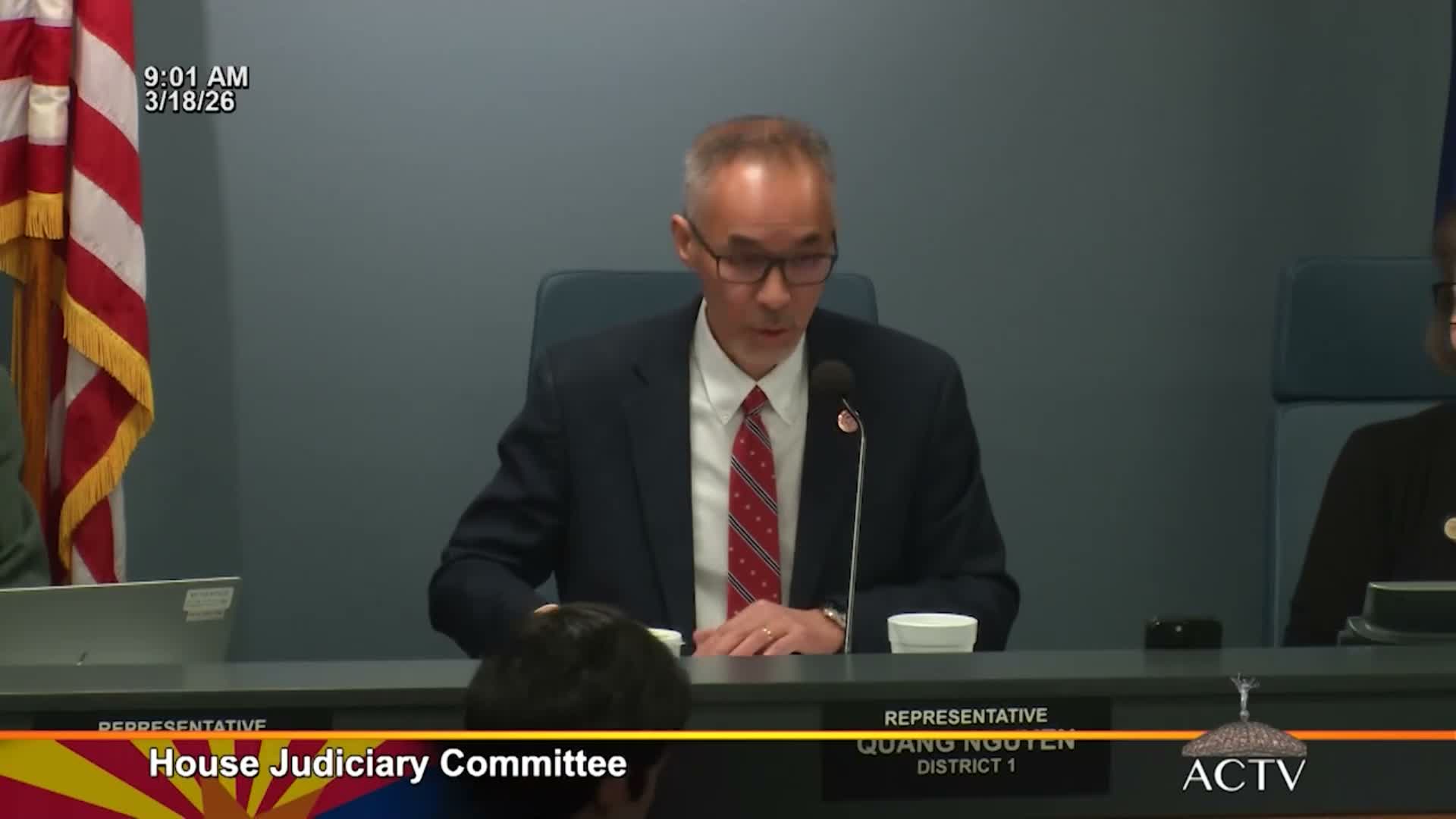
Senate Bill 10 94, discussed in committee March 17, would create a civil cause of action for a person who received an irreversible gender‑reassignment surgery while under 18 in violation of Arizona law and would require courts to award specified damages.
Sponsor and proponents said the bill responds to evolving medical guidance and the later‑life harms some patients experience. "The American Society of Plastic Surgeons says, don't do it until they're 19...The American Medical Association says, don't do it on minors," the sponsor told the committee, arguing that a longer limitations period aligns with other statutes that recognize delayed discovery of harm.
Witnesses opposing the bill included Paul Bixler and Gene Woodbury of the ACLU of Arizona. Woodbury said the state already has a statutory ban on the surgery and that SB 10 94 would extend a double standard into liability by treating transgender patients differently. "This kind of discrimination not only makes it harder for trans people to access care, but it makes it harder for everyone to access care," he said.
Other public testimony was mixed. Ruth Carter, a licensed attorney who said she obtained a non‑binary driver's license in Arizona, spoke in opposition and said parental informed consent and existing safeguards play a role in medical decisions. Two witnesses who described detransition experiences—represented by the Center for American Liberty—urged the committee to adopt protections for people who say they were harmed by youth procedures. "If a girl grows up to be a woman and realizes that she should not have lost her healthy breasts, she has no way to get them back," said Dr. Travis Morell in support of the bill.
Committee members debated the statutory and medical claims. The sponsor insisted the bill only applies to procedures performed on minors and that it requires proof of harm to recover damages. After public comment, a motion to return SB 10 94 with a due‑pass recommendation carried on the committee floor; the transcript records the vote as 6 yes and 3 no.
What it means: If the bill proceeds and becomes law it would add an explicit civil remedy and an extended limitations period for certain irreversible procedures performed on minors. Opponents warned it could create discriminatory liability tied to the patient's status; supporters said it fills a gap for people whose harms appear later in life. The measure now moves forward according to regular legislative procedures.
Sources: Sponsor comments and committee testimony, March 17 committee hearing.
Sponsor and proponents said the bill responds to evolving medical guidance and the later‑life harms some patients experience. "The American Society of Plastic Surgeons says, don't do it until they're 19...The American Medical Association says, don't do it on minors," the sponsor told the committee, arguing that a longer limitations period aligns with other statutes that recognize delayed discovery of harm.
Witnesses opposing the bill included Paul Bixler and Gene Woodbury of the ACLU of Arizona. Woodbury said the state already has a statutory ban on the surgery and that SB 10 94 would extend a double standard into liability by treating transgender patients differently. "This kind of discrimination not only makes it harder for trans people to access care, but it makes it harder for everyone to access care," he said.
Other public testimony was mixed. Ruth Carter, a licensed attorney who said she obtained a non‑binary driver's license in Arizona, spoke in opposition and said parental informed consent and existing safeguards play a role in medical decisions. Two witnesses who described detransition experiences—represented by the Center for American Liberty—urged the committee to adopt protections for people who say they were harmed by youth procedures. "If a girl grows up to be a woman and realizes that she should not have lost her healthy breasts, she has no way to get them back," said Dr. Travis Morell in support of the bill.
Committee members debated the statutory and medical claims. The sponsor insisted the bill only applies to procedures performed on minors and that it requires proof of harm to recover damages. After public comment, a motion to return SB 10 94 with a due‑pass recommendation carried on the committee floor; the transcript records the vote as 6 yes and 3 no.
What it means: If the bill proceeds and becomes law it would add an explicit civil remedy and an extended limitations period for certain irreversible procedures performed on minors. Opponents warned it could create discriminatory liability tied to the patient's status; supporters said it fills a gap for people whose harms appear later in life. The measure now moves forward according to regular legislative procedures.
Sources: Sponsor comments and committee testimony, March 17 committee hearing.
View the Full Meeting & All Its Details
This article offers just a summary. Unlock complete video, transcripts, and insights as a Founder Member.
✓
Watch full, unedited meeting videos
✓
Search every word spoken in unlimited transcripts
✓
AI summaries & real-time alerts (all government levels)
✓
Permanent access to expanding government content
30-day money-back guarantee
