Committee advances bill to explicitly protect menopause-related conditions under FEHA
March 18, 2026 | California State Assembly, House, Legislative, California
This article was created by AI summarizing key points discussed. AI makes mistakes, so for full details and context, please refer to the video of the full meeting. Please report any errors so we can fix them. Report an error »
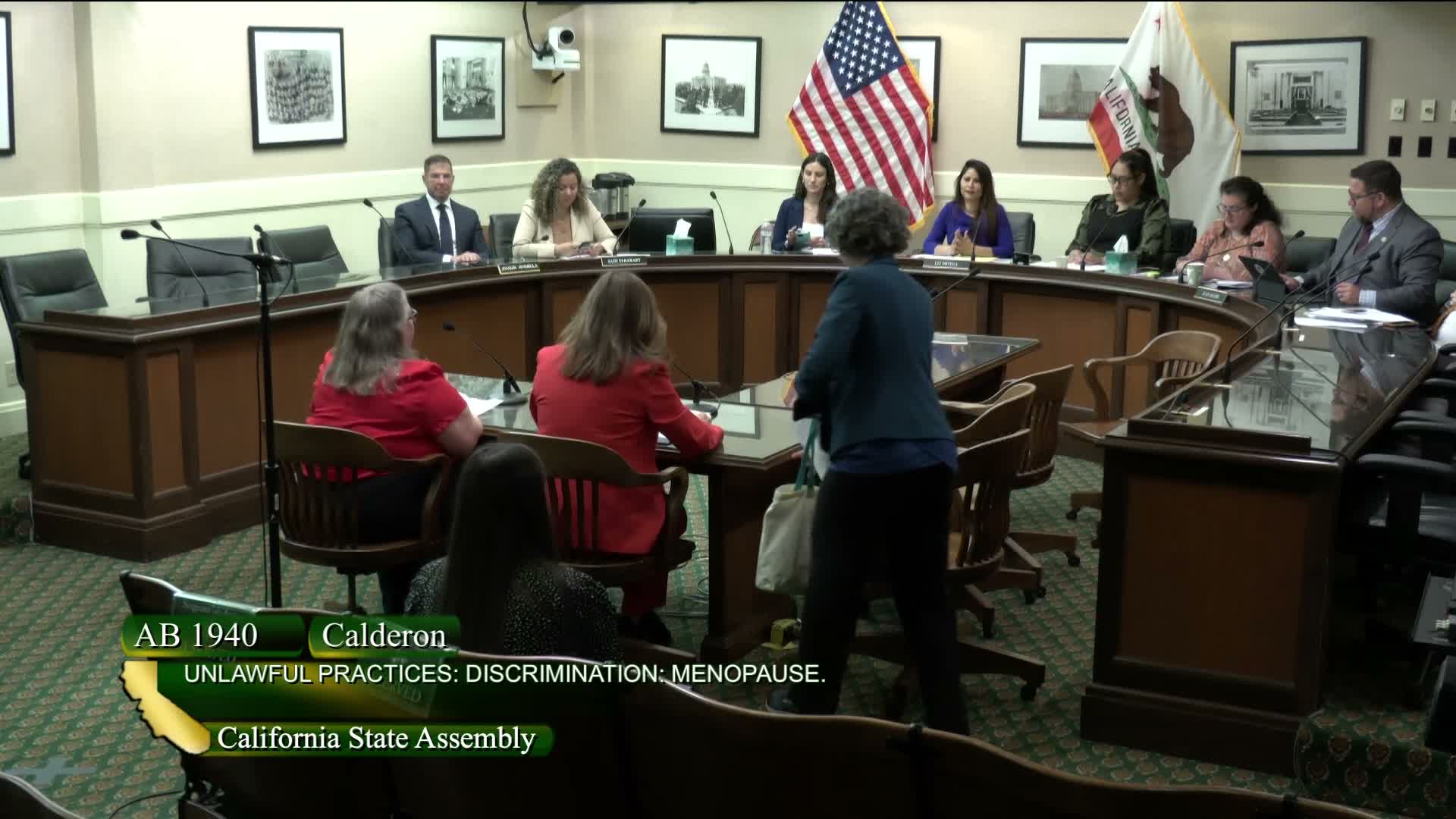
Assemblymember Calderon told the committee AB 1940 would update the Fair Employment and Housing Act to explicitly cover perimenopause, menopause and postmenopause, aiming to reduce discrimination and improve access to reasonable accommodations for affected workers.
"Menopause can bring a wide variety of symptoms, including physical, emotional and cognitive changes," the author said, arguing that existing workplace norms often ignore those needs and that explicit statutory protections would promote retention and economic equity.
Alex Zuko, policy director for the California Commission on the Status of Women and Girls, and Dr. Amy Day, founder and clinic director of the Women's Vitality Center, testified in support, describing patient stories and research that link menopausal symptoms to workplace performance and attrition. Dr. Day told the committee about patients experiencing cognitive symptoms and heavy bleeding that interfered with job performance and asked that workers be informed of rights and accommodations.
Business groups including the California Chamber of Commerce and the California Restaurant Association expressed support for the bill's goals but raised concerns about expanding protected classifications within FEHA and potential litigation or compliance complexity. They urged pursuing amendments or relying on existing reasonable-accommodation and disability frameworks.
Members discussed working with stakeholders on possible clarifying language. The committee passed AB 1940 and referred it to the Judiciary Committee for further consideration.
"Menopause can bring a wide variety of symptoms, including physical, emotional and cognitive changes," the author said, arguing that existing workplace norms often ignore those needs and that explicit statutory protections would promote retention and economic equity.
Alex Zuko, policy director for the California Commission on the Status of Women and Girls, and Dr. Amy Day, founder and clinic director of the Women's Vitality Center, testified in support, describing patient stories and research that link menopausal symptoms to workplace performance and attrition. Dr. Day told the committee about patients experiencing cognitive symptoms and heavy bleeding that interfered with job performance and asked that workers be informed of rights and accommodations.
Business groups including the California Chamber of Commerce and the California Restaurant Association expressed support for the bill's goals but raised concerns about expanding protected classifications within FEHA and potential litigation or compliance complexity. They urged pursuing amendments or relying on existing reasonable-accommodation and disability frameworks.
Members discussed working with stakeholders on possible clarifying language. The committee passed AB 1940 and referred it to the Judiciary Committee for further consideration.
View the Full Meeting & All Its Details
This article offers just a summary. Unlock complete video, transcripts, and insights as a Founder Member.
✓
Watch full, unedited meeting videos
✓
Search every word spoken in unlimited transcripts
✓
AI summaries & real-time alerts (all government levels)
✓
Permanent access to expanding government content
30-day money-back guarantee
