Assembly panel: Fair Plan clearinghouse has not meaningfully depopulated residual market; members push for more data and statutory fixes
March 18, 2026 | California State Assembly, House, Legislative, California
This article was created by AI summarizing key points discussed. AI makes mistakes, so for full details and context, please refer to the video of the full meeting. Please report any errors so we can fix them. Report an error »
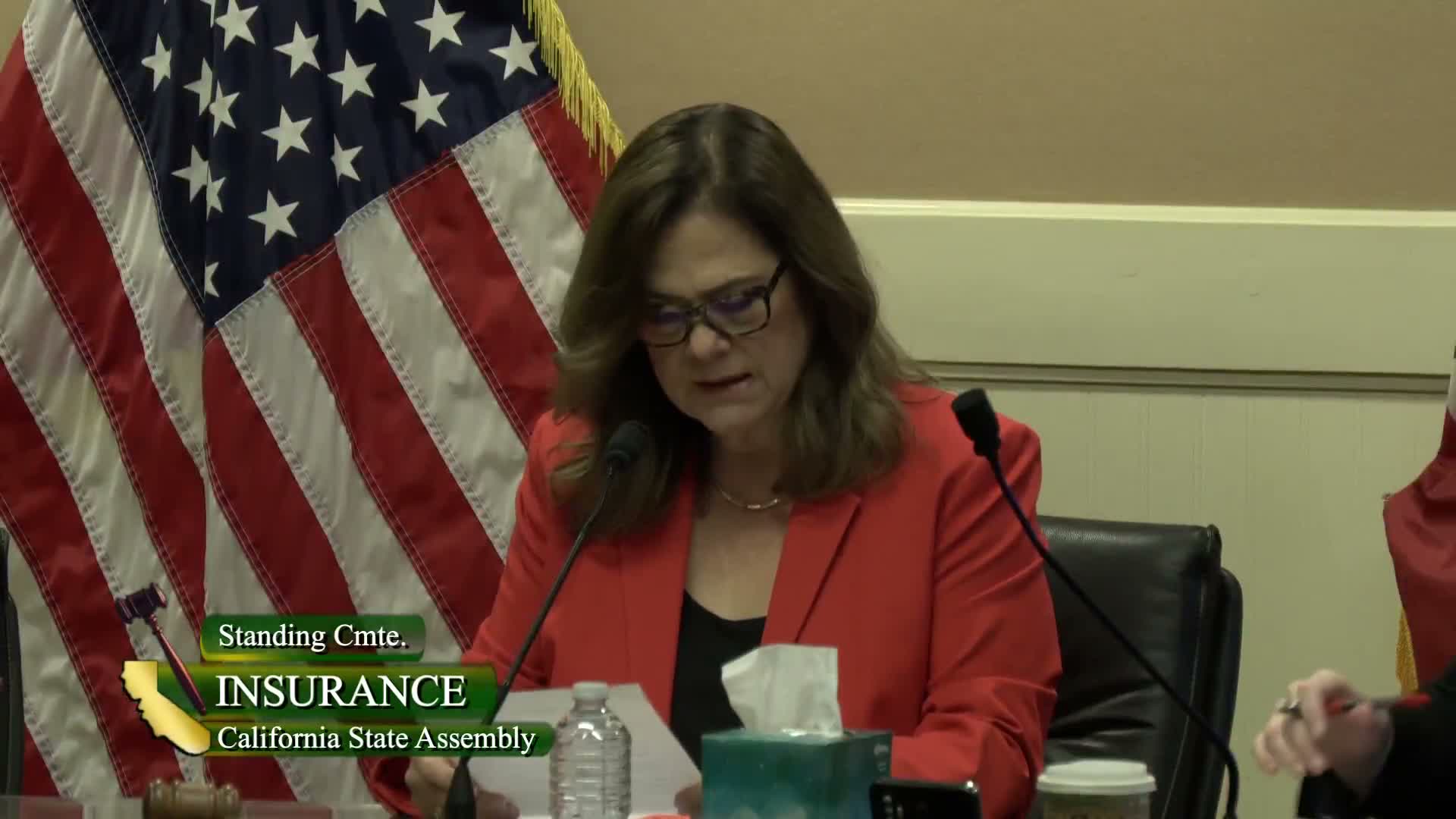
SACRAMENTO — The California State Assembly Insurance Committee held an outcomes review of AB 3012 on July 1 to examine whether the Fair Plan’s residential clearinghouse is helping policyholders return to the voluntary insurance market. Committee members, Department of Insurance officials and industry witnesses agreed the program has fallen short of expectations and proposed data, operational and statutory changes to improve results.
“Simply stated, the legislature created the clearinghouse program with the intent of depopulating the fair plan and providing a pathway for policyholders to return to the voluntary market,” the committee chair said in opening remarks. The committee focused on why the clearinghouse has not produced more transfers to private insurers and what fixes could help.
Josephine Figueroa, Deputy Commissioner and Legislative Director at the California Department of Insurance, told the committee the department’s oversight role is limited because the Fair Plan manages and operates the clearinghouse. The department has not received formal consumer complaints tied specifically to clearinghouse operations, Figueroa said, but it has identified structural barriers that limit effectiveness: low insurer participation, a statutory requirement that offers be made through a broker or broker of record, broker compensation that can favor keeping policies in the Fair Plan, and insufficient reporting about offers and outcomes.
“Only 11 residential insurers have signed clearinghouse participation agreements,” Figueroa said, and CDI’s data show roughly 730 residential risks have been placed by voluntary-market carriers through the clearinghouse from its inception in 2021 through April 30, 2025. The department recommended expanding mandatory reporting, allowing more direct outreach to consumers after a set period, simplifying commission payments and strengthening broker education to increase successful transfers.
Industry witnesses described broader market realities that limit any single program’s effectiveness. John Norwood of the Independent Insurance Agents and Brokers of California said the clearinghouse was conceived as “another tool” for brokers, but depopulation requires a healthy admitted market and actuarially sound Fair Plan rates. The Fair Plan itself, Norwood said, has sought substantial rate increases to become actuarially sound.
Mark Seckin of the American Property Casualty Insurance Association and Sarah Taylor of the Personal Insurance Federation of California emphasized that the core constraints are rate adequacy, underwriting capacity and operational frictions. “Clearinghouses can help, but they are not the primary driver of depopulation,” Seckin told the committee, citing Florida and Louisiana as contrasting models where different combinations of pricing discipline and mandatory movement produced different results.
Representatives of surplus lines brokers and wholesale markets described legal and procedural barriers to using surplus lines capacity. Cliston Brown of the Surplus Line Association of California said California’s insurance code requires surplus line placements through surplus brokers and that restriction has limited surplus-market participation in the clearinghouse except in narrow cases.
Several lawmakers pressed witnesses for hard metrics and regional details. Committee members asked how many offers were made through the clearinghouse versus how many resulted in new policies; witnesses said the Fair Plan’s self-reporting currently only captures cancellations where brokers selected the clearinghouse as the reason, so offer-level data are incomplete.
Assemblymembers also raised concerns about underinsurance. Witnesses and members agreed that even if a policyholder returns to the admitted market, the new policy must provide adequate replacement-cost coverage — an area with known gaps made worse by demand surge and rapidly rising construction costs.
A handful of public commenters said new entrants and E&S (excess and surplus) market capacity could increase transfers. Robert Feldman, CEO of Wow Insurance, said his company and several E&S carriers recently joined the clearinghouse and are working with brokers to place additional risks.
Lawmakers did not take formal votes at the hearing. Committee members asked staff to pursue more detailed data reporting provisions, broker education requirements, and narrow statutory clarifications (for example, limited appointment authority for insurers that do not use independent brokers) that could reduce operational barriers.
The committee concluded the clearinghouse has value as a tool but is unlikely to depopulate the Fair Plan on its own without concurrent market improvements, more complete reporting, and targeted statutory changes. The committee said it will continue oversight as the state’s sustainable insurance strategy (SIS) is implemented and market conditions evolve.
“Simply stated, the legislature created the clearinghouse program with the intent of depopulating the fair plan and providing a pathway for policyholders to return to the voluntary market,” the committee chair said in opening remarks. The committee focused on why the clearinghouse has not produced more transfers to private insurers and what fixes could help.
Josephine Figueroa, Deputy Commissioner and Legislative Director at the California Department of Insurance, told the committee the department’s oversight role is limited because the Fair Plan manages and operates the clearinghouse. The department has not received formal consumer complaints tied specifically to clearinghouse operations, Figueroa said, but it has identified structural barriers that limit effectiveness: low insurer participation, a statutory requirement that offers be made through a broker or broker of record, broker compensation that can favor keeping policies in the Fair Plan, and insufficient reporting about offers and outcomes.
“Only 11 residential insurers have signed clearinghouse participation agreements,” Figueroa said, and CDI’s data show roughly 730 residential risks have been placed by voluntary-market carriers through the clearinghouse from its inception in 2021 through April 30, 2025. The department recommended expanding mandatory reporting, allowing more direct outreach to consumers after a set period, simplifying commission payments and strengthening broker education to increase successful transfers.
Industry witnesses described broader market realities that limit any single program’s effectiveness. John Norwood of the Independent Insurance Agents and Brokers of California said the clearinghouse was conceived as “another tool” for brokers, but depopulation requires a healthy admitted market and actuarially sound Fair Plan rates. The Fair Plan itself, Norwood said, has sought substantial rate increases to become actuarially sound.
Mark Seckin of the American Property Casualty Insurance Association and Sarah Taylor of the Personal Insurance Federation of California emphasized that the core constraints are rate adequacy, underwriting capacity and operational frictions. “Clearinghouses can help, but they are not the primary driver of depopulation,” Seckin told the committee, citing Florida and Louisiana as contrasting models where different combinations of pricing discipline and mandatory movement produced different results.
Representatives of surplus lines brokers and wholesale markets described legal and procedural barriers to using surplus lines capacity. Cliston Brown of the Surplus Line Association of California said California’s insurance code requires surplus line placements through surplus brokers and that restriction has limited surplus-market participation in the clearinghouse except in narrow cases.
Several lawmakers pressed witnesses for hard metrics and regional details. Committee members asked how many offers were made through the clearinghouse versus how many resulted in new policies; witnesses said the Fair Plan’s self-reporting currently only captures cancellations where brokers selected the clearinghouse as the reason, so offer-level data are incomplete.
Assemblymembers also raised concerns about underinsurance. Witnesses and members agreed that even if a policyholder returns to the admitted market, the new policy must provide adequate replacement-cost coverage — an area with known gaps made worse by demand surge and rapidly rising construction costs.
A handful of public commenters said new entrants and E&S (excess and surplus) market capacity could increase transfers. Robert Feldman, CEO of Wow Insurance, said his company and several E&S carriers recently joined the clearinghouse and are working with brokers to place additional risks.
Lawmakers did not take formal votes at the hearing. Committee members asked staff to pursue more detailed data reporting provisions, broker education requirements, and narrow statutory clarifications (for example, limited appointment authority for insurers that do not use independent brokers) that could reduce operational barriers.
The committee concluded the clearinghouse has value as a tool but is unlikely to depopulate the Fair Plan on its own without concurrent market improvements, more complete reporting, and targeted statutory changes. The committee said it will continue oversight as the state’s sustainable insurance strategy (SIS) is implemented and market conditions evolve.
View the Full Meeting & All Its Details
This article offers just a summary. Unlock complete video, transcripts, and insights as a Founder Member.
✓
Watch full, unedited meeting videos
✓
Search every word spoken in unlimited transcripts
✓
AI summaries & real-time alerts (all government levels)
✓
Permanent access to expanding government content
30-day money-back guarantee
