Committee moves bill to curb invasive workplace surveillance, including facial, gait and emotion recognition
March 18, 2026 | California State Assembly, House, Legislative, California
This article was created by AI summarizing key points discussed. AI makes mistakes, so for full details and context, please refer to the video of the full meeting. Please report any errors so we can fix them. Report an error »
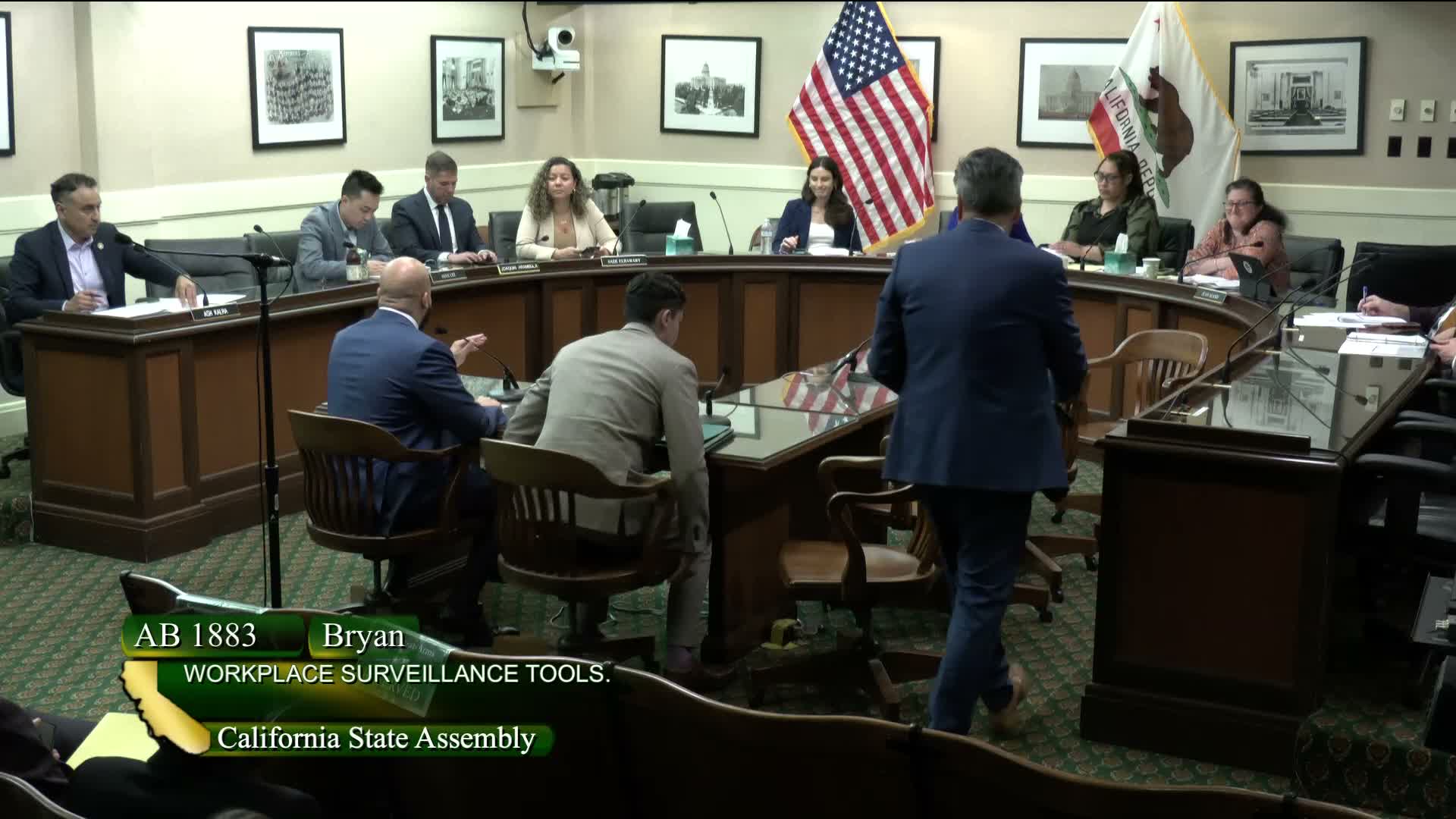
Assemblymember Bridal presented AB 1883, a measure aiming to prohibit or strictly limit use of invasive workplace surveillance technologies — including facial, gait and emotion recognition — and to place guardrails on other analytic tools used to monitor employees.
Labor and privacy groups described concrete examples of surveillance harms and discrimination. Yvonne Fernandez of the California Federation of Labor Unions told the committee that employers now have access to tools that can continuously monitor conversations and interactions and that such surveillance can chill protected activity. Shane Guzman, representing Teamsters California, said emotional-recognition tools can generate biased outcomes and risk worker safety.
Business and industry witnesses raised counterarguments: the California Chamber and other groups said the bill as drafted reads like a ban and could block legitimate safety or security uses, and they urged the legislature to consider narrower guardrails and clearer enforcement mechanisms. Civil-justice and small-business groups warned of exposure to punitive damages and forum-shopping risk under the bill's private-right-of-action language.
Committee members engaged on the balance between protecting workers and preserving important safety or operational uses. The committee voted to move AB 1883 and referred it to the privacy and consumer protection committee for further refinement and possible amendments.
Labor and privacy groups described concrete examples of surveillance harms and discrimination. Yvonne Fernandez of the California Federation of Labor Unions told the committee that employers now have access to tools that can continuously monitor conversations and interactions and that such surveillance can chill protected activity. Shane Guzman, representing Teamsters California, said emotional-recognition tools can generate biased outcomes and risk worker safety.
Business and industry witnesses raised counterarguments: the California Chamber and other groups said the bill as drafted reads like a ban and could block legitimate safety or security uses, and they urged the legislature to consider narrower guardrails and clearer enforcement mechanisms. Civil-justice and small-business groups warned of exposure to punitive damages and forum-shopping risk under the bill's private-right-of-action language.
Committee members engaged on the balance between protecting workers and preserving important safety or operational uses. The committee voted to move AB 1883 and referred it to the privacy and consumer protection committee for further refinement and possible amendments.
Don't Miss a Word: See the Full Meeting!
Go beyond summaries. Unlock every video, transcript, and key insight with a Founder Membership.
✓
Get instant access to full meeting videos
✓
Search and clip any phrase from complete transcripts
✓
Receive AI-powered summaries & custom alerts
✓
Enjoy lifetime, unrestricted access to government data
30-day money-back guarantee
