Committee advances bill requiring 90‑day notice before employers deploy AI surveillance or management tools
March 18, 2026 | California State Assembly, House, Legislative, California
This article was created by AI summarizing key points discussed. AI makes mistakes, so for full details and context, please refer to the video of the full meeting. Please report any errors so we can fix them. Report an error »
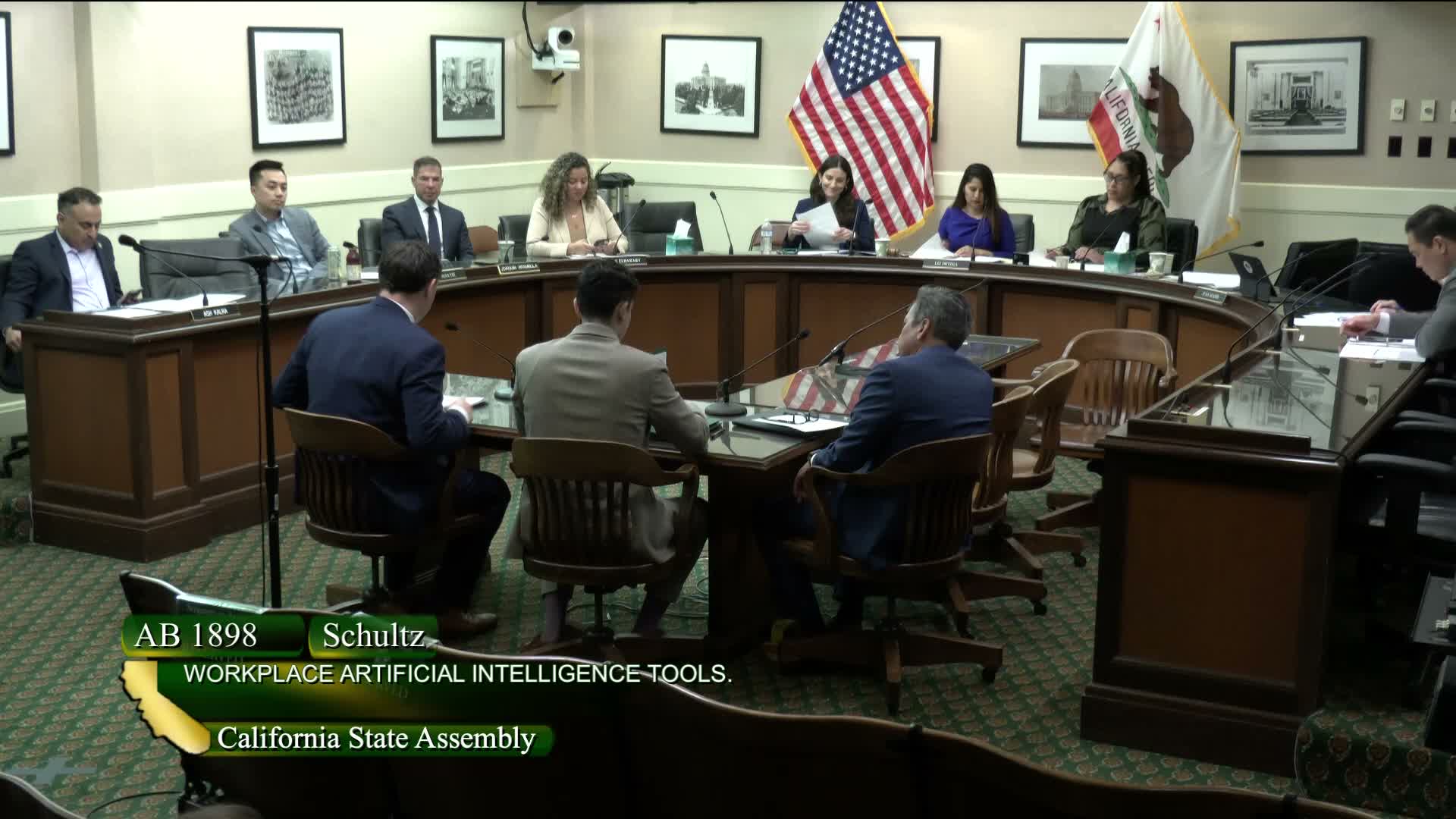
Assemblymember Schultz presented AB 1898, a measure seeking to give workers advance notice before employers deploy AI tools that surveil or manage employees and to require disclosure of the tool's purpose, what worker data will be collected, employment decisions it may influence, and the general workplace locations where the tool will be used.
Supporters, including labor unions, privacy organizations and worker advocates, said the requirement is a modest transparency step that empowers employees to understand and respond to algorithmic management and automated decision systems. "This bill is saying that you as an employee have a right to know what's being monitored," the author said.
Opponents, such as the California Chamber of Commerce and other industry groups, expressed concerns about the volume and scope of required notices, the potential need to disclose proprietary or security-sensitive information, and the administrative burden of a pre-deployment notice regime. Several witnesses urged narrowing definitions, clarifying notice contents and avoiding unintended consequences such as effectively blocking deployment when notices are not returned.
The committee passed AB 1898 and referred it to the privacy and consumer protection committee. Members said they expect to continue negotiations on definitions, notice requirements and enforcement language.
Supporters, including labor unions, privacy organizations and worker advocates, said the requirement is a modest transparency step that empowers employees to understand and respond to algorithmic management and automated decision systems. "This bill is saying that you as an employee have a right to know what's being monitored," the author said.
Opponents, such as the California Chamber of Commerce and other industry groups, expressed concerns about the volume and scope of required notices, the potential need to disclose proprietary or security-sensitive information, and the administrative burden of a pre-deployment notice regime. Several witnesses urged narrowing definitions, clarifying notice contents and avoiding unintended consequences such as effectively blocking deployment when notices are not returned.
The committee passed AB 1898 and referred it to the privacy and consumer protection committee. Members said they expect to continue negotiations on definitions, notice requirements and enforcement language.
Don't Miss a Word: See the Full Meeting!
Go beyond summaries. Unlock every video, transcript, and key insight with a Founder Membership.
✓
Get instant access to full meeting videos
✓
Search and clip any phrase from complete transcripts
✓
Receive AI-powered summaries & custom alerts
✓
Enjoy lifetime, unrestricted access to government data
30-day money-back guarantee
