Assembly subcommittee: teacher supply is rising but shortages and regional gaps persist
March 18, 2026 | California State Assembly, House, Legislative, California
This article was created by AI summarizing key points discussed. AI makes mistakes, so for full details and context, please refer to the video of the full meeting. Please report any errors so we can fix them. Report an error »
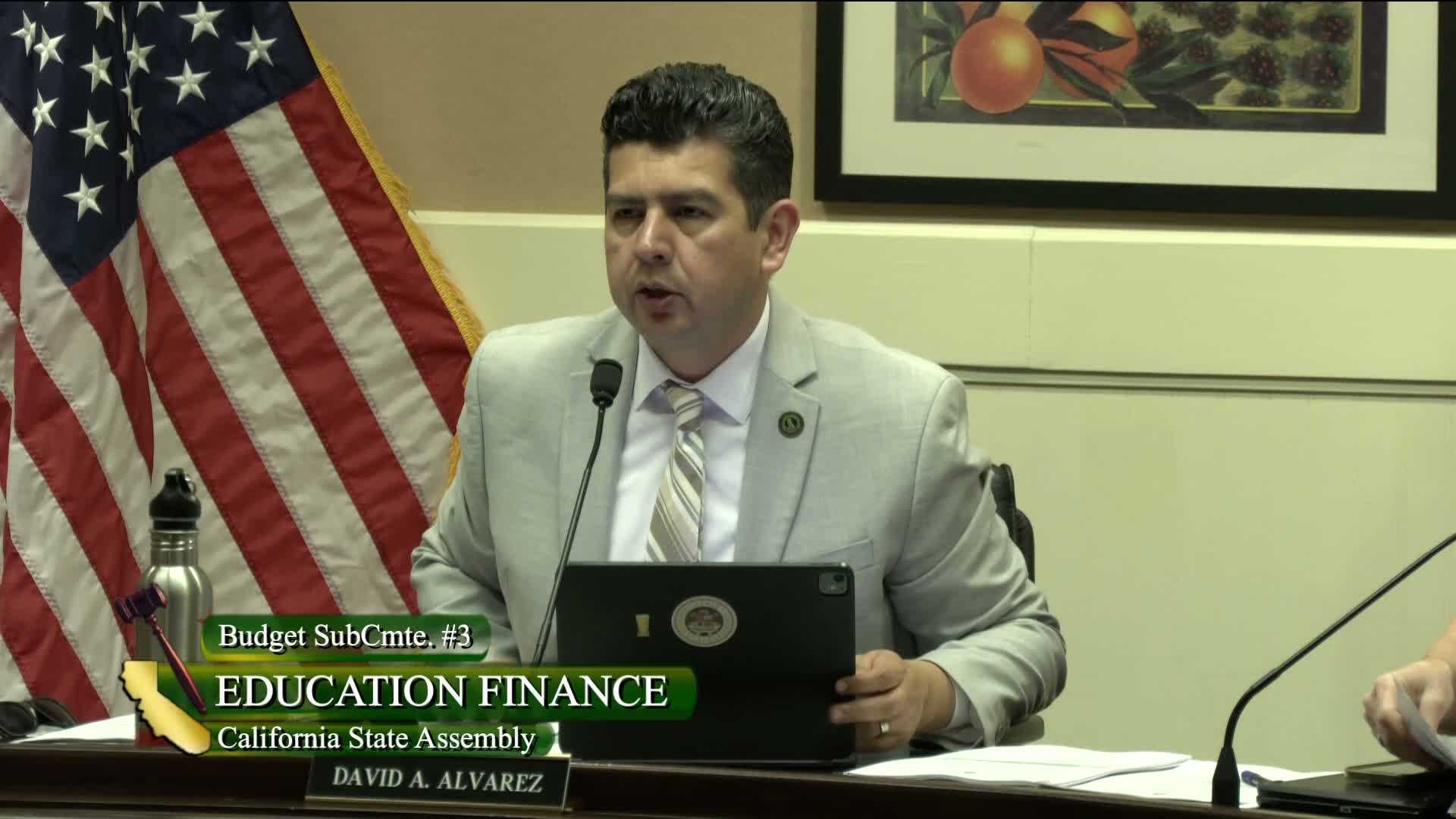
Chair Alvarez convened the Budget Subcommittee No. 3 on Education Finance to review state efforts to rebuild California's teacher pipeline and to identify which investments should be sustained. Panelists agreed that credential production has improved but warned that staffing churn and regional imbalances keep shortages entrenched.
The Commission on Teacher Credentialing reported preliminary April data showing an uptick in credential production, summarizing the finding succinctly: "Teacher supply is rebounding," but the commission cautioned supply gains alone are insufficient to meet demand across the state. The panel noted that counties reported an estimated 23,078 hires needed for 2025'26, even as the state issued record numbers of preliminary credentials in 2024'25.
Research presented by Tara Kinney of the Learning Policy Institute reinforced the mixed picture: new credentialing is up sharply — "preliminary teaching credentials ... have increased by about 40% in the past two years" — yet turnover remains high (roughly 14%), and many openings result from teachers shifting schools or leaving the profession. Panelists said high turnover and greater student support needs (including special education and bilingual programs), plus policy-driven demand (expansion of transitional kindergarten, Prop 28 arts funding and career-technical education), have kept demand elevated despite declining enrollment.
Speakers representing educator preparation programs and teachers described practical rollout issues. Cynthia Grutsik, dean at San Francisco State's College of Education, said CSU campuses prepare roughly half of California's teachers and outlined capacity constraints at both universities and districts that could limit how quickly stipend and residency programs scale. Twin Rivers teacher Anna Aguilar testified that local schools began 2025'26 with significant vacancies, linking working conditions and early retirements to persistent shortages.
Committee members pressed the panel on data gaps. The commission and panelists agreed the state needs better linkage between credentialing, employment and assignment data so funding can be targeted to subject areas and regions with the greatest shortfalls. Chair Alvarez also flagged the risk that one'time program dollars could be undercut by near'term budget pressures that produce layoffs or "pink slips," potentially eroding retention gains from recruitment programs.
The hearing ended with a series of public comments urging the Legislature to sustain the Golden State Teacher Grant, expand residency investments and remove barriers in authorization programs for areas such as computer science. The subcommittee left several issues open for staff follow'up, including better employment data sharing and targeted proposals for special-education and bilingual teacher shortages.
The panel did not take formal votes; next steps include technical follow'ups, requested reports, and potential funding decisions during the May revise and subsequent budget deliberations.
The Commission on Teacher Credentialing reported preliminary April data showing an uptick in credential production, summarizing the finding succinctly: "Teacher supply is rebounding," but the commission cautioned supply gains alone are insufficient to meet demand across the state. The panel noted that counties reported an estimated 23,078 hires needed for 2025'26, even as the state issued record numbers of preliminary credentials in 2024'25.
Research presented by Tara Kinney of the Learning Policy Institute reinforced the mixed picture: new credentialing is up sharply — "preliminary teaching credentials ... have increased by about 40% in the past two years" — yet turnover remains high (roughly 14%), and many openings result from teachers shifting schools or leaving the profession. Panelists said high turnover and greater student support needs (including special education and bilingual programs), plus policy-driven demand (expansion of transitional kindergarten, Prop 28 arts funding and career-technical education), have kept demand elevated despite declining enrollment.
Speakers representing educator preparation programs and teachers described practical rollout issues. Cynthia Grutsik, dean at San Francisco State's College of Education, said CSU campuses prepare roughly half of California's teachers and outlined capacity constraints at both universities and districts that could limit how quickly stipend and residency programs scale. Twin Rivers teacher Anna Aguilar testified that local schools began 2025'26 with significant vacancies, linking working conditions and early retirements to persistent shortages.
Committee members pressed the panel on data gaps. The commission and panelists agreed the state needs better linkage between credentialing, employment and assignment data so funding can be targeted to subject areas and regions with the greatest shortfalls. Chair Alvarez also flagged the risk that one'time program dollars could be undercut by near'term budget pressures that produce layoffs or "pink slips," potentially eroding retention gains from recruitment programs.
The hearing ended with a series of public comments urging the Legislature to sustain the Golden State Teacher Grant, expand residency investments and remove barriers in authorization programs for areas such as computer science. The subcommittee left several issues open for staff follow'up, including better employment data sharing and targeted proposals for special-education and bilingual teacher shortages.
The panel did not take formal votes; next steps include technical follow'ups, requested reports, and potential funding decisions during the May revise and subsequent budget deliberations.
Don't Miss a Word: See the Full Meeting!
Go beyond summaries. Unlock every video, transcript, and key insight with a Founder Membership.
✓
Get instant access to full meeting videos
✓
Search and clip any phrase from complete transcripts
✓
Receive AI-powered summaries & custom alerts
✓
Enjoy lifetime, unrestricted access to government data
30-day money-back guarantee
