State water board warns SAFER program funding could slip after Cap‑and‑Invest changes
March 18, 2026 | California State Assembly, House, Legislative, California
This article was created by AI summarizing key points discussed. AI makes mistakes, so for full details and context, please refer to the video of the full meeting. Please report any errors so we can fix them. Report an error »
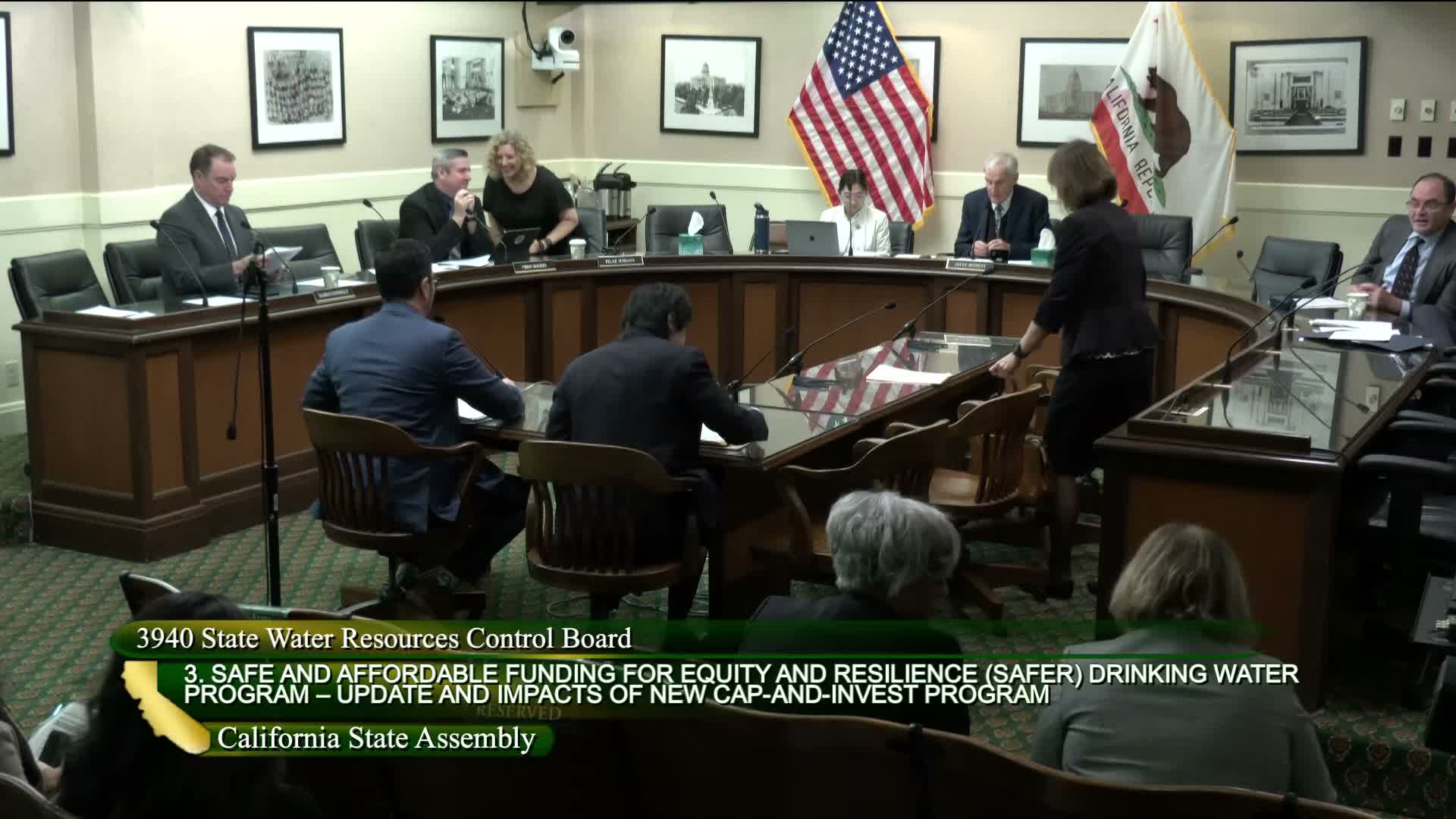
State Water Board Chair Joaquin Esquivel told the subcommittee the SAFE and Affordable Drinking Water (SAFER) program has delivered major results—helping reduce the number of Californians without safe drinking water from 1.6 million to roughly 600,000 through $1.8 billion in distributed grants—but that recent changes to the cap‑and‑invest (Cap‑and‑Invest) allocation tiers introduced uncertainty.
"We have 98% of Californians, 98.5 that are served by water systems that are meeting standards," Esquivel said, while noting the remaining communities are often the most intractable and expensive to serve.
The Legislative Analyst's Office explained that SB 840 placed SAFER in a third funding tier that must wait until tiers one and two are fully funded; as a result, SAFER may receive funding only in arrears, late in the fiscal year. LAO and Department of Finance officials said the governor's budget projection shows approximately $92,000,000 for SAFE/SAFER in FY26‑27 under the new structure, down from the program's prior $130,000,000 design maximum.
Esquivel said the board will lean on other pots of funding and manage project pipelines so projects continue; LAO recommended lawmakers consider the tradeoffs of the new tiering structure and plan accordingly. Members pressed for clarity on what SAFER funds can uniquely pay for (emergency and interim deliveries, technical assistance and nimble construction) and how the board will prioritize scarce flexible funds during the transition.
The subcommittee asked follow‑up questions on definitions (what counts as having "access" versus receiving interim water deliveries) and on the prospects for closing the last service gaps; Esquivel said many remaining communities are politically and technically difficult to consolidate or remediate and that emerging contaminants add complexity.
"We have 98% of Californians, 98.5 that are served by water systems that are meeting standards," Esquivel said, while noting the remaining communities are often the most intractable and expensive to serve.
The Legislative Analyst's Office explained that SB 840 placed SAFER in a third funding tier that must wait until tiers one and two are fully funded; as a result, SAFER may receive funding only in arrears, late in the fiscal year. LAO and Department of Finance officials said the governor's budget projection shows approximately $92,000,000 for SAFE/SAFER in FY26‑27 under the new structure, down from the program's prior $130,000,000 design maximum.
Esquivel said the board will lean on other pots of funding and manage project pipelines so projects continue; LAO recommended lawmakers consider the tradeoffs of the new tiering structure and plan accordingly. Members pressed for clarity on what SAFER funds can uniquely pay for (emergency and interim deliveries, technical assistance and nimble construction) and how the board will prioritize scarce flexible funds during the transition.
The subcommittee asked follow‑up questions on definitions (what counts as having "access" versus receiving interim water deliveries) and on the prospects for closing the last service gaps; Esquivel said many remaining communities are politically and technically difficult to consolidate or remediate and that emerging contaminants add complexity.
View the Full Meeting & All Its Details
This article offers just a summary. Unlock complete video, transcripts, and insights as a Founder Member.
✓
Watch full, unedited meeting videos
✓
Search every word spoken in unlimited transcripts
✓
AI summaries & real-time alerts (all government levels)
✓
Permanent access to expanding government content
30-day money-back guarantee
