Assembly committee advances bill to make ignoring arbitrators an unfair labor practice for UC
March 18, 2026 | California State Assembly, House, Legislative, California
This article was created by AI summarizing key points discussed. AI makes mistakes, so for full details and context, please refer to the video of the full meeting. Please report any errors so we can fix them. Report an error »
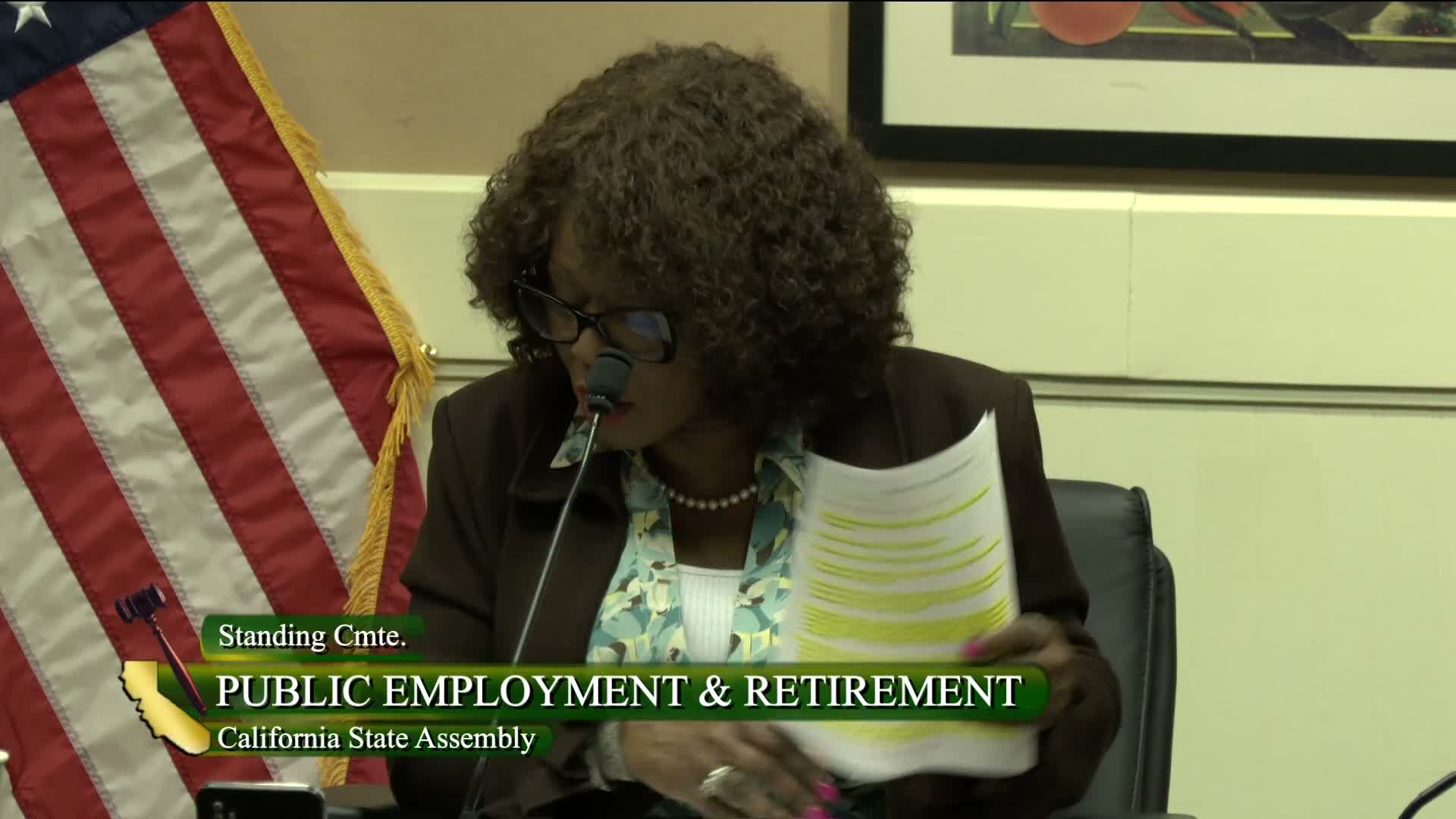
AB 1582 (Ortega) was advanced out of the Assembly Committee on Public Employment and Retirement on a voice vote after members heard competing testimony about how the University of California handles arbitration outcomes.
The bill, introduced by the author during the committee's morning session, would make it an unfair labor practice for a higher‑education employer to circumvent or ignore a neutral arbitrator's decision in disputes arising from contracting out work that is covered by collective bargaining agreements. The measure would also require make‑whole relief for violations and allow recovery of attorney fees and costs.
Supporters told the committee the bill is aimed at stopping a cycle of delay and noncompliance. "At UCLA, it took four years, three arbitrations, [and] a court proceeding" for cafeteria workers' contracting disputes, said Andrew Martinez, a senior custodian at UCLA representing AFSCME 3299. Martinez said the university has repeatedly contracted out service jobs and then ignored arbitration decisions to preserve that contracting out, leaving union members to bear the cost and delay of repeating proceedings.
Multiple labor organizations registered support at the microphone, including AFSCME, the California Nurses Association and Teamsters affiliates.
The University of California, through legislative advocate Tyler Aguilar, opposed the bill in a respectful presentation. Aguilar said the university values collective bargaining and works in good faith but warned the bill "significantly alters the mutually agreed upon framework for grievances" by imposing statutory liabilities and penalties not negotiated at the bargaining table. He said a ruling at one campus could trigger system‑wide consequences at other campuses, including medical centers that need flexibility to contract for services, and noted the bill's potential fines — cited in committee testimony as $1,000 per day backdated to the date of charge filing — could create "unacceptable operational risk."
Committee members did not engage in extended debate on the floor after testimony. A motion to pass AB 1582 and refer it to the committee on appropriations was made and seconded; the clerk reported sufficient votes and the item was placed on call for absent members. The committee reported the item as out "7 to 0."
Next steps: the bill was referred to the Assembly Appropriations Committee for further consideration and fiscal analysis.
The bill, introduced by the author during the committee's morning session, would make it an unfair labor practice for a higher‑education employer to circumvent or ignore a neutral arbitrator's decision in disputes arising from contracting out work that is covered by collective bargaining agreements. The measure would also require make‑whole relief for violations and allow recovery of attorney fees and costs.
Supporters told the committee the bill is aimed at stopping a cycle of delay and noncompliance. "At UCLA, it took four years, three arbitrations, [and] a court proceeding" for cafeteria workers' contracting disputes, said Andrew Martinez, a senior custodian at UCLA representing AFSCME 3299. Martinez said the university has repeatedly contracted out service jobs and then ignored arbitration decisions to preserve that contracting out, leaving union members to bear the cost and delay of repeating proceedings.
Multiple labor organizations registered support at the microphone, including AFSCME, the California Nurses Association and Teamsters affiliates.
The University of California, through legislative advocate Tyler Aguilar, opposed the bill in a respectful presentation. Aguilar said the university values collective bargaining and works in good faith but warned the bill "significantly alters the mutually agreed upon framework for grievances" by imposing statutory liabilities and penalties not negotiated at the bargaining table. He said a ruling at one campus could trigger system‑wide consequences at other campuses, including medical centers that need flexibility to contract for services, and noted the bill's potential fines — cited in committee testimony as $1,000 per day backdated to the date of charge filing — could create "unacceptable operational risk."
Committee members did not engage in extended debate on the floor after testimony. A motion to pass AB 1582 and refer it to the committee on appropriations was made and seconded; the clerk reported sufficient votes and the item was placed on call for absent members. The committee reported the item as out "7 to 0."
Next steps: the bill was referred to the Assembly Appropriations Committee for further consideration and fiscal analysis.
Don't Miss a Word: See the Full Meeting!
Go beyond summaries. Unlock every video, transcript, and key insight with a Founder Membership.
✓
Get instant access to full meeting videos
✓
Search and clip any phrase from complete transcripts
✓
Receive AI-powered summaries & custom alerts
✓
Enjoy lifetime, unrestricted access to government data
30-day money-back guarantee
