Committee advances $75 cap, insurance limits for photo‑enforcement and sends ballot question to voters
March 18, 2026 | 2026 Legislature Arizona, Arizona
This article was created by AI summarizing key points discussed. AI makes mistakes, so for full details and context, please refer to the video of the full meeting. Please report any errors so we can fix them. Report an error »
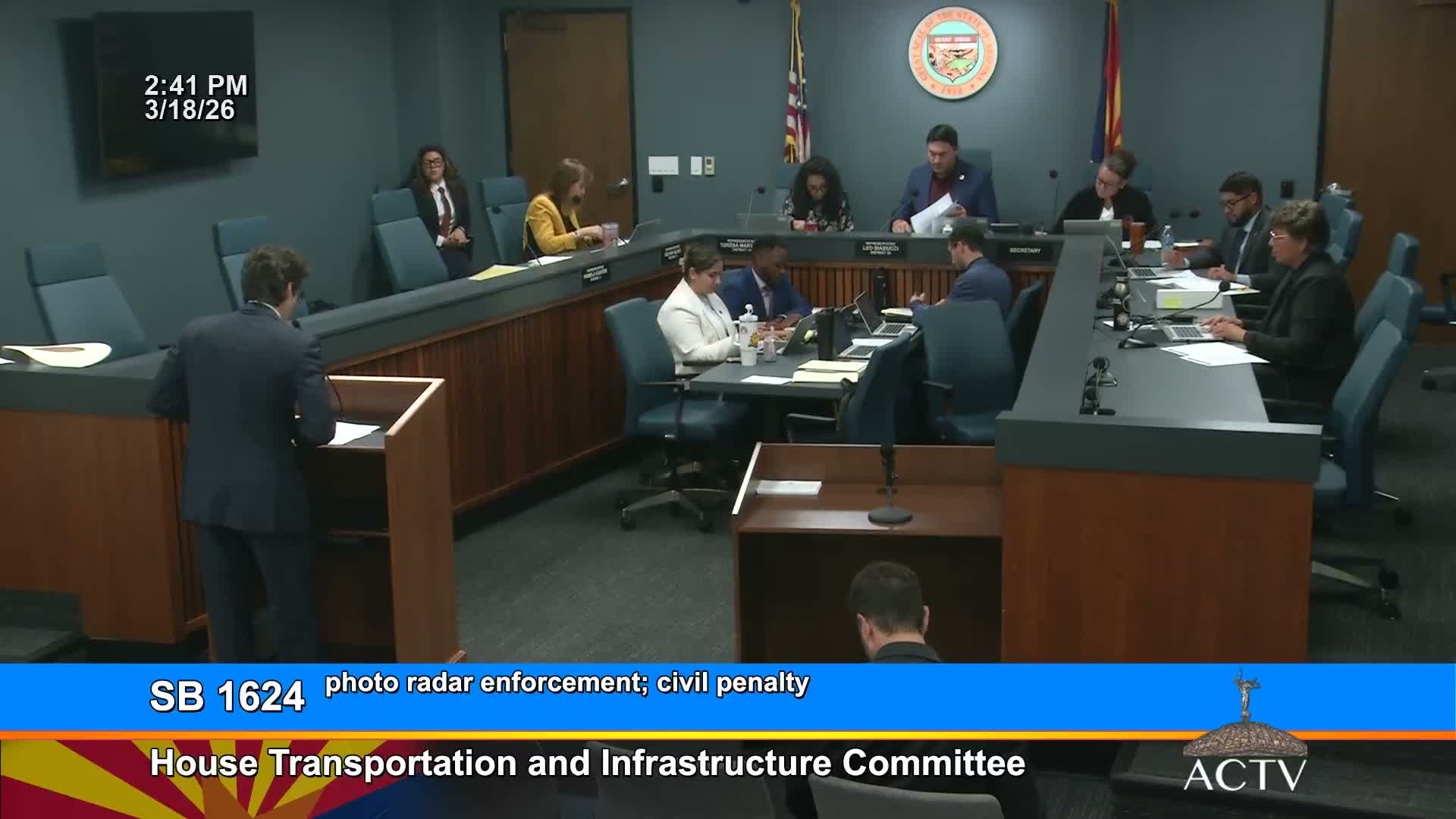
Members of the Arizona House transportation committee on March 17 recommended SB1624, a measure to cap civil penalties from photo‑enforcement systems at $75 and to bar ADOT, courts and insurers from using those camera citations to suspend licenses, transmit abstracts or adjust rates. The committee also advanced Senate Concurrent Resolution 1004, a ballot referral that would allow cities with existing photo‑enforcement contracts in place by Dec. 31, 2026, to present the question to local voters.
The bill’s sponsor defended the measure as a practical reform to encourage payment and reduce administrative friction. “This came out of the senate from ’25 to ’26,” Senator Gowen said, arguing the change “will probably get people to just pay their fines ... quick enough and do their due diligence.” Gowen also supported an amendment by Rep. Biasuchi that makes excessive speed from a photo enforcement system a class‑3 misdemeanor for very large speed violations and designates $15 of the $75 penalty for a peace officer training equipment fund.
Insurance industry representatives urged caution. Emily Raymond of Govan Schwartz Public Affairs, testifying for a consortium of insurers, said the bill’s ticket‑masking provisions were a concern because insurers “need to mitigate risk and assess risk according to the individual.” Raymond told the committee that preventing insurers from seeing photo‑enforcement citations could force companies to “turn a blind eye to high risk behavior,” shifting risk across all policyholders.
Municipal officials and the League of Cities and Towns described a negotiated compromise. Doug Cole, representing Paradise Valley and the League, said SCR1004 reflects an agreement with six Arizona cities that currently operate photo enforcement: “This is a mirror bill ... this is Senator Rogers’ bill, that was negotiated with the six cities and towns.” Under the referral’s terms explained to the committee, if the statewide measure moves forward and voters approve it, municipalities that had contracts by the end of 2026 would still have to put continued use before their local voters by 2028.
Committee members pressed for fiscal detail about where the reduced penalty money would flow; sponsors acknowledged some downstream surcharges and assessments are set by statute and said they would provide additional fiscal clarifications. After debate and a floor amendment to address excessive speeding, the committee adopted the amendment and returned SB1624 with a due‑pass recommendation (vote reported in committee: 4 ayes, 2 nays). SCR1004 also received a due‑pass recommendation (committee vote reported 4–2).
The measures now move to the House floor; SCR1004, if advanced and signed by leadership, would be placed on the statewide ballot for voters to decide this November. If SCR1004 passes, municipalities identified in the text (listed in committee testimony as Paradise Valley, Scottsdale, Tempe, Chandler, Mesa and Phoenix) would later ask local voters whether to continue photo enforcement.
The bill’s sponsor defended the measure as a practical reform to encourage payment and reduce administrative friction. “This came out of the senate from ’25 to ’26,” Senator Gowen said, arguing the change “will probably get people to just pay their fines ... quick enough and do their due diligence.” Gowen also supported an amendment by Rep. Biasuchi that makes excessive speed from a photo enforcement system a class‑3 misdemeanor for very large speed violations and designates $15 of the $75 penalty for a peace officer training equipment fund.
Insurance industry representatives urged caution. Emily Raymond of Govan Schwartz Public Affairs, testifying for a consortium of insurers, said the bill’s ticket‑masking provisions were a concern because insurers “need to mitigate risk and assess risk according to the individual.” Raymond told the committee that preventing insurers from seeing photo‑enforcement citations could force companies to “turn a blind eye to high risk behavior,” shifting risk across all policyholders.
Municipal officials and the League of Cities and Towns described a negotiated compromise. Doug Cole, representing Paradise Valley and the League, said SCR1004 reflects an agreement with six Arizona cities that currently operate photo enforcement: “This is a mirror bill ... this is Senator Rogers’ bill, that was negotiated with the six cities and towns.” Under the referral’s terms explained to the committee, if the statewide measure moves forward and voters approve it, municipalities that had contracts by the end of 2026 would still have to put continued use before their local voters by 2028.
Committee members pressed for fiscal detail about where the reduced penalty money would flow; sponsors acknowledged some downstream surcharges and assessments are set by statute and said they would provide additional fiscal clarifications. After debate and a floor amendment to address excessive speeding, the committee adopted the amendment and returned SB1624 with a due‑pass recommendation (vote reported in committee: 4 ayes, 2 nays). SCR1004 also received a due‑pass recommendation (committee vote reported 4–2).
The measures now move to the House floor; SCR1004, if advanced and signed by leadership, would be placed on the statewide ballot for voters to decide this November. If SCR1004 passes, municipalities identified in the text (listed in committee testimony as Paradise Valley, Scottsdale, Tempe, Chandler, Mesa and Phoenix) would later ask local voters whether to continue photo enforcement.
View the Full Meeting & All Its Details
This article offers just a summary. Unlock complete video, transcripts, and insights as a Founder Member.
✓
Watch full, unedited meeting videos
✓
Search every word spoken in unlimited transcripts
✓
AI summaries & real-time alerts (all government levels)
✓
Permanent access to expanding government content
30-day money-back guarantee
