Okta and SoCure pitch statewide digital identity options as lawmakers raise privacy concerns
March 18, 2026 | 2026 Legislature Arizona, Arizona
This article was created by AI summarizing key points discussed. AI makes mistakes, so for full details and context, please refer to the video of the full meeting. Please report any errors so we can fix them. Report an error »
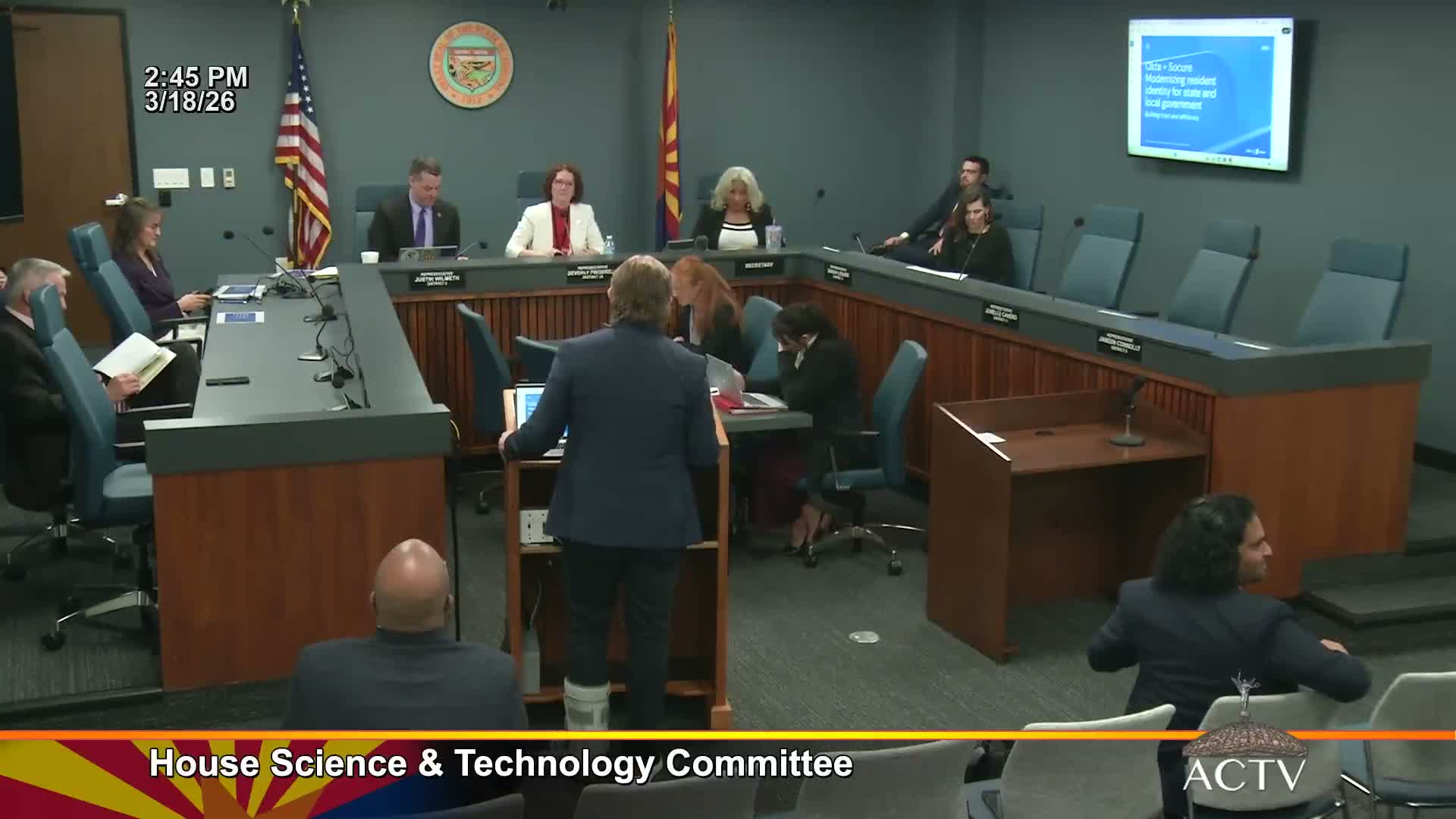
Okta and SoCure presented a joint briefing on digital identity strategies for state government and answered lawmakers’ questions about privacy, federal funding and the risk of a national‑style ID.
Morgan Reid, Okta’s field CTO and a former Arizona state CIO, told the committee that many residents struggle to access government services online and that credential compromise is a primary attack vector. She said a single, resident‑centric login experience could reduce friction and improve security across roughly 130 state agencies and boards. Reid noted Okta already supports workforce sign‑ons in Arizona and said the company seeks to extend identity work for citizens while preserving user control.
Jordan Burris, head of public sector at SoCure, described identity‑verification methods that combine contextual signals (device and IP context, phone and email history, document validation and biometrics) to detect fraud. Burris cautioned that many traditional verification methods are becoming less reliable and said SoCure’s research suggests current methods may be ineffective against evolving adversaries by 2027; he advocated layered signals and vendor transparency so government reviewers see why a given decision is recommended.
During Q&A, a legislator raised concerns that state digital ID efforts and mobile driver’s licenses (MDLs) could evolve into a national ID or threaten Fourth Amendment privacy protections. Reid described Verifiable Digital Credentials (VDCs) the vendors are piloting with other states; she said VDCs can show residents what data will be shared and let them approve transmission to a specific service rather than exposing unnecessary personal data. Both vendors cited pilot conversations with Utah and other states and said states frequently pair policy guardrails with vendor partnerships.
Lawmakers asked about federal funding and whether MDLs can be implemented without strings attached. The presenters said many MDL efforts have federal components but that states can choose self‑funded models and that a statute or bill could define statewide responsibilities and incentives to encourage agency adoption.
Multiple members expressed constituent fears about surveillance and emphasized protecting state rights and privacy. Several members said they personally would avoid a Real ID driver license and use passports instead; presenters and members agreed that communicating optionality and privacy protections to residents is important.
The committee did not take action; the briefing closed with thanks to the presenters.
Morgan Reid, Okta’s field CTO and a former Arizona state CIO, told the committee that many residents struggle to access government services online and that credential compromise is a primary attack vector. She said a single, resident‑centric login experience could reduce friction and improve security across roughly 130 state agencies and boards. Reid noted Okta already supports workforce sign‑ons in Arizona and said the company seeks to extend identity work for citizens while preserving user control.
Jordan Burris, head of public sector at SoCure, described identity‑verification methods that combine contextual signals (device and IP context, phone and email history, document validation and biometrics) to detect fraud. Burris cautioned that many traditional verification methods are becoming less reliable and said SoCure’s research suggests current methods may be ineffective against evolving adversaries by 2027; he advocated layered signals and vendor transparency so government reviewers see why a given decision is recommended.
During Q&A, a legislator raised concerns that state digital ID efforts and mobile driver’s licenses (MDLs) could evolve into a national ID or threaten Fourth Amendment privacy protections. Reid described Verifiable Digital Credentials (VDCs) the vendors are piloting with other states; she said VDCs can show residents what data will be shared and let them approve transmission to a specific service rather than exposing unnecessary personal data. Both vendors cited pilot conversations with Utah and other states and said states frequently pair policy guardrails with vendor partnerships.
Lawmakers asked about federal funding and whether MDLs can be implemented without strings attached. The presenters said many MDL efforts have federal components but that states can choose self‑funded models and that a statute or bill could define statewide responsibilities and incentives to encourage agency adoption.
Multiple members expressed constituent fears about surveillance and emphasized protecting state rights and privacy. Several members said they personally would avoid a Real ID driver license and use passports instead; presenters and members agreed that communicating optionality and privacy protections to residents is important.
The committee did not take action; the briefing closed with thanks to the presenters.
View the Full Meeting & All Its Details
This article offers just a summary. Unlock complete video, transcripts, and insights as a Founder Member.
✓
Watch full, unedited meeting videos
✓
Search every word spoken in unlimited transcripts
✓
AI summaries & real-time alerts (all government levels)
✓
Permanent access to expanding government content
30-day money-back guarantee
