Secretary McDonald: federal review found long-running fiscal mismanagement at Division of Services for the Blind; 56 furloughed and 17 on RIF list
March 18, 2026 | 2026 Legislature AR, Arkansas
This article was created by AI summarizing key points discussed. AI makes mistakes, so for full details and context, please refer to the video of the full meeting. Please report any errors so we can fix them. Report an error »
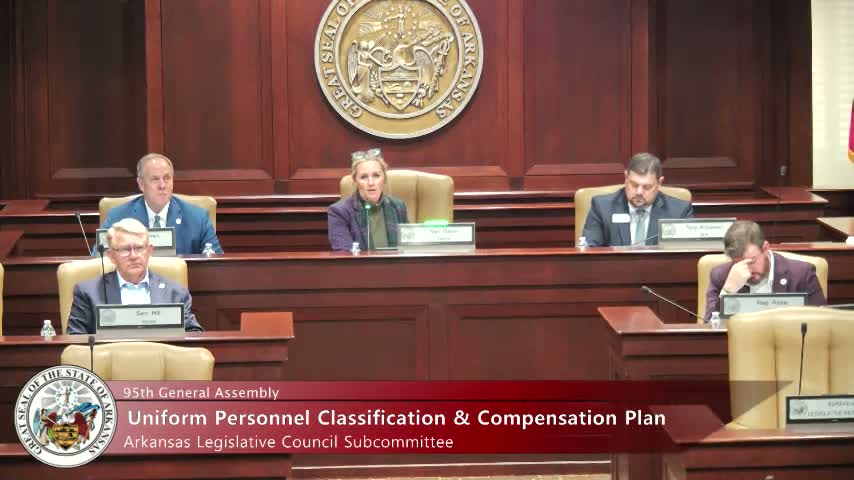
Secretary Hugh McDonald, the state's commerce secretary, told the legislative subcommittee on March 19 that a federal review found the Division of Services for the Blind (DSB) had long-standing fiscal problems that led to furloughs and a reduction in force.
McDonald said the U.S. Department of Education's Office of Special Education and Rehabilitative Services (RSA) notified the state on Feb. 25 that RSA had designated DSB "a high risk grantee" because of "excessive spending in administrative costs and drawdown patterns" and a failure to implement fiscal planning and mitigation. "DSB... has been mismanaged for a long time," McDonald said, reading from the RSA communication he had shared with the panel.
The committee heard that the department had moved to streamline operations after a prior realignment, but that some programs were being cross-subsidized and that obligations exceeded available funds. McDonald said the result was a second round of furloughs; at the time of the hearing 56 DSB employees were furloughed and 17 employees appeared on a reduction-in-force (RIF) list scheduled to be released March 31. He said the governor had named an interim leader and the administration recommended bringing in an external director to restore fiscal controls and operations.
Why it matters: DSB provides vocational rehabilitation services to blind and visually impaired Arkansans; disruptions to staffing affect service delivery and may require federal agreement for restoration of funds. McDonald told the committee that RSA's letter dates DSB's fiscal problems to at least 2020 and cited an 18% increase in participants from 2020 to 2024 while VR purchased-services expenditures rose about 78% in that period.
Committee members pressed the administration on who is accountable for DSB. McDonald described a statutory tension: the DSB board "shall appoint" the commissioner (subject to governor approval), yet statute also directs the commissioner to report to the secretary of the Department of Commerce. "There's an inherent problem there," McDonald said, adding that the board's independence has complicated oversight.
Senator Love asked whether the layoffs would fall disproportionately on African American employees, saying "they usually fall on African Americans" in similar actions. McDonald said the RIF decisions were performance-based and that department staff did not analyze racial composition before finalizing the RIF list; he and staff agreed to provide the committee with demographic information about the division and the individuals affected.
What officials will do next: McDonald and Workforce Connections' Executive Director Cody Waits told lawmakers they are seeking RSA approval and have been in frequent communication with federal officials; committee members requested more detailed documentation of the fiscal problems and a demographic breakdown of affected employees. The administration said it would provide additional detail on the specific expenditures RSA cited and on steps to restore operations.
The subcommittee did not take a formal vote on the RIF (it was discussed as part of report items), but members requested follow-up materials and data from the Department of Commerce and Workforce Connections.
McDonald said the U.S. Department of Education's Office of Special Education and Rehabilitative Services (RSA) notified the state on Feb. 25 that RSA had designated DSB "a high risk grantee" because of "excessive spending in administrative costs and drawdown patterns" and a failure to implement fiscal planning and mitigation. "DSB... has been mismanaged for a long time," McDonald said, reading from the RSA communication he had shared with the panel.
The committee heard that the department had moved to streamline operations after a prior realignment, but that some programs were being cross-subsidized and that obligations exceeded available funds. McDonald said the result was a second round of furloughs; at the time of the hearing 56 DSB employees were furloughed and 17 employees appeared on a reduction-in-force (RIF) list scheduled to be released March 31. He said the governor had named an interim leader and the administration recommended bringing in an external director to restore fiscal controls and operations.
Why it matters: DSB provides vocational rehabilitation services to blind and visually impaired Arkansans; disruptions to staffing affect service delivery and may require federal agreement for restoration of funds. McDonald told the committee that RSA's letter dates DSB's fiscal problems to at least 2020 and cited an 18% increase in participants from 2020 to 2024 while VR purchased-services expenditures rose about 78% in that period.
Committee members pressed the administration on who is accountable for DSB. McDonald described a statutory tension: the DSB board "shall appoint" the commissioner (subject to governor approval), yet statute also directs the commissioner to report to the secretary of the Department of Commerce. "There's an inherent problem there," McDonald said, adding that the board's independence has complicated oversight.
Senator Love asked whether the layoffs would fall disproportionately on African American employees, saying "they usually fall on African Americans" in similar actions. McDonald said the RIF decisions were performance-based and that department staff did not analyze racial composition before finalizing the RIF list; he and staff agreed to provide the committee with demographic information about the division and the individuals affected.
What officials will do next: McDonald and Workforce Connections' Executive Director Cody Waits told lawmakers they are seeking RSA approval and have been in frequent communication with federal officials; committee members requested more detailed documentation of the fiscal problems and a demographic breakdown of affected employees. The administration said it would provide additional detail on the specific expenditures RSA cited and on steps to restore operations.
The subcommittee did not take a formal vote on the RIF (it was discussed as part of report items), but members requested follow-up materials and data from the Department of Commerce and Workforce Connections.
Don't Miss a Word: See the Full Meeting!
Go beyond summaries. Unlock every video, transcript, and key insight with a Founder Membership.
✓
Get instant access to full meeting videos
✓
Search and clip any phrase from complete transcripts
✓
Receive AI-powered summaries & custom alerts
✓
Enjoy lifetime, unrestricted access to government data
30-day money-back guarantee
