Arkansas committee hears plan to "decouple" Medicare Advantage to lower retiree costs
March 18, 2026 | 2026 Legislature AR, Arkansas
This article was created by AI summarizing key points discussed. AI makes mistakes, so for full details and context, please refer to the video of the full meeting. Please report any errors so we can fix them. Report an error »
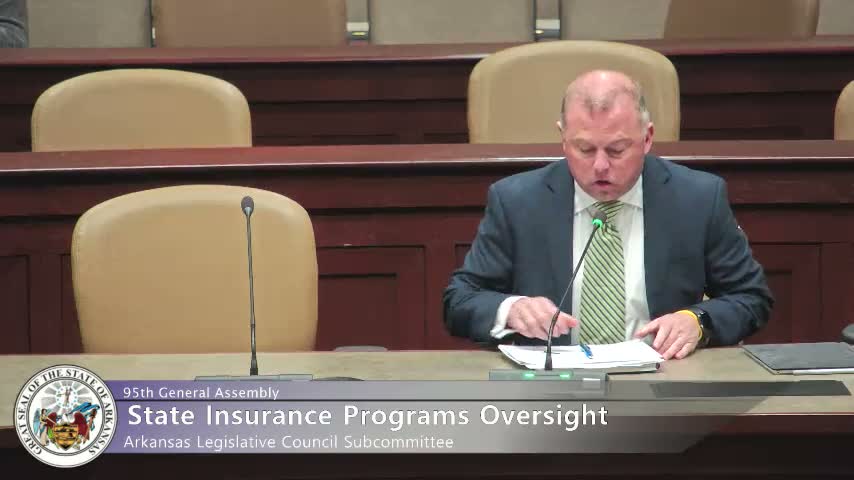
Grant Wallace, director of the employee benefits division and office of property risk, told an Arkansas legislative committee that the state is exploring "decoupling" the Medicare Advantage group plan that covers post‑65 state and public school retirees.
"We were seeing a significant savings by decoupling our plan for our members, to the tune of $100 to $200 per participant per month," Wallace said, describing early estimates while noting final numbers depend on upcoming federal rate-setting and a carrier response.
Consultants from Seagull Consulting — Patrick Klein, vice president, and Kristen Shatten, senior vice president — reviewed how recent federal changes have altered Part D funding and licensed the strategy. Klein said the state’s initial MAPD (Medicare Advantage with Part D) option produced enrollment just over 50% after a 2023 RFP and “generated around $40,000,000 in savings.” Shatten said the Inflation Reduction Act shifted much of Part D funding into a risk‑adjusted direct subsidy paid to carriers, increasing that subsidy from a historical average of a few dollars to roughly $200 per enrolled member and making risk scores central to plan funding.
Why it matters: shifting the MAPD into separate medical-only MA and standalone Part D contracts could let the state realize a more favorable funding differential on the pharmacy side because standalone Part D markets and MAPD medical populations are being paid differently under current CMS rules. Shatten explained that CMS issues an "advance notice" in January and a "final rate notice" the first Monday in April; carriers then produce renewal bids (individual bids in June and national Part D details in August). The committee was told it should expect revised contract amendments in May–June after advisory‑board and State Board of Finance review.
Senator Petty asked whether higher risk scores mean the state or members pay more; Shatten said members likely face lower out‑of‑pocket expense under current plan designs because a 2025 standard sets a $2,000 out‑of‑pocket maximum, but those richer benefits shift costs across the plan and into carriers’ bids. She added that risk scores depend on medical coding and that MAPD plans that include medical provider relationships generally produce higher and more accurate risk scores than standalone Part D plans.
What’s next: Wallace said the EBD will await the April CMS final notice and UnitedHealthcare’s renewal work; the committee expects consultants and EBD staff to return with reports in April or June. No formal motion or vote took place; the committee adjourned and will reconvene May 13.
Sources: Committee hearing transcript; statements attributed to Grant Wallace (director, employee benefits division and office of property risk), Patrick Klein (vice president, Seagull Consulting), and Kristen Shatten (senior vice president, Seagull Consulting).
"We were seeing a significant savings by decoupling our plan for our members, to the tune of $100 to $200 per participant per month," Wallace said, describing early estimates while noting final numbers depend on upcoming federal rate-setting and a carrier response.
Consultants from Seagull Consulting — Patrick Klein, vice president, and Kristen Shatten, senior vice president — reviewed how recent federal changes have altered Part D funding and licensed the strategy. Klein said the state’s initial MAPD (Medicare Advantage with Part D) option produced enrollment just over 50% after a 2023 RFP and “generated around $40,000,000 in savings.” Shatten said the Inflation Reduction Act shifted much of Part D funding into a risk‑adjusted direct subsidy paid to carriers, increasing that subsidy from a historical average of a few dollars to roughly $200 per enrolled member and making risk scores central to plan funding.
Why it matters: shifting the MAPD into separate medical-only MA and standalone Part D contracts could let the state realize a more favorable funding differential on the pharmacy side because standalone Part D markets and MAPD medical populations are being paid differently under current CMS rules. Shatten explained that CMS issues an "advance notice" in January and a "final rate notice" the first Monday in April; carriers then produce renewal bids (individual bids in June and national Part D details in August). The committee was told it should expect revised contract amendments in May–June after advisory‑board and State Board of Finance review.
Senator Petty asked whether higher risk scores mean the state or members pay more; Shatten said members likely face lower out‑of‑pocket expense under current plan designs because a 2025 standard sets a $2,000 out‑of‑pocket maximum, but those richer benefits shift costs across the plan and into carriers’ bids. She added that risk scores depend on medical coding and that MAPD plans that include medical provider relationships generally produce higher and more accurate risk scores than standalone Part D plans.
What’s next: Wallace said the EBD will await the April CMS final notice and UnitedHealthcare’s renewal work; the committee expects consultants and EBD staff to return with reports in April or June. No formal motion or vote took place; the committee adjourned and will reconvene May 13.
Sources: Committee hearing transcript; statements attributed to Grant Wallace (director, employee benefits division and office of property risk), Patrick Klein (vice president, Seagull Consulting), and Kristen Shatten (senior vice president, Seagull Consulting).
Don't Miss a Word: See the Full Meeting!
Go beyond summaries. Unlock every video, transcript, and key insight with a Founder Membership.
✓
Get instant access to full meeting videos
✓
Search and clip any phrase from complete transcripts
✓
Receive AI-powered summaries & custom alerts
✓
Enjoy lifetime, unrestricted access to government data
30-day money-back guarantee
