Committee hears bill to join four interstate health-professional licensure compacts
March 18, 2026 | 2026 Legislature Alaska, Alaska
This article was created by AI summarizing key points discussed. AI makes mistakes, so for full details and context, please refer to the video of the full meeting. Please report any errors so we can fix them. Report an error »
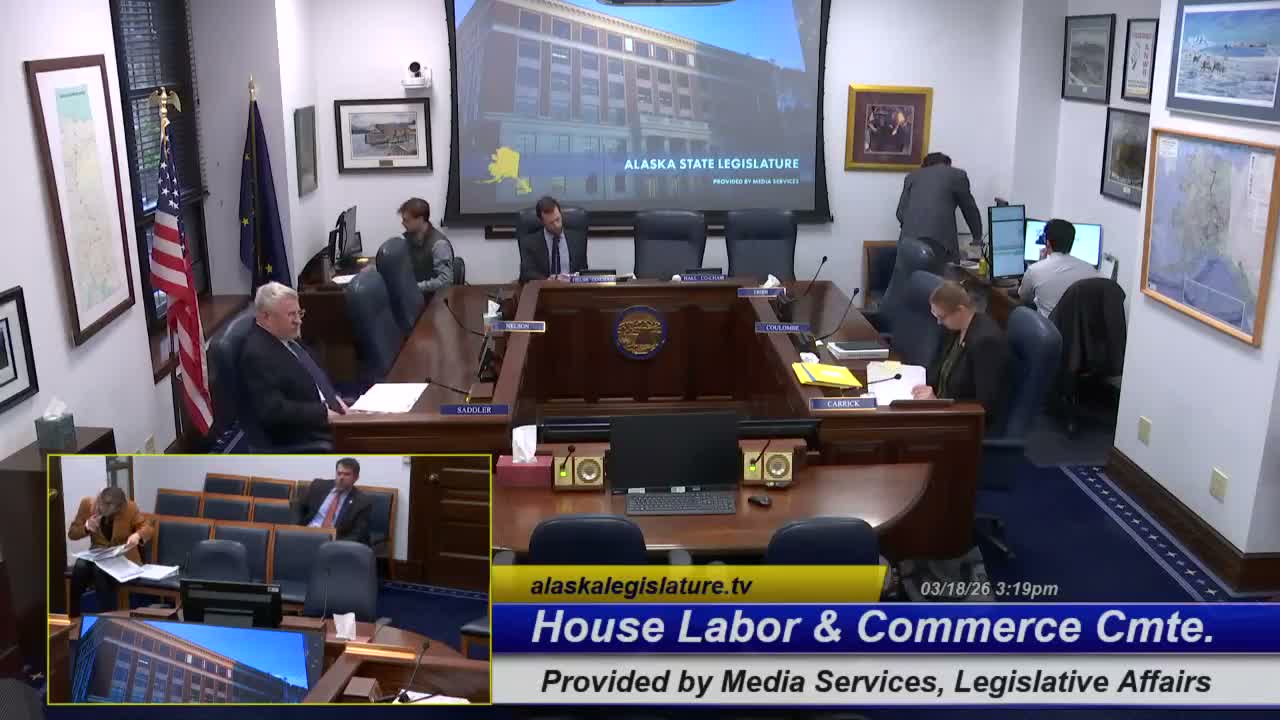
The House Labor and Commerce Committee heard testimony April 24 on HB 352, a bill that would authorize Alaska to join four interstate licensing compacts covering physicians, physician assistants, psychologists and EMS personnel.
Courtney Owen, staff to Co-Chair Fields, told the committee that HB 352 "would enact Alaska's participation in 4 interstate medical licensure compacts," listing the interstate medical licensure compact (IMLC), the PA licensure compact, the psychology interjurisdictional compact (PSYPACT) and the EMS personnel licensure interstate compact. Representatives and agency staff then questioned how compact credentials, background checks and fees would be handled.
Sylvan Robb, director of the Division of Corporations, Business and Professional Licensing, said applicants who need compact credentials submit fingerprint cards that the division forwards to the Department of Public Safety and the FBI, and said the division "doesn't anticipate that we would need additional staff to process the fingerprint cards" as reflected in the bill's zero fiscal note. Robb added that compacts can reduce document volume for the division and speed the licensure timeline.
Marvin Riginden reported that the Alaska Psychological Association's board voted to endorse PSYPACT and HB 352. Janet Orwig (identified earlier by the chair as representing SCIPAC) explained that PSYPACT requires an "e-passport" certificate as part of authorization to practice interjurisdictional psychology; authorized holders receive a verification badge and appear in a public verification directory.
Laurie Wing Hyer, health-care legislative liaison for the Legislature, said Alaska already participates in dozens of interstate compacts across agencies and that the proposed licensure compacts would not be the state's first.
Committee members pressed for clarity on costs. Robb said most compacts do not charge states for membership and that, in his experience, the largest fee he had seen was about $6,000 a year. Gwen Saviors, deputy director for the Division of Corporations, Business and Professional Licensing, gave itemized information provided to the committee: she said the IMLC imposes no cost to the state (applicants pay a roughly $700 compact cost), the PA licensure compact has no established state cost yet, and PSYPACT charges roughly $10 per authorization for Alaska home-state applicants with a $6,000 annual cap on collections.
Members also asked whether compacts would reduce in-state capacity. Orwig said PSYPACT monitoring has not shown significant license loss in member states; Brian Webb of the Alaska Department of Health's emergency medical services office said compacts would not reduce EMS capacity and can provide temporary augmentation for remote operations and seasonal demands.
The committee did not vote on HB 352 during the hearing and paused the meeting to take up the next agenda item.
What happens next: The bill will return for additional hearings and potential amendment; committee members asked staff to circulate follow-up documentation on compact costs, the constitutional authority cited for compacts, and state-by-state participation data before further action.
Courtney Owen, staff to Co-Chair Fields, told the committee that HB 352 "would enact Alaska's participation in 4 interstate medical licensure compacts," listing the interstate medical licensure compact (IMLC), the PA licensure compact, the psychology interjurisdictional compact (PSYPACT) and the EMS personnel licensure interstate compact. Representatives and agency staff then questioned how compact credentials, background checks and fees would be handled.
Sylvan Robb, director of the Division of Corporations, Business and Professional Licensing, said applicants who need compact credentials submit fingerprint cards that the division forwards to the Department of Public Safety and the FBI, and said the division "doesn't anticipate that we would need additional staff to process the fingerprint cards" as reflected in the bill's zero fiscal note. Robb added that compacts can reduce document volume for the division and speed the licensure timeline.
Marvin Riginden reported that the Alaska Psychological Association's board voted to endorse PSYPACT and HB 352. Janet Orwig (identified earlier by the chair as representing SCIPAC) explained that PSYPACT requires an "e-passport" certificate as part of authorization to practice interjurisdictional psychology; authorized holders receive a verification badge and appear in a public verification directory.
Laurie Wing Hyer, health-care legislative liaison for the Legislature, said Alaska already participates in dozens of interstate compacts across agencies and that the proposed licensure compacts would not be the state's first.
Committee members pressed for clarity on costs. Robb said most compacts do not charge states for membership and that, in his experience, the largest fee he had seen was about $6,000 a year. Gwen Saviors, deputy director for the Division of Corporations, Business and Professional Licensing, gave itemized information provided to the committee: she said the IMLC imposes no cost to the state (applicants pay a roughly $700 compact cost), the PA licensure compact has no established state cost yet, and PSYPACT charges roughly $10 per authorization for Alaska home-state applicants with a $6,000 annual cap on collections.
Members also asked whether compacts would reduce in-state capacity. Orwig said PSYPACT monitoring has not shown significant license loss in member states; Brian Webb of the Alaska Department of Health's emergency medical services office said compacts would not reduce EMS capacity and can provide temporary augmentation for remote operations and seasonal demands.
The committee did not vote on HB 352 during the hearing and paused the meeting to take up the next agenda item.
What happens next: The bill will return for additional hearings and potential amendment; committee members asked staff to circulate follow-up documentation on compact costs, the constitutional authority cited for compacts, and state-by-state participation data before further action.
View the Full Meeting & All Its Details
This article offers just a summary. Unlock complete video, transcripts, and insights as a Founder Member.
✓
Watch full, unedited meeting videos
✓
Search every word spoken in unlimited transcripts
✓
AI summaries & real-time alerts (all government levels)
✓
Permanent access to expanding government content
30-day money-back guarantee
