Committee reviews bill to modernize Alaska travel-insurance law
March 18, 2026 | 2026 Legislature Alaska, Alaska
This article was created by AI summarizing key points discussed. AI makes mistakes, so for full details and context, please refer to the video of the full meeting. Please report any errors so we can fix them. Report an error »
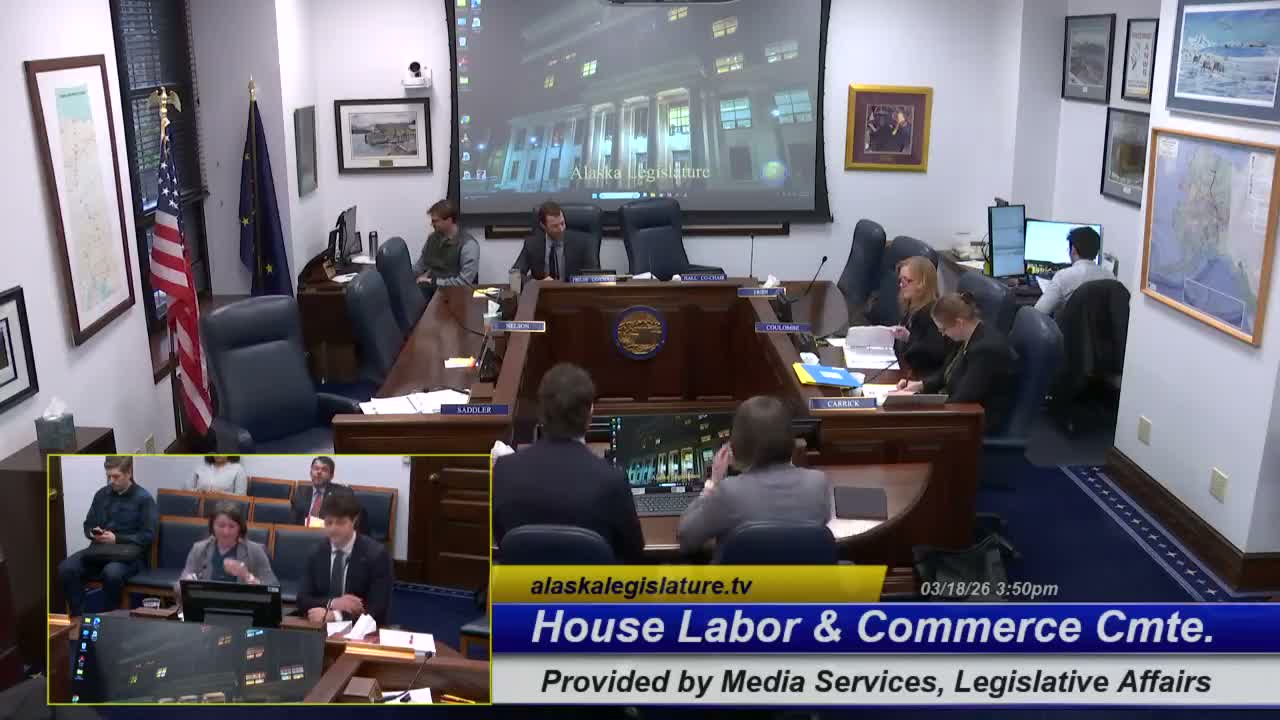
The House Labor and Commerce Committee heard HB 302 on April 24, a bill to update Alaska's travel-insurance statutes to a model adopted by many states.
Representative Carolyn Hall (HD 16) opened the presentation, saying the bill modernizes Alaska's travel-insurance law to reflect long distances, remote destinations and the high cost of emergency evacuations from parts of the state. "Travel insurance exists to protect travelers from these sorts of financial burdens," Hall said, introducing the bill.
Keith Bruce, staff to Representative Hall, read a section-by-section analysis. The bill creates a new Article 4 on travel insurance, adds definitions (including blanket travel insurance, travel protection plans and travel retailer/limited producer roles), clarifies premium-tax reporting, and directs that travel insurance products will generally be filed under Alaska's inland marine line. The read-through also noted consumer-protection provisions (disclosure requirements, a 10'15-day free-refund period in many sales paths, preexisting-condition disclosure, opt-out prohibitions in booking flows, and marketing transparency), licensing and fingerprinting requirements for travel-insurance limited producers and administrators, and a repeal of older statutes.
Duke DeHaas of Allianz Partners USA, testifying for industry, said the measure codifies model language from the National Association of Insurance Commissioners and related model legislation. He told the committee the model includes about 19 consumer protections, streamlines filing for regulators and could expand distribution channels so additional travel agencies and retail channels can offer travel insurance in Alaska. DeHaas said the model "puts Alaska in line with the rest of the country" and argued consistent statutory language reduces regulatory variability and helps ensure all companies follow a common rule book.
Heather Carpenter, director of the Division of Insurance, told the committee the model is more comprehensive than the state's current statute and gives the division clearer rules and enforcement tools to protect consumers; she noted 41 states have adopted similar frameworks.
Members asked whether Alaskan businesses currently sell travel insurance, whether out-of-state sellers must comply with Alaska law, and why the updated definitions explicitly list emergency evacuation and repatriation. DeHaas said Alaska travel agencies do sell travel insurance and that purchasers resident in Alaska would have the protections of Alaska law. He said the listed items were previously covered in practice but are spelled out in modern model language to remove ambiguity.
The committee did not vote. Members agreed to another hearing and possibly to set amendment deadlines after further review.
What happens next: The committee will reconvene to consider amendments and possible vote; staff and sponsors will provide materials (including sectional clarifications and related fiscal notes) before the next hearing.
Representative Carolyn Hall (HD 16) opened the presentation, saying the bill modernizes Alaska's travel-insurance law to reflect long distances, remote destinations and the high cost of emergency evacuations from parts of the state. "Travel insurance exists to protect travelers from these sorts of financial burdens," Hall said, introducing the bill.
Keith Bruce, staff to Representative Hall, read a section-by-section analysis. The bill creates a new Article 4 on travel insurance, adds definitions (including blanket travel insurance, travel protection plans and travel retailer/limited producer roles), clarifies premium-tax reporting, and directs that travel insurance products will generally be filed under Alaska's inland marine line. The read-through also noted consumer-protection provisions (disclosure requirements, a 10'15-day free-refund period in many sales paths, preexisting-condition disclosure, opt-out prohibitions in booking flows, and marketing transparency), licensing and fingerprinting requirements for travel-insurance limited producers and administrators, and a repeal of older statutes.
Duke DeHaas of Allianz Partners USA, testifying for industry, said the measure codifies model language from the National Association of Insurance Commissioners and related model legislation. He told the committee the model includes about 19 consumer protections, streamlines filing for regulators and could expand distribution channels so additional travel agencies and retail channels can offer travel insurance in Alaska. DeHaas said the model "puts Alaska in line with the rest of the country" and argued consistent statutory language reduces regulatory variability and helps ensure all companies follow a common rule book.
Heather Carpenter, director of the Division of Insurance, told the committee the model is more comprehensive than the state's current statute and gives the division clearer rules and enforcement tools to protect consumers; she noted 41 states have adopted similar frameworks.
Members asked whether Alaskan businesses currently sell travel insurance, whether out-of-state sellers must comply with Alaska law, and why the updated definitions explicitly list emergency evacuation and repatriation. DeHaas said Alaska travel agencies do sell travel insurance and that purchasers resident in Alaska would have the protections of Alaska law. He said the listed items were previously covered in practice but are spelled out in modern model language to remove ambiguity.
The committee did not vote. Members agreed to another hearing and possibly to set amendment deadlines after further review.
What happens next: The committee will reconvene to consider amendments and possible vote; staff and sponsors will provide materials (including sectional clarifications and related fiscal notes) before the next hearing.
View the Full Meeting & All Its Details
This article offers just a summary. Unlock complete video, transcripts, and insights as a Founder Member.
✓
Watch full, unedited meeting videos
✓
Search every word spoken in unlimited transcripts
✓
AI summaries & real-time alerts (all government levels)
✓
Permanent access to expanding government content
30-day money-back guarantee
