Senate Education Committee debates SB 277 funding changes for correspondence programs and charter administrative fees
March 18, 2026 | 2026 Legislature Alaska, Alaska
This article was created by AI summarizing key points discussed. AI makes mistakes, so for full details and context, please refer to the video of the full meeting. Please report any errors so we can fix them. Report an error »
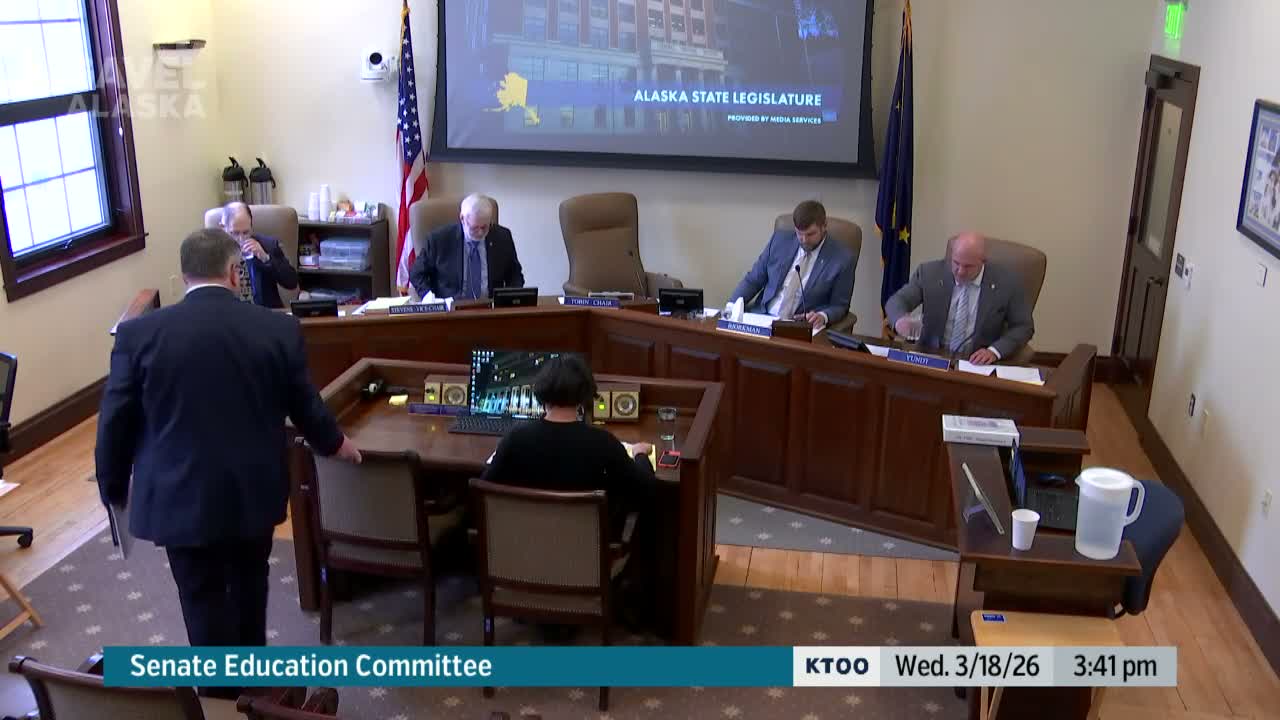
The Senate Education Committee met March 18 in Juneau to hear testimony on Senate Bill 277, a package of education-funding and technical changes sponsored by Sen. Lukey Gale Tobin, chair of the committee. The bill would (a) allow districts to charge an administrative services rate to charter schools of up to 8% or the district’s actual administrative costs (Section 1), (b) let students leaving statewide correspondence programs retain instructional materials without repaying programs (Section 2), (c) adjust pupil transportation grants using a motor fuels CPI change (Section 3), (d) require cooperative agreements between districts for certain out‑of‑district correspondence services and cap indirect charges at 8% (Section 4), (e) eliminate the 0.9 correspondence multiplier so correspondence students count as 1.0 for base funding (Section 5), (f) raise the Base Student Allocation (BSA) by the Anchorage CPI (about $126 to $6,786.54; Section 6), and (g) change where correspondence students’ average daily membership (ADM) is reported so they are included in the district where they reside and counted at the lowest‑ADM school in that district (Section 7). The bill also includes technical updates, rehiring language for the Southeast Regional Resource Center, a reading grant program expansion, and a study of the foundation formula.
Why it matters: The package shifts how state dollars follow (or are routed for) students enrolled in statewide correspondence programs, increases per‑student funding in some ways, and creates new guardrails for districts providing services to out‑of‑district students. Those changes could materially alter revenue flows for small statewide programs and some rural districts, while increasing costs for the state budget. Laurie Weed, the department’s school finance manager, presented a fiscal estimate that the combined changes would cost roughly $77.7 million for FY2027–2032 and an estimated supplemental appropriation of about $78.7 million for FY2026; Deb Riddle detailed program and staffing costs tied to the reading incentive and implementation.
Sponsor and committee discussion: Sen. Lukey Gale Tobin opened the hearing and walked members through each section, telling the committee that Sections 4 and 7 are intended to create cooperative agreements to protect both home districts and statewide providers while ensuring students can use local services such as athletics or special education supports. Tobin said the 8% cap is modeled to be the lesser of an actual administrative cost or 8% and that the language is version A, open to refinement. Committee members asked whether the changes would inadvertently subject correspondence students to the full foundation multipliers; staff and sponsor repeatedly stated the intent is that correspondence students receive 1.0 of ADM for base funding but not be run through all multipliers, and that clarifying language will be included in later drafts. Senator Kiel urged clarity and narrower drafting on material retention and counting rules; Senator Yount and others sought examples of how the cooperative agreements and the 8% cap would apply in practice.
Expert testimony and fiscal briefing: The committee invited Chris Reitong, executive director of the Southeast Regional Resource Center (SERC), who said SERC supports the bill’s rehiring language (sections 11–16) because it would allow the center to rehire retired certified staff to meet high‑demand needs like special education and counseling. On costs, Laurie Weed said the fiscal note projects roughly $77.7M across FY2027–2032 (with about $72.97M tied to public education funding formula changes and $4.74M tied to transportation), and estimated an immediate FY2026 supplemental of about $78.7M if the bill had immediate effect. Deb Riddle summarized the reading incentive fiscal estimate (about $21.84M) and implementation costs including one FTE and a contract for rubric development.
Public testimony: The hearing drew heavy public turnout by remote public commenters. Roughly three dozen people signed up; the large majority who spoke by phone represented statewide correspondence programs, homeschooling families, or program staff and urged the committee to amend Sections 4 and 7. Common concerns: (1) redirecting state funds to the residence district would leave statewide correspondence providers with little or no guaranteed revenue, threatening program viability and parental choice; (2) the cooperative‑agreement language in Section 4 is permissive as written (“may cooperate”) in ways commenters said could allow home districts to keep funds without passing them to the enrolling program; (3) the 8% administrative cap was described by several callers as arbitrary or insufficiently justified as a limit or, conversely, a mechanism that could be expanded later; and (4) families using correspondence programs worried that benefits such as the $450 reading incentive would go to the district rather than the program or family. Representative quotes: Marshall Blankenship said the 8% increase “is an arbitrary success tax” that could take resources from successful programs; Kendra Piper said the bill “shifts funding and control back towards the very districts that many families like mine have chosen to leave”; Carolyn Storm of the Coalition for Education Equity urged additional conversations with districts and said “a cap of 8% may not be enough.” Several program leaders (IDEA, Raven, CyberLink and others) warned that the bill as drafted could force families to go fully independent.
Points for revision: Multiple legislators and invited witnesses suggested concrete fixes if the committee moves forward: (a) change the language in Section 7 so funding remains with the enrolled program unless a clearly defined cooperative agreement transfers a specified portion to the resident district; (b) convert permissive cooperative language (“may cooperate”) into mandatory minimum terms and an enforcement or dispute mechanism; (c) specify which dollars are subject to the 8% admin fee versus educational service fees and set clear caps or formulas for both; and (d) add clarifying statutory text to ensure correspondence students are not run through unintended multipliers. Several speakers recommended the bill sponsor and staff work with the Department of Education and affected programs to produce a committee substitute with clearer mechanics and guardrails.
What happened next: The committee took no final vote on SB 277 during the hearing. Chair Tobin said staff will work on language tweaks and that public testimony would continue at future bill hearings if needed. The committee also forwarded three governor appointees to a joint session for consideration (see separate article).
Why it matters: The package shifts how state dollars follow (or are routed for) students enrolled in statewide correspondence programs, increases per‑student funding in some ways, and creates new guardrails for districts providing services to out‑of‑district students. Those changes could materially alter revenue flows for small statewide programs and some rural districts, while increasing costs for the state budget. Laurie Weed, the department’s school finance manager, presented a fiscal estimate that the combined changes would cost roughly $77.7 million for FY2027–2032 and an estimated supplemental appropriation of about $78.7 million for FY2026; Deb Riddle detailed program and staffing costs tied to the reading incentive and implementation.
Sponsor and committee discussion: Sen. Lukey Gale Tobin opened the hearing and walked members through each section, telling the committee that Sections 4 and 7 are intended to create cooperative agreements to protect both home districts and statewide providers while ensuring students can use local services such as athletics or special education supports. Tobin said the 8% cap is modeled to be the lesser of an actual administrative cost or 8% and that the language is version A, open to refinement. Committee members asked whether the changes would inadvertently subject correspondence students to the full foundation multipliers; staff and sponsor repeatedly stated the intent is that correspondence students receive 1.0 of ADM for base funding but not be run through all multipliers, and that clarifying language will be included in later drafts. Senator Kiel urged clarity and narrower drafting on material retention and counting rules; Senator Yount and others sought examples of how the cooperative agreements and the 8% cap would apply in practice.
Expert testimony and fiscal briefing: The committee invited Chris Reitong, executive director of the Southeast Regional Resource Center (SERC), who said SERC supports the bill’s rehiring language (sections 11–16) because it would allow the center to rehire retired certified staff to meet high‑demand needs like special education and counseling. On costs, Laurie Weed said the fiscal note projects roughly $77.7M across FY2027–2032 (with about $72.97M tied to public education funding formula changes and $4.74M tied to transportation), and estimated an immediate FY2026 supplemental of about $78.7M if the bill had immediate effect. Deb Riddle summarized the reading incentive fiscal estimate (about $21.84M) and implementation costs including one FTE and a contract for rubric development.
Public testimony: The hearing drew heavy public turnout by remote public commenters. Roughly three dozen people signed up; the large majority who spoke by phone represented statewide correspondence programs, homeschooling families, or program staff and urged the committee to amend Sections 4 and 7. Common concerns: (1) redirecting state funds to the residence district would leave statewide correspondence providers with little or no guaranteed revenue, threatening program viability and parental choice; (2) the cooperative‑agreement language in Section 4 is permissive as written (“may cooperate”) in ways commenters said could allow home districts to keep funds without passing them to the enrolling program; (3) the 8% administrative cap was described by several callers as arbitrary or insufficiently justified as a limit or, conversely, a mechanism that could be expanded later; and (4) families using correspondence programs worried that benefits such as the $450 reading incentive would go to the district rather than the program or family. Representative quotes: Marshall Blankenship said the 8% increase “is an arbitrary success tax” that could take resources from successful programs; Kendra Piper said the bill “shifts funding and control back towards the very districts that many families like mine have chosen to leave”; Carolyn Storm of the Coalition for Education Equity urged additional conversations with districts and said “a cap of 8% may not be enough.” Several program leaders (IDEA, Raven, CyberLink and others) warned that the bill as drafted could force families to go fully independent.
Points for revision: Multiple legislators and invited witnesses suggested concrete fixes if the committee moves forward: (a) change the language in Section 7 so funding remains with the enrolled program unless a clearly defined cooperative agreement transfers a specified portion to the resident district; (b) convert permissive cooperative language (“may cooperate”) into mandatory minimum terms and an enforcement or dispute mechanism; (c) specify which dollars are subject to the 8% admin fee versus educational service fees and set clear caps or formulas for both; and (d) add clarifying statutory text to ensure correspondence students are not run through unintended multipliers. Several speakers recommended the bill sponsor and staff work with the Department of Education and affected programs to produce a committee substitute with clearer mechanics and guardrails.
What happened next: The committee took no final vote on SB 277 during the hearing. Chair Tobin said staff will work on language tweaks and that public testimony would continue at future bill hearings if needed. The committee also forwarded three governor appointees to a joint session for consideration (see separate article).
View the Full Meeting & All Its Details
This article offers just a summary. Unlock complete video, transcripts, and insights as a Founder Member.
✓
Watch full, unedited meeting videos
✓
Search every word spoken in unlimited transcripts
✓
AI summaries & real-time alerts (all government levels)
✓
Permanent access to expanding government content
30-day money-back guarantee
