Mass. hearing on ballot initiative to curb legislative stipends spotlights transparency, redistribution and constitutional concerns
March 17, 2026 | 2026 Legislature MA, Massachusetts
This article was created by AI summarizing key points discussed. AI makes mistakes, so for full details and context, please refer to the video of the full meeting. Please report any errors so we can fix them. Report an error »
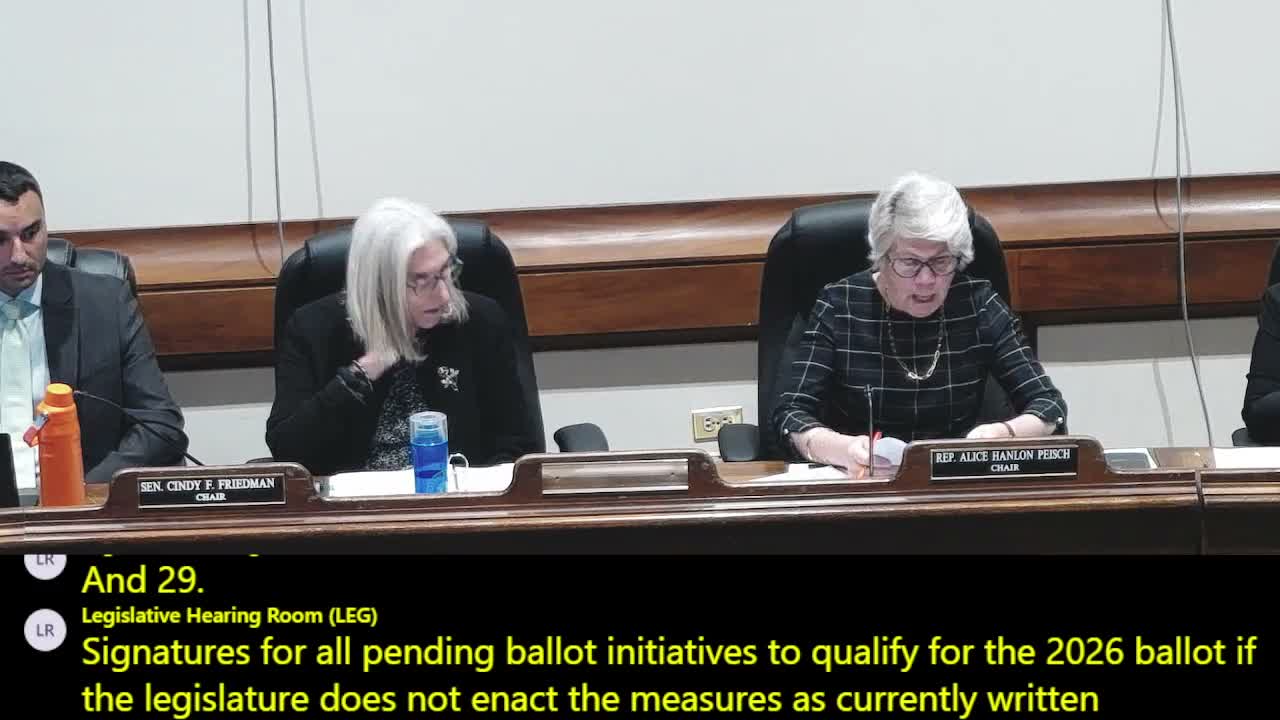
The Special Joint Committee on Initiative Petitions heard testimony on initiative petition number 20537 (filed as H.5010), a measure that would limit and condition many leadership stipends and redirect savings toward higher pay for lower‑paid legislators.
House Chair Alice Peish opened the hearing and explained the Article 48 process for initiative petitions and the additional signature threshold (12,429) required for ballot qualification if the legislature does not enact the measure.
Proponents told the committee the current stipend system concentrates power in a few leaders and rewards loyalty rather than work. Jonathan Hecht, a former state representative and lead proponent, said the petition "cuts by nearly two thirds the number of stipends under the control of the four legislative leaders" and would shift funding to pay rank‑and‑file legislators for service on joint committees. Hecht said the current system allows leaders to control appointments to roughly 179 paid positions and asserted that "this is not normal." He told members the measure would condition half of leadership and chair stipends on public committee debates and recorded public votes to create transparency and restore committee deliberation.
The proponents offered several data points during testimony: supporters and their witnesses cited a recent reporting figure for total stipend spending (about $5.4 million annually) and described many committees that receive stipends but hold few or no public hearings. Mary Connington, director of government transparency at the Pioneer Institute, told the committee leadership-controlled stipends "create a structure where loyalty to the Speaker of the House, Senate president, and minority leaders become an economic necessity." Several former legislators said the stipend structure discourages independent voting and makes public committee debate rare.
Experts and proponents framed the petition as a compensation-policy intervention to make legislative service more accessible. Emily Ronco of the National Conference of State Legislatures (appearing by prerecorded testimony) reviewed national models and data, noting Massachusetts is categorized among full‑time legislatures and citing national averages for state legislative pay and practices (NCSL materials cited a national average figure and comparative salary ranges across full‑, hybrid- and part‑time states).
Committee members asked implementation and legal questions. Senator Brendan Crichton and others pressed proponents on whether the statute "sets rules" for committee procedure or merely conditions pay. Proponents said the petition is a pay statute expressed in objective terms (stipends as percentages of base salary tied to documented committee activity) and that clerks would perform a ministerial certification based on public records showing whether required transparent procedures occurred. Proponents described the petition's objective metrics (for example, eligibility tied to committees assigned at least 50 bills at a session's start) but acknowledged that "weight" versus "volume" of bills can raise practical questions for committees such as bonding, which may handle high‑impact bills in small numbers.
Representative Michael Day asked about the petition's fundraising and signature-gathering: proponents reported raising roughly $322,000, with approximately $303,000 spent on paid signature‑gathering firms and estimated about 15,000 volunteer-collected signatures out of about 95,000 total gathered; members requested follow-up documentation to clarify contracts and per‑signature arrangements.
Opponents raised constitutional and operational objections. Sean Keeley, a law professor at Boston University School of Law, testified the proposal (as described in committee testimony) "is unconstitutional" because it attempts to impose procedural requirements on how each chamber governs itself. Keeley cited Massachusetts constitutional provisions and case law (Paesner v. Attorney General) to argue that the constitution assigns each house the power to determine its own officers and rules and to insulate legislative deliberations; he warned the measure could prompt frequent litigation over whether required public markups and votes occurred and could have unforeseen effects on bicameral cooperation and committee structures.
Members and witnesses debated tradeoffs: proponents emphasized restoring public committee debate and making extra pay contingent on public work; opponents and some members warned that a statutory attempt to define committee procedure could be struck down or produce operational burdens.
Public commenters largely supported the petition. Speakers representing LEAP, Act on Mass, Pioneer Institute, Progressive Democrats of Massachusetts and others described the stipend system as concentrating power and undermining accountability; several urged the committee to give the petition a favorable report or pursue legislative reforms to raise base pay or limit supplements.
The committee received written testimony through March 21 at 5 p.m. and took no formal vote at the hearing. The committee will decide next steps on whether to report the petition favorably, unfavorably, or take other procedural action.
House Chair Alice Peish opened the hearing and explained the Article 48 process for initiative petitions and the additional signature threshold (12,429) required for ballot qualification if the legislature does not enact the measure.
Proponents told the committee the current stipend system concentrates power in a few leaders and rewards loyalty rather than work. Jonathan Hecht, a former state representative and lead proponent, said the petition "cuts by nearly two thirds the number of stipends under the control of the four legislative leaders" and would shift funding to pay rank‑and‑file legislators for service on joint committees. Hecht said the current system allows leaders to control appointments to roughly 179 paid positions and asserted that "this is not normal." He told members the measure would condition half of leadership and chair stipends on public committee debates and recorded public votes to create transparency and restore committee deliberation.
The proponents offered several data points during testimony: supporters and their witnesses cited a recent reporting figure for total stipend spending (about $5.4 million annually) and described many committees that receive stipends but hold few or no public hearings. Mary Connington, director of government transparency at the Pioneer Institute, told the committee leadership-controlled stipends "create a structure where loyalty to the Speaker of the House, Senate president, and minority leaders become an economic necessity." Several former legislators said the stipend structure discourages independent voting and makes public committee debate rare.
Experts and proponents framed the petition as a compensation-policy intervention to make legislative service more accessible. Emily Ronco of the National Conference of State Legislatures (appearing by prerecorded testimony) reviewed national models and data, noting Massachusetts is categorized among full‑time legislatures and citing national averages for state legislative pay and practices (NCSL materials cited a national average figure and comparative salary ranges across full‑, hybrid- and part‑time states).
Committee members asked implementation and legal questions. Senator Brendan Crichton and others pressed proponents on whether the statute "sets rules" for committee procedure or merely conditions pay. Proponents said the petition is a pay statute expressed in objective terms (stipends as percentages of base salary tied to documented committee activity) and that clerks would perform a ministerial certification based on public records showing whether required transparent procedures occurred. Proponents described the petition's objective metrics (for example, eligibility tied to committees assigned at least 50 bills at a session's start) but acknowledged that "weight" versus "volume" of bills can raise practical questions for committees such as bonding, which may handle high‑impact bills in small numbers.
Representative Michael Day asked about the petition's fundraising and signature-gathering: proponents reported raising roughly $322,000, with approximately $303,000 spent on paid signature‑gathering firms and estimated about 15,000 volunteer-collected signatures out of about 95,000 total gathered; members requested follow-up documentation to clarify contracts and per‑signature arrangements.
Opponents raised constitutional and operational objections. Sean Keeley, a law professor at Boston University School of Law, testified the proposal (as described in committee testimony) "is unconstitutional" because it attempts to impose procedural requirements on how each chamber governs itself. Keeley cited Massachusetts constitutional provisions and case law (Paesner v. Attorney General) to argue that the constitution assigns each house the power to determine its own officers and rules and to insulate legislative deliberations; he warned the measure could prompt frequent litigation over whether required public markups and votes occurred and could have unforeseen effects on bicameral cooperation and committee structures.
Members and witnesses debated tradeoffs: proponents emphasized restoring public committee debate and making extra pay contingent on public work; opponents and some members warned that a statutory attempt to define committee procedure could be struck down or produce operational burdens.
Public commenters largely supported the petition. Speakers representing LEAP, Act on Mass, Pioneer Institute, Progressive Democrats of Massachusetts and others described the stipend system as concentrating power and undermining accountability; several urged the committee to give the petition a favorable report or pursue legislative reforms to raise base pay or limit supplements.
The committee received written testimony through March 21 at 5 p.m. and took no formal vote at the hearing. The committee will decide next steps on whether to report the petition favorably, unfavorably, or take other procedural action.
View the Full Meeting & All Its Details
This article offers just a summary. Unlock complete video, transcripts, and insights as a Founder Member.
✓
Watch full, unedited meeting videos
✓
Search every word spoken in unlimited transcripts
✓
AI summaries & real-time alerts (all government levels)
✓
Permanent access to expanding government content
30-day money-back guarantee
