DOT officials tell House Finance Committee Alaska has $373 million deferred‑maintenance backlog; governor proposes $32M
March 18, 2026 | 2026 Legislature Alaska, Alaska
This article was created by AI summarizing key points discussed. AI makes mistakes, so for full details and context, please refer to the video of the full meeting. Please report any errors so we can fix them. Report an error »
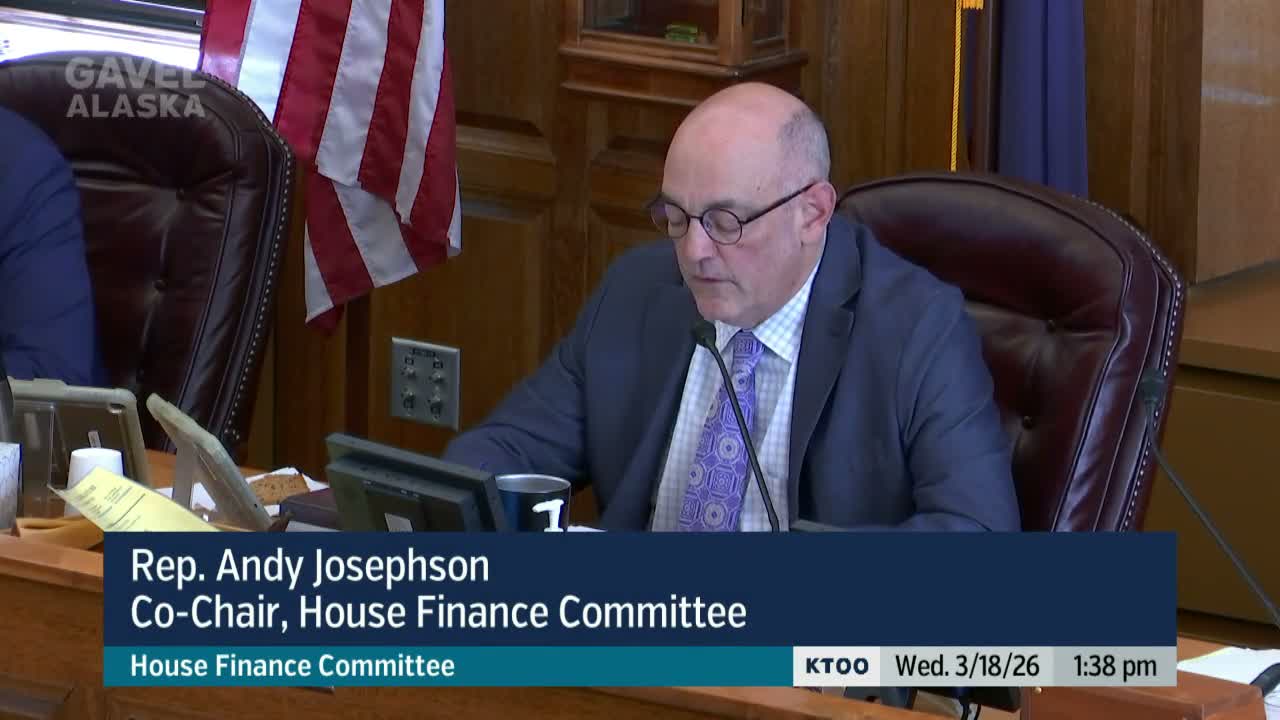
Department of Transportation & Public Facilities officials told the Alaska House Finance Committee on March 18 that the division responsible for state buildings manages roughly 706 facilities across 233 locations with an assessed value of about $2 billion and about 4.25 million square feet of space.
"Our mission is to deliver, improve, and maintain safe and reliable facilities across the state of Alaska," Daniel Gibson, director of the Division of Facility Services, told the committee during the department's briefing. Gibson outlined four functional areas—statewide public facilities, maintenance and operations, administration and leasing—and said state‑owned office space is 98% occupied.
Chief Christopher Hodgen reported the department’s current deferred‑maintenance backlog at approximately $373,000,000, splitting that estimate into about $210 million for Public Building Fund (PBF) office facilities and approximately $163 million for DOT and Division of Facility Services (DFS) programmatic buildings such as maintenance stations and snow‑removal equipment buildings. Hodgen said the figures come from recent facility condition assessments.
Committee members pressed agency staff on how funding is prioritized. Hodgen described facility condition assessments and a facility condition ratio derived from the assessments; he said "that ratio from the study that we did about a year ago was about 0.3, which comes to that fair," characterizing many assets as in fair condition. He and Director Don Pinone explained that PBF facilities are self‑funded through tenant rates and include a depreciation component that supports capital improvement projects, while DOT/DFS programmatic buildings typically depend on general‑fund allocations.
Pinone told the committee the governor’s FY‑26 capital request includes $26,000,000 in general capital deferred‑maintenance funding plus a $6,000,000 Public Building Fund appropriation. "In the governor's budget this year in the capital budget, we've proposed a $26,000,000 capital income fund funded, deferred maintenance appropriation. And a $6,000,000, public building fund appropriation," Pinone said.
Gibson also detailed leasing trends: the state manages about 1.6 million square feet of state‑owned office occupancy agreements and roughly 3.6 million square feet of private leases statewide; costs for private leases rose from about $47.5 million in FY25 to $49.2 million in FY26. He noted many long‑term leases (10–20 years), limited turnover, and occasional co‑location successes (for example, DEED and DCCED in Juneau that allowed termination of a roughly 20,000‑square‑foot private lease).
Committee members asked for supporting materials and more granularity. Agency staff said they would provide project lists, the Facilities Council scoring and department‑by‑department cost‑per‑square‑foot tables for DOT‑owned buildings and private leases. Hodgen and Gibson agreed to share the Facilities Council rankings and the department’s prioritized list of top deferred‑maintenance projects for the committee’s review.
What’s next: agency staff said they will provide the scoring and prioritized project lists and that the administration’s capital request ($26M + $6M) will be allocated against those priorities; the committee signaled it will review those materials as it evaluates capital and maintenance appropriations.
Ending: The DOT&PF presenters thanked the committee and were excused; the committee recessed briefly before moving to House Bill 193.
"Our mission is to deliver, improve, and maintain safe and reliable facilities across the state of Alaska," Daniel Gibson, director of the Division of Facility Services, told the committee during the department's briefing. Gibson outlined four functional areas—statewide public facilities, maintenance and operations, administration and leasing—and said state‑owned office space is 98% occupied.
Chief Christopher Hodgen reported the department’s current deferred‑maintenance backlog at approximately $373,000,000, splitting that estimate into about $210 million for Public Building Fund (PBF) office facilities and approximately $163 million for DOT and Division of Facility Services (DFS) programmatic buildings such as maintenance stations and snow‑removal equipment buildings. Hodgen said the figures come from recent facility condition assessments.
Committee members pressed agency staff on how funding is prioritized. Hodgen described facility condition assessments and a facility condition ratio derived from the assessments; he said "that ratio from the study that we did about a year ago was about 0.3, which comes to that fair," characterizing many assets as in fair condition. He and Director Don Pinone explained that PBF facilities are self‑funded through tenant rates and include a depreciation component that supports capital improvement projects, while DOT/DFS programmatic buildings typically depend on general‑fund allocations.
Pinone told the committee the governor’s FY‑26 capital request includes $26,000,000 in general capital deferred‑maintenance funding plus a $6,000,000 Public Building Fund appropriation. "In the governor's budget this year in the capital budget, we've proposed a $26,000,000 capital income fund funded, deferred maintenance appropriation. And a $6,000,000, public building fund appropriation," Pinone said.
Gibson also detailed leasing trends: the state manages about 1.6 million square feet of state‑owned office occupancy agreements and roughly 3.6 million square feet of private leases statewide; costs for private leases rose from about $47.5 million in FY25 to $49.2 million in FY26. He noted many long‑term leases (10–20 years), limited turnover, and occasional co‑location successes (for example, DEED and DCCED in Juneau that allowed termination of a roughly 20,000‑square‑foot private lease).
Committee members asked for supporting materials and more granularity. Agency staff said they would provide project lists, the Facilities Council scoring and department‑by‑department cost‑per‑square‑foot tables for DOT‑owned buildings and private leases. Hodgen and Gibson agreed to share the Facilities Council rankings and the department’s prioritized list of top deferred‑maintenance projects for the committee’s review.
What’s next: agency staff said they will provide the scoring and prioritized project lists and that the administration’s capital request ($26M + $6M) will be allocated against those priorities; the committee signaled it will review those materials as it evaluates capital and maintenance appropriations.
Ending: The DOT&PF presenters thanked the committee and were excused; the committee recessed briefly before moving to House Bill 193.
View the Full Meeting & All Its Details
This article offers just a summary. Unlock complete video, transcripts, and insights as a Founder Member.
✓
Watch full, unedited meeting videos
✓
Search every word spoken in unlimited transcripts
✓
AI summaries & real-time alerts (all government levels)
✓
Permanent access to expanding government content
30-day money-back guarantee
