Court system asks Legislature to add a superior court judge in Palmer, citing heavy caseloads
March 18, 2026 | 2026 Legislature Alaska, Alaska
This article was created by AI summarizing key points discussed. AI makes mistakes, so for full details and context, please refer to the video of the full meeting. Please report any errors so we can fix them. Report an error »
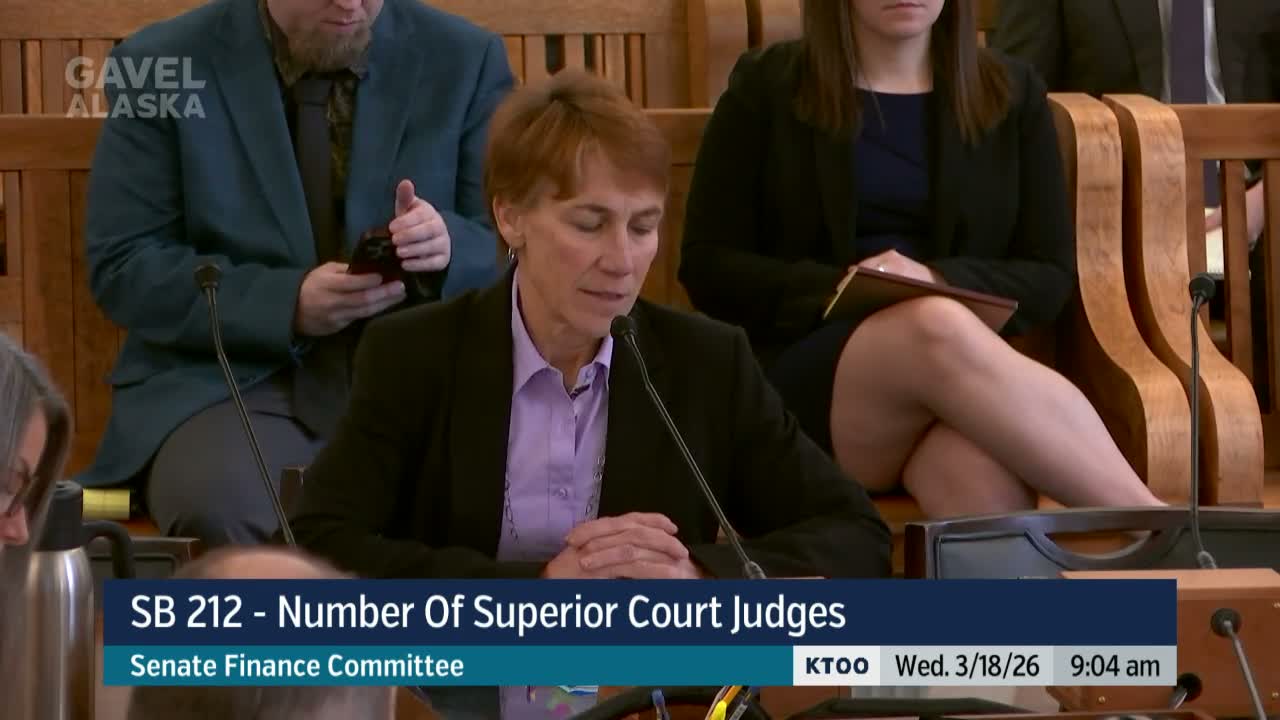
Nancy Mead, general counsel for the Alaska Court System, told the Senate Finance Committee on March 18 that she was introducing Senate Bill 212 to amend AS 22.10.120 and increase the statewide number of superior court judges from 45 to 46, allocating the additional seat to the 3rd Judicial District to serve in Palmer.
Mead said the court’s data show Palmer judges carry the highest caseloads in the state. "Last year, they were carrying 683 cases per judge," she said, contrasting that with a statewide average of 458 cases per judge. She estimated the Palmer court handles roughly 2,800 superior‑court cases a year and said the numbers, combined with more complex electronic evidence and an increase in self‑represented litigants, have lengthened case processing time.
Mead described repeated stopgap measures the Judiciary has used to manage the load—including temporarily assigning Anchorage judges to Palmer, reassigning district‑court judges, and using pro tem or retired judges—and said those approaches cause ripple effects across the statewide system. She told the committee Palmer had not received an additional superior court judge since 2007 and pointed to population growth in the Matanuska‑Susitna Valley as a contributing factor.
Senators asked about courtroom space and capital costs. Mead said the court has used previously appropriated capital funds to remodel basement space (including creating a grand‑jury courtroom) and that the new position could be housed without an immediate additional capital appropriation, though further capital outlay will likely be needed in the future to expand courtrooms.
Senator Cedric Kiel summarized fiscal notes for SB 212: "The trial court's allocation has a first‑year cost for fiscal year 2027 of 775.5 with four permanent full‑time positions," he said, and that removing one‑time costs leaves an annual ongoing cost of $680,000. Kiel also read a Public Defender fiscal note requesting one permanent attorney at $268,000 and a Department of Law criminal‑side note showing $305,500 in the first year and $303,000 ongoing.
Angie Kemp of the Department of Law cautioned that adding judges can spread existing attorneys thinner and increase travel and operational costs. "Anytime a new judge is added to a location, that spreads attorneys out even further," Kemp said, noting the department's supplemental and fiscal requests reflect rising costs such as witness travel.
There was no public testimony at the hearing. The committee set SB 212 aside for later consideration without action.
Mead said the court’s data show Palmer judges carry the highest caseloads in the state. "Last year, they were carrying 683 cases per judge," she said, contrasting that with a statewide average of 458 cases per judge. She estimated the Palmer court handles roughly 2,800 superior‑court cases a year and said the numbers, combined with more complex electronic evidence and an increase in self‑represented litigants, have lengthened case processing time.
Mead described repeated stopgap measures the Judiciary has used to manage the load—including temporarily assigning Anchorage judges to Palmer, reassigning district‑court judges, and using pro tem or retired judges—and said those approaches cause ripple effects across the statewide system. She told the committee Palmer had not received an additional superior court judge since 2007 and pointed to population growth in the Matanuska‑Susitna Valley as a contributing factor.
Senators asked about courtroom space and capital costs. Mead said the court has used previously appropriated capital funds to remodel basement space (including creating a grand‑jury courtroom) and that the new position could be housed without an immediate additional capital appropriation, though further capital outlay will likely be needed in the future to expand courtrooms.
Senator Cedric Kiel summarized fiscal notes for SB 212: "The trial court's allocation has a first‑year cost for fiscal year 2027 of 775.5 with four permanent full‑time positions," he said, and that removing one‑time costs leaves an annual ongoing cost of $680,000. Kiel also read a Public Defender fiscal note requesting one permanent attorney at $268,000 and a Department of Law criminal‑side note showing $305,500 in the first year and $303,000 ongoing.
Angie Kemp of the Department of Law cautioned that adding judges can spread existing attorneys thinner and increase travel and operational costs. "Anytime a new judge is added to a location, that spreads attorneys out even further," Kemp said, noting the department's supplemental and fiscal requests reflect rising costs such as witness travel.
There was no public testimony at the hearing. The committee set SB 212 aside for later consideration without action.
View the Full Meeting & All Its Details
This article offers just a summary. Unlock complete video, transcripts, and insights as a Founder Member.
✓
Watch full, unedited meeting videos
✓
Search every word spoken in unlimited transcripts
✓
AI summaries & real-time alerts (all government levels)
✓
Permanent access to expanding government content
30-day money-back guarantee
