Senators introduce broad revenue bill with education tax, S‑corp levy, digital apportionment and 17.5% gross oil tax option
March 18, 2026 | 2026 Legislature Alaska, Alaska
This article was created by AI summarizing key points discussed. AI makes mistakes, so for full details and context, please refer to the video of the full meeting. Please report any errors so we can fix them. Report an error »
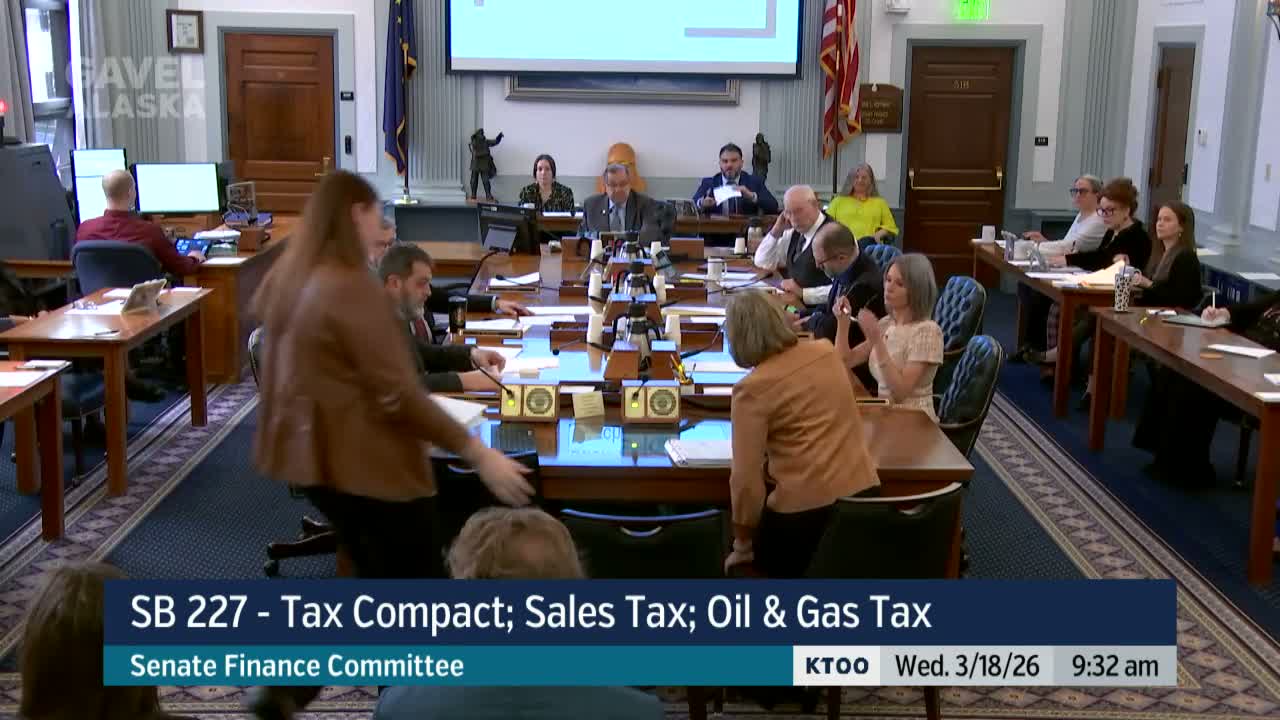
Senator Kathy Giesel (District E, Anchorage) introduced Senate Bill 227 (version G) to the Senate Finance Committee on March 18 as a menu of revenue measures the sponsors said could address state budget shortfalls.
Giesel described five elements: a bracketed education tax (the bill calls it an "education tax" in statute and would collect amounts from the third and fourth paychecks of the year in brackets—for example, $20 per year for incomes under $30,000, $30 for $30,000–$90,000, with higher brackets defined in the bill); an S‑corporation tax to align pass‑through entities with corporate tax treatment (bracketed beginning at $1,000,000 net income in the version presented); a modern education/head tax option; a 15¢ per barrel infrastructure surcharge on oil (Giesel said it is intended for Dalton Highway maintenance and estimated roughly $28.5 million in revenue); and a gross production tax option discussed in subsequent remarks.
Giesel said an intern’s estimate put the education tax revenue at about $11.5 million annually and noted that the bill could be amended to direct revenues into an education fund but, as written, the language is intent only and revenues would go into the general fund unless the committee amends the bill.
Senator Bill Wilakowski (East Anchorage) explained the bill’s oil‑tax provisions and an amendment option to move Alaska from its current complex net‑profit structure toward a gross production tax. Wilakowski argued the current net system has produced lower tax collections because credits and gross value reductions reduce the tax base; he proposed a 17.5% gross tax at the gross‑value point of production, saying it would bring the state’s take closer to historical shares when combined with existing royalties. "If you had a 17 and a half percent of the gross, you'd be getting $1,480,000,000," he said, citing a gross‑value projection for 2027 and contrasting that with lower current collections.
Wilakowski also described a "highly digitized" apportionment change for large C corporations that would alter where internet and digital sales are sourced for corporate tax purposes; he said the Department of Revenue estimates much of that revenue would be a reallocation from other states rather than a net new tax for companies.
Committee members probed the mechanics and fiscal modeling: senators asked how many taxpayers would fall into S‑corp brackets (Giesel said the Department of Revenue holds confidential distribution data and that an indirect expenditure report identified roughly 11,700 S‑corp/LLC entities but not how many would be in each bracket), whether the education tax constituted a progressive income tax or a head tax (committee members noted it functions like a capitated/variable head tax collected on specific paychecks), and how implementation would handle seasonal workers or multiple levies (Giesel said provisions for reimbursement exist).
Senators requested additional modeling from the Department of Revenue and asked for comparative IRR/rate‑of‑return data to assess competitiveness if oil taxes change. No vote was taken; the committee set SB 227 aside for further fiscal analysis and scheduled other budget related items for the afternoon.
Giesel described five elements: a bracketed education tax (the bill calls it an "education tax" in statute and would collect amounts from the third and fourth paychecks of the year in brackets—for example, $20 per year for incomes under $30,000, $30 for $30,000–$90,000, with higher brackets defined in the bill); an S‑corporation tax to align pass‑through entities with corporate tax treatment (bracketed beginning at $1,000,000 net income in the version presented); a modern education/head tax option; a 15¢ per barrel infrastructure surcharge on oil (Giesel said it is intended for Dalton Highway maintenance and estimated roughly $28.5 million in revenue); and a gross production tax option discussed in subsequent remarks.
Giesel said an intern’s estimate put the education tax revenue at about $11.5 million annually and noted that the bill could be amended to direct revenues into an education fund but, as written, the language is intent only and revenues would go into the general fund unless the committee amends the bill.
Senator Bill Wilakowski (East Anchorage) explained the bill’s oil‑tax provisions and an amendment option to move Alaska from its current complex net‑profit structure toward a gross production tax. Wilakowski argued the current net system has produced lower tax collections because credits and gross value reductions reduce the tax base; he proposed a 17.5% gross tax at the gross‑value point of production, saying it would bring the state’s take closer to historical shares when combined with existing royalties. "If you had a 17 and a half percent of the gross, you'd be getting $1,480,000,000," he said, citing a gross‑value projection for 2027 and contrasting that with lower current collections.
Wilakowski also described a "highly digitized" apportionment change for large C corporations that would alter where internet and digital sales are sourced for corporate tax purposes; he said the Department of Revenue estimates much of that revenue would be a reallocation from other states rather than a net new tax for companies.
Committee members probed the mechanics and fiscal modeling: senators asked how many taxpayers would fall into S‑corp brackets (Giesel said the Department of Revenue holds confidential distribution data and that an indirect expenditure report identified roughly 11,700 S‑corp/LLC entities but not how many would be in each bracket), whether the education tax constituted a progressive income tax or a head tax (committee members noted it functions like a capitated/variable head tax collected on specific paychecks), and how implementation would handle seasonal workers or multiple levies (Giesel said provisions for reimbursement exist).
Senators requested additional modeling from the Department of Revenue and asked for comparative IRR/rate‑of‑return data to assess competitiveness if oil taxes change. No vote was taken; the committee set SB 227 aside for further fiscal analysis and scheduled other budget related items for the afternoon.
View the Full Meeting & All Its Details
This article offers just a summary. Unlock complete video, transcripts, and insights as a Founder Member.
✓
Watch full, unedited meeting videos
✓
Search every word spoken in unlimited transcripts
✓
AI summaries & real-time alerts (all government levels)
✓
Permanent access to expanding government content
30-day money-back guarantee
