Senate Resources Committee hears analysis of SB 275, consultants outline market shocks, pricing options and transparency needs
March 18, 2026 | 2026 Legislature Alaska, Alaska
This article was created by AI summarizing key points discussed. AI makes mistakes, so for full details and context, please refer to the video of the full meeting. Please report any errors so we can fix them. Report an error »
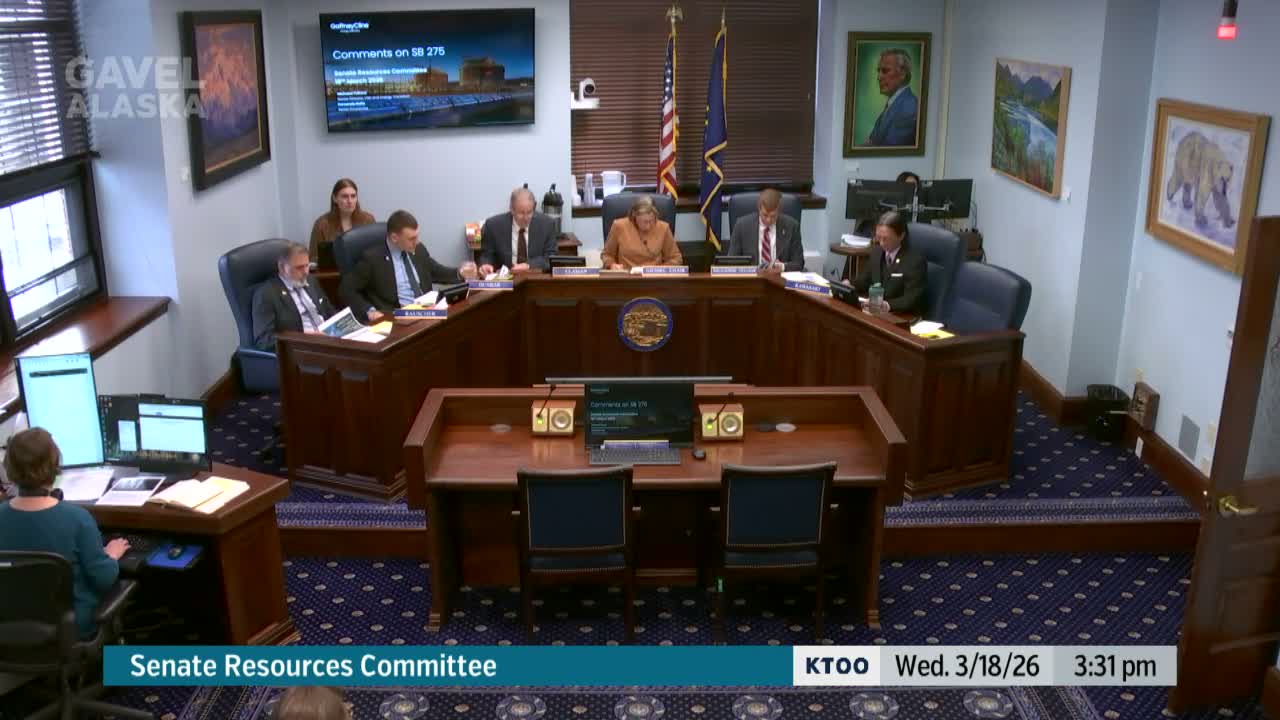
The Alaska Senate Resources Committee heard expert analysis on Wednesday of SB 275, a bill proposing a surcharge related to natural gas projects, and pressed outside consultants about how market shocks, pricing models and confidentiality rules could shape state revenue.
Nick Fulford, senior director for LNG and energy transition at Gaffney & Klein, told the committee that recent disruptions to global shipping and reported damage at the Ras Laffan export complex in Qatar have tightened the LNG market and “could have quite a significant effect on the desirability of LNG from Alaska.” Fulford said that while shorter shipping routes from Alaska to Asia can be an advantage, the ultimate value to the state depends heavily on how the project is structured and who bears price risk.
Gaffney & Klein presented three broad contract structures that would produce very different fiscal outcomes: (1) a fixed transfer-price model in which upstream producers sell gas at a low, steady price (examples discussed were $1–$1.25 per unit) and the LNG company takes market risk; (2) a netback mechanism in which producers receive a percentage of the ultimate sale price and upstream tax revenues vary with markets; and (3) tolling arrangements in which producers pay a flat processing fee and downstream market risk rests with the producers. Fulford said each model shifts the balance of potential upside and downside between royalties, production taxes and corporate income tax receipts for the state.
Fulford also walked the committee through illustrative cost assumptions the consultants used for the exercise: a $25 billion liquefaction plant (about $12.50 per ton per year), a $15 billion pipeline including compression, and $10 billion for gas processing and CO2 removal. Using those inputs and a set of levelized-cost assumptions, the presentation produced three example cost lines (roughly $11, $8 and a low scenario) that, when deducted from prevailing Asian LNG prices, yield a wide range of wellhead netbacks. "If you use the $11 number, you can see that for the last six months or so, the value of the gas on the slope would have been about 0 or slightly negative," Fulford said. Under other assumptions or recent forward-curve price spikes, netbacks could be substantially higher.
Senators focused questions on valuation, risk and oversight. Sen. Kawasaki pressed whether Alaska could command a pricing premium; Fulford said buyers consider supply-diversity value but that a large share of any premium is already consumed by project capital and operating costs. Sen. Dunbar asked whether high oil prices could cause producers to favor reinjecting gas to support oil production; Fulford said such technical choices and the presence of CO2 injection options are part of the producers’ calculus. Sen. Wilikowski raised concern that low upstream transfer prices could leave the state with little or no upstream tax base; Fulford replied that the state’s receipts hinge on which party takes marketing risk and on the contractual distribution of value along the chain.
Committee members also pressed on transparency and access to confidential project models. Fulford pointed to international examples — including LNG Canada — where joint economic models and controlled, nonpublic review by government experts enabled negotiation of fiscal terms. He described common confidentiality regimes in which a defined list of reviewers sign nondisclosure agreements and receive access to the economic model. "These are typically confidential, but they are designed to give key government stakeholders sufficient visibility to have confidence in the decisions they’re making around tax and fiscal arrangements," Fulford said.
Matt Kissinger, AGDC’s commercial manager who was on the call, confirmed that a $1.25 figure provided to a previous Wood Mackenzie study in 2022 reflected inputs AGDC had given based on producer conversations at that time.
No formal action or vote was taken at the hearing. The committee paused the presentation at a logical breakpoint and scheduled Fulford and Gaffney & Klein economist Fernando Rola to return for a continuation focused on surcharge implications; members were asked to submit follow-up questions in writing.
The committee’s next step is the resumed presentation at the next scheduled meeting, where senators said they expect more detail on the proposed surcharge, potential statutory changes to protect state interests and the confidentiality arrangements that would govern access to project economic models.
Nick Fulford, senior director for LNG and energy transition at Gaffney & Klein, told the committee that recent disruptions to global shipping and reported damage at the Ras Laffan export complex in Qatar have tightened the LNG market and “could have quite a significant effect on the desirability of LNG from Alaska.” Fulford said that while shorter shipping routes from Alaska to Asia can be an advantage, the ultimate value to the state depends heavily on how the project is structured and who bears price risk.
Gaffney & Klein presented three broad contract structures that would produce very different fiscal outcomes: (1) a fixed transfer-price model in which upstream producers sell gas at a low, steady price (examples discussed were $1–$1.25 per unit) and the LNG company takes market risk; (2) a netback mechanism in which producers receive a percentage of the ultimate sale price and upstream tax revenues vary with markets; and (3) tolling arrangements in which producers pay a flat processing fee and downstream market risk rests with the producers. Fulford said each model shifts the balance of potential upside and downside between royalties, production taxes and corporate income tax receipts for the state.
Fulford also walked the committee through illustrative cost assumptions the consultants used for the exercise: a $25 billion liquefaction plant (about $12.50 per ton per year), a $15 billion pipeline including compression, and $10 billion for gas processing and CO2 removal. Using those inputs and a set of levelized-cost assumptions, the presentation produced three example cost lines (roughly $11, $8 and a low scenario) that, when deducted from prevailing Asian LNG prices, yield a wide range of wellhead netbacks. "If you use the $11 number, you can see that for the last six months or so, the value of the gas on the slope would have been about 0 or slightly negative," Fulford said. Under other assumptions or recent forward-curve price spikes, netbacks could be substantially higher.
Senators focused questions on valuation, risk and oversight. Sen. Kawasaki pressed whether Alaska could command a pricing premium; Fulford said buyers consider supply-diversity value but that a large share of any premium is already consumed by project capital and operating costs. Sen. Dunbar asked whether high oil prices could cause producers to favor reinjecting gas to support oil production; Fulford said such technical choices and the presence of CO2 injection options are part of the producers’ calculus. Sen. Wilikowski raised concern that low upstream transfer prices could leave the state with little or no upstream tax base; Fulford replied that the state’s receipts hinge on which party takes marketing risk and on the contractual distribution of value along the chain.
Committee members also pressed on transparency and access to confidential project models. Fulford pointed to international examples — including LNG Canada — where joint economic models and controlled, nonpublic review by government experts enabled negotiation of fiscal terms. He described common confidentiality regimes in which a defined list of reviewers sign nondisclosure agreements and receive access to the economic model. "These are typically confidential, but they are designed to give key government stakeholders sufficient visibility to have confidence in the decisions they’re making around tax and fiscal arrangements," Fulford said.
Matt Kissinger, AGDC’s commercial manager who was on the call, confirmed that a $1.25 figure provided to a previous Wood Mackenzie study in 2022 reflected inputs AGDC had given based on producer conversations at that time.
No formal action or vote was taken at the hearing. The committee paused the presentation at a logical breakpoint and scheduled Fulford and Gaffney & Klein economist Fernando Rola to return for a continuation focused on surcharge implications; members were asked to submit follow-up questions in writing.
The committee’s next step is the resumed presentation at the next scheduled meeting, where senators said they expect more detail on the proposed surcharge, potential statutory changes to protect state interests and the confidentiality arrangements that would govern access to project economic models.
View the Full Meeting & All Its Details
This article offers just a summary. Unlock complete video, transcripts, and insights as a Founder Member.
✓
Watch full, unedited meeting videos
✓
Search every word spoken in unlimited transcripts
✓
AI summaries & real-time alerts (all government levels)
✓
Permanent access to expanding government content
30-day money-back guarantee
