Committee hears SB 23 to add civics requirement; sponsors, iCivics and teachers urge changes to fiscal and waiver language
March 18, 2026 | 2026 Legislature Alaska, Alaska
This article was created by AI summarizing key points discussed. AI makes mistakes, so for full details and context, please refer to the video of the full meeting. Please report any errors so we can fix them. Report an error »
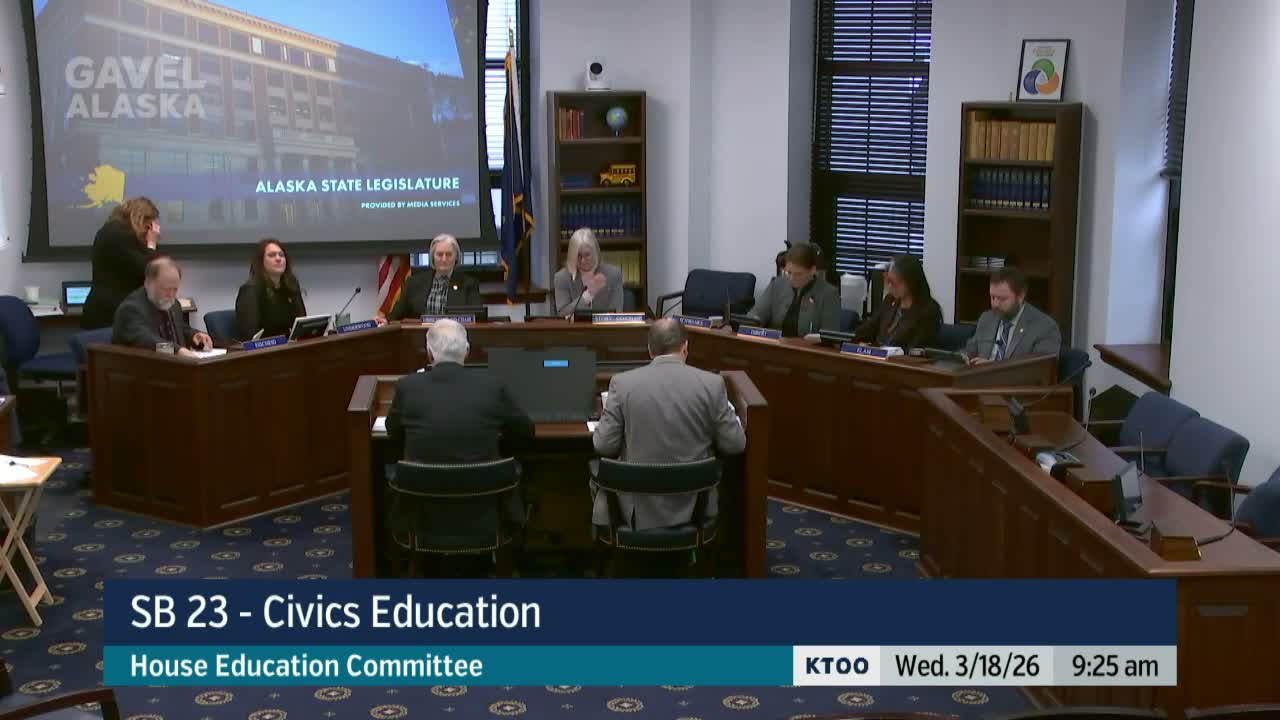
Senate Bill 23, a proposal from Sen. Gary Stevens to establish a civics graduation requirement, received invited testimony and public comment before the House Education Committee on March 18.
Sen. Gary Stevens (Kodiak) told the committee SB 23 would require students to complete either a semester course, pass a civics test, or complete a civics project as one path to graduate. "This bill calls for an establishment of a civics program graduation requirement," Stevens said, describing the measure as intended to strengthen civic knowledge, participation and trust in institutions.
Alex Copeland of Homer spoke in support and urged careful drafting of special-education waiver language so accommodations and modifications are clearly available. "The special education waiver needs to be really looked into," Copeland said, adding that many special-education students can succeed with proper accommodations and that project-based assessments are valuable.
Sean Healy, chief policy and advocacy officer for iCivics, testified in support and cited research showing that students who took civics courses performed better on assessments. "Young people that had a class in civics in eighth grade did about 10% better on this test," Healy said, and he recommended dedicated instructional time, professional learning for teachers and a range of assessment models including project-based options and civic seals.
Committee members expressed concerns about the bill's fiscal note and whether the State Board or DEED would be required to develop curriculum. Sponsor staff said the bill is being revised to direct the board to publish an accessible list of existing open-source resources rather than produce a wholly new curriculum, and they are working with DEED to reduce the fiscal impact.
The committee held SB 23 over for a future hearing and requested a sectional analysis and an updated fiscal note from DEED so members can consider amendments on curriculum language and special-education accommodations.
Sen. Gary Stevens (Kodiak) told the committee SB 23 would require students to complete either a semester course, pass a civics test, or complete a civics project as one path to graduate. "This bill calls for an establishment of a civics program graduation requirement," Stevens said, describing the measure as intended to strengthen civic knowledge, participation and trust in institutions.
Alex Copeland of Homer spoke in support and urged careful drafting of special-education waiver language so accommodations and modifications are clearly available. "The special education waiver needs to be really looked into," Copeland said, adding that many special-education students can succeed with proper accommodations and that project-based assessments are valuable.
Sean Healy, chief policy and advocacy officer for iCivics, testified in support and cited research showing that students who took civics courses performed better on assessments. "Young people that had a class in civics in eighth grade did about 10% better on this test," Healy said, and he recommended dedicated instructional time, professional learning for teachers and a range of assessment models including project-based options and civic seals.
Committee members expressed concerns about the bill's fiscal note and whether the State Board or DEED would be required to develop curriculum. Sponsor staff said the bill is being revised to direct the board to publish an accessible list of existing open-source resources rather than produce a wholly new curriculum, and they are working with DEED to reduce the fiscal impact.
The committee held SB 23 over for a future hearing and requested a sectional analysis and an updated fiscal note from DEED so members can consider amendments on curriculum language and special-education accommodations.
View the Full Meeting & All Its Details
This article offers just a summary. Unlock complete video, transcripts, and insights as a Founder Member.
✓
Watch full, unedited meeting videos
✓
Search every word spoken in unlimited transcripts
✓
AI summaries & real-time alerts (all government levels)
✓
Permanent access to expanding government content
30-day money-back guarantee
