Legislative Finance tells Alaska senators POMV models show short‑term windfall, longer‑term deficits under SB 274
March 18, 2026 | 2026 Legislature Alaska, Alaska
This article was created by AI summarizing key points discussed. AI makes mistakes, so for full details and context, please refer to the video of the full meeting. Please report any errors so we can fix them. Report an error »
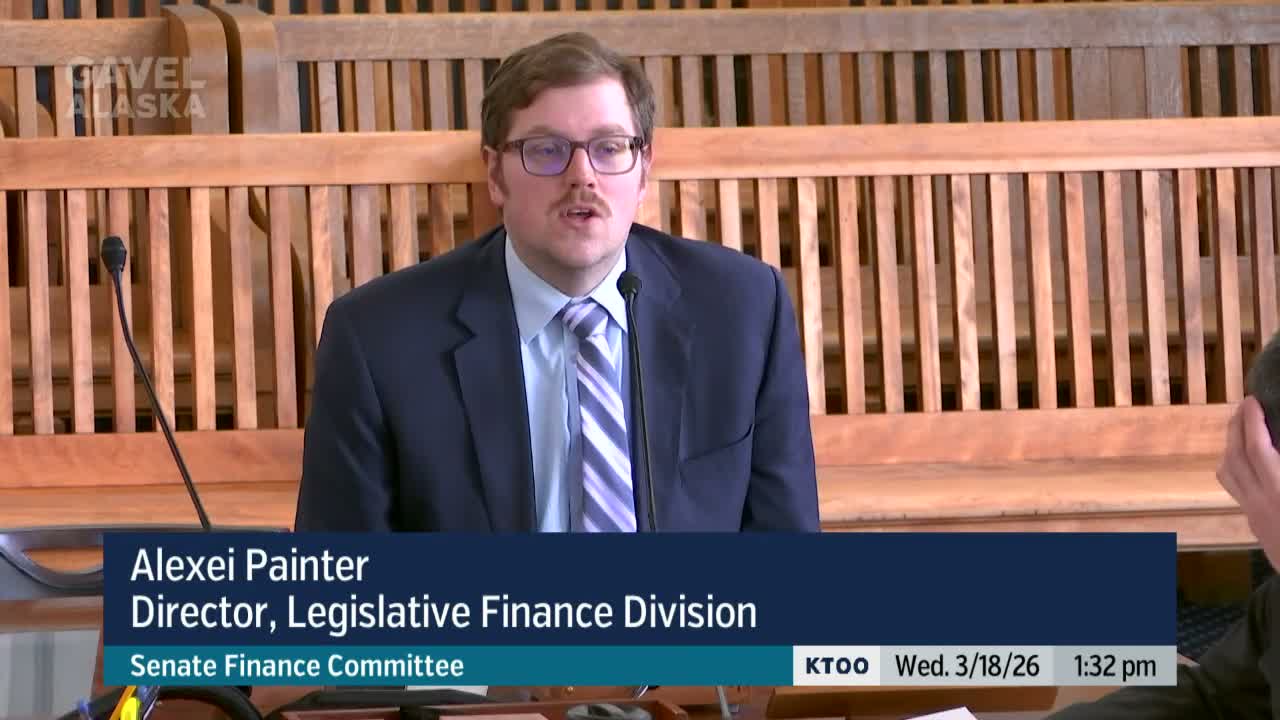
Anchorage — Legislative Finance staff told the Senate Finance Committee on March 18 that Alaska’s spring revenue forecast produces a sizable one‑time surplus in fiscal 2026 and a modest surplus in fiscal 2027 but that structural deficits are likely to return in fiscal 2028 and beyond under conservative assumptions.
"The projected revenue based on the spring forecast is about $6,500,000,000," said Lehi Painter, Director of the Legislative Finance Division, who led the fiscal summary. Painter said the FY26 management plan appropriations total just over $6.0 billion, leaving a projected surplus before supplementals of roughly $492.7 million, but he warned that a series of pending items could reduce that figure.
Painter listed specific downside risks: a pending SNAP penalty in appeal of about $4.6 million, a Department of Education finalization of K‑12 figures that could be $11–$16 million higher than the bill estimate, and a possible $71.9 million cost if a K‑12 disparity appeal fails. "There's a lot of ways that that [surplus] could quickly disappear," Painter said.
Connor Bell, fiscal analyst, walked the committee through longer‑term modeling of the statutory POMV (percent‑of‑market‑value) draw and the effect of SB 274, which phases a lower draw rate (4.9% down to 4.5% by FY33). Under the status‑quo 5% draw, the model shows deficits in FY28–FY34 that are largely bridged by reserve draws, with a peak modeled deficit near FY33. With SB 274’s lower phased draw, Bell said early deficits are larger but the earnings reserve account (ERA) balance is higher in many scenarios.
Bell also presented probabilistic models that vary oil prices, permanent fund returns and production. The sensitivity analysis produced a wide distribution of outcomes: "In FY29, we see about a roughly $500 million deficit to $500 million surplus," Bell said. In some cases the ERA is materially reduced; in about 10% of modeled runs the ERA balance falls to zero by FY32 under the status‑quo assumptions.
Committee members questioned assumptions that affect K‑12 funding, the governor’s dividend estimate and capital budgeting. Painter said the presentation used conservative assumptions requested by the committee, including a $400 million capital‑budget baseline and a $1,000 dividend mirroring last year’s plan. He noted that Medicaid costs were modeled to grow faster (about 4.8 percent) than most agency operations (2.5 percent).
Why it matters: The presentation framed SB 274 as a tradeoff between near‑term budget pressure and longer‑term ERA resilience. Lawmakers will weigh whether to change draw rules now to bolster the ERA or keep higher near‑term distributions. Bell cautioned that the crossover where a lower phased draw could yield more dollars occurs many decades out under their linear modeling.
What’s next: The committee received the briefing and discussed assumptions; no formal action was taken. The Senate Finance Committee will continue budget oversight at upcoming meetings and will consider these modeling assumptions as it reviews governor and legislative proposals.
"The projected revenue based on the spring forecast is about $6,500,000,000," said Lehi Painter, Director of the Legislative Finance Division, who led the fiscal summary. Painter said the FY26 management plan appropriations total just over $6.0 billion, leaving a projected surplus before supplementals of roughly $492.7 million, but he warned that a series of pending items could reduce that figure.
Painter listed specific downside risks: a pending SNAP penalty in appeal of about $4.6 million, a Department of Education finalization of K‑12 figures that could be $11–$16 million higher than the bill estimate, and a possible $71.9 million cost if a K‑12 disparity appeal fails. "There's a lot of ways that that [surplus] could quickly disappear," Painter said.
Connor Bell, fiscal analyst, walked the committee through longer‑term modeling of the statutory POMV (percent‑of‑market‑value) draw and the effect of SB 274, which phases a lower draw rate (4.9% down to 4.5% by FY33). Under the status‑quo 5% draw, the model shows deficits in FY28–FY34 that are largely bridged by reserve draws, with a peak modeled deficit near FY33. With SB 274’s lower phased draw, Bell said early deficits are larger but the earnings reserve account (ERA) balance is higher in many scenarios.
Bell also presented probabilistic models that vary oil prices, permanent fund returns and production. The sensitivity analysis produced a wide distribution of outcomes: "In FY29, we see about a roughly $500 million deficit to $500 million surplus," Bell said. In some cases the ERA is materially reduced; in about 10% of modeled runs the ERA balance falls to zero by FY32 under the status‑quo assumptions.
Committee members questioned assumptions that affect K‑12 funding, the governor’s dividend estimate and capital budgeting. Painter said the presentation used conservative assumptions requested by the committee, including a $400 million capital‑budget baseline and a $1,000 dividend mirroring last year’s plan. He noted that Medicaid costs were modeled to grow faster (about 4.8 percent) than most agency operations (2.5 percent).
Why it matters: The presentation framed SB 274 as a tradeoff between near‑term budget pressure and longer‑term ERA resilience. Lawmakers will weigh whether to change draw rules now to bolster the ERA or keep higher near‑term distributions. Bell cautioned that the crossover where a lower phased draw could yield more dollars occurs many decades out under their linear modeling.
What’s next: The committee received the briefing and discussed assumptions; no formal action was taken. The Senate Finance Committee will continue budget oversight at upcoming meetings and will consider these modeling assumptions as it reviews governor and legislative proposals.
Don't Miss a Word: See the Full Meeting!
Go beyond summaries. Unlock every video, transcript, and key insight with a Founder Membership.
✓
Get instant access to full meeting videos
✓
Search and clip any phrase from complete transcripts
✓
Receive AI-powered summaries & custom alerts
✓
Enjoy lifetime, unrestricted access to government data
30-day money-back guarantee
