Experts warn of environmental and cultural risks as BOEM considers seabed mineral areas off Alaska
March 18, 2026 | 2026 Legislature Alaska, Alaska
This article was created by AI summarizing key points discussed. AI makes mistakes, so for full details and context, please refer to the video of the full meeting. Please report any errors so we can fix them. Report an error »
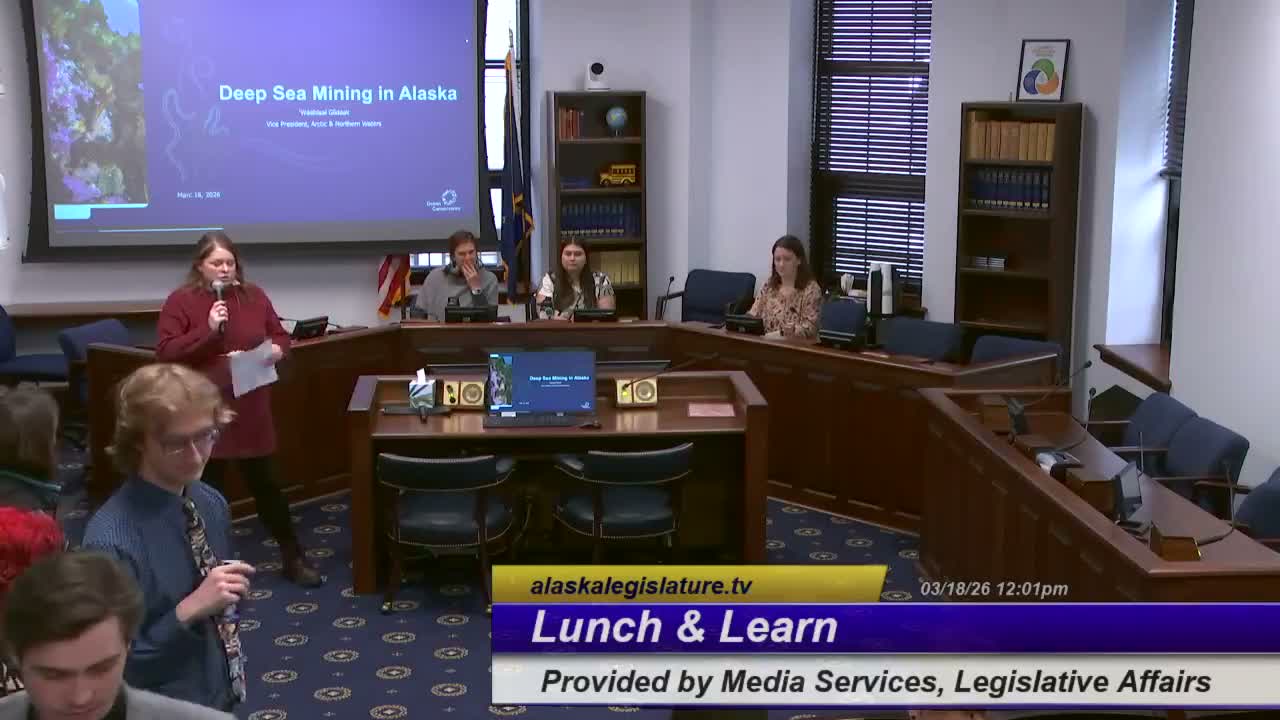
Anne Robertson, policy director for Aqua DC, and other presenters told a March briefing hosted for the House Resources office that the Bureau of Ocean Energy Management's recent request for information (RFI) over offshore Alaska could put important fisheries and Indigenous subsistence areas at risk.
"On January 29, the Bureau of Ocean Energy Management ... initiated a request for information for areas offshore of Alaska for potential seabed mineral development," Robertson said, describing RFI areas that include the Aleutians, Gulf of Alaska seamounts, parts of Norton Sound and Goodnews Bay, and the Chukchi Borderlands.
Why it matters: Those zones, presenters said, overlap with essential fish habitat closures and areas relied on for commercial, recreational and subsistence harvest. Bobbie Jo Dobish, an attorney who works on marine governance, cautioned that seabed mining is not a narrow operation. "This is really something that creates large-scale disturbances to seabed habitat," she said, warning of long-lasting harm to invertebrates, deep corals and food-web linkages that support fisheries and marine mammals.
Tribal concerns and procedural requests: Anna Velasquez, Alaska Sea Grant fellow for the Central Council of Tlingit and Haida Indian Tribes of Alaska, said her tribe's submitted comment letter calls for a precautionary approach that includes Indigenous knowledge, government-to-government consultation with BOEM and a comprehensive environmental impact statement (EIS) rather than a shorter environmental assessment (EA). "We have advocated for a comprehensive environmental review prior to any leasing decisions," Velasquez said, noting that about "80% of the request for information or interest area is currently closed" to some fishing methods.
Regulatory process and risk: Dobish outlined BOEM's RFI-to-area-identification pathway and said the agency has signaled a rapid timetable in other jurisdictions. She noted that BOEM sometimes conducts an EA (a shorter, desk-study assessment) and has not yet committed to requiring an EIS for testing or certain delineation activities. "There could be actual testing of those big mining equipment on your outer continental shelf without an EIS ever having been done," she said. Dobish also stressed that leases, if issued, typically run 20 to 30 years and are difficult to revoke.
Economic and technical uncertainty: Presenters said large-scale seabed extraction remains largely unproven and that processing infrastructure is limited. Dobish and Robertson said most processing to date has taken place in Japan and that major proponents discuss processing in Japan, Indonesia or China. Robertson summarized the near-term outlook: "At this time, it seems that the most likely scenario is that we would see minerals leave our seabed, be processed overseas due to logistical and economic constraints, and we would be left to kind of deal with the impacts."
Modeling and ecological unknowns: Dobish cited plume modeling presented to the briefing showing broad potential dispersal ranges for dewatering discharge (she summarized the modeling as "between 20 and 2,000 kilometers") and warned currents around the Aleutians and Bering Strait could carry sediment and contaminants into adjacent fisheries and subsistence areas. Velasquez emphasized that many biological effects are not yet quantified and could be intergenerational in scope.
Calls to action and next steps: Presenters urged Alaskans to submit comments to BOEM during the RFI period and requested that BOEM engage in government-to-government consultation with tribes. The presenters differed slightly on the RFI closing date as stated in the session: Anne Robertson said the public comment period was extended to April 2, while Anna Velasquez referred to April 1 as the closing day; organizers encouraged checking the federal register for the official deadline and for copies of submitted tribal letters.
The session closed after a brief question-and-answer period in which presenters reiterated that seabed mining technology and economics remain uncertain and that industry actors have asked federal policymakers for subsidies or support for processing infrastructure. Organizers said they would provide additional materials and urged continued engagement to build the federal record.
"On January 29, the Bureau of Ocean Energy Management ... initiated a request for information for areas offshore of Alaska for potential seabed mineral development," Robertson said, describing RFI areas that include the Aleutians, Gulf of Alaska seamounts, parts of Norton Sound and Goodnews Bay, and the Chukchi Borderlands.
Why it matters: Those zones, presenters said, overlap with essential fish habitat closures and areas relied on for commercial, recreational and subsistence harvest. Bobbie Jo Dobish, an attorney who works on marine governance, cautioned that seabed mining is not a narrow operation. "This is really something that creates large-scale disturbances to seabed habitat," she said, warning of long-lasting harm to invertebrates, deep corals and food-web linkages that support fisheries and marine mammals.
Tribal concerns and procedural requests: Anna Velasquez, Alaska Sea Grant fellow for the Central Council of Tlingit and Haida Indian Tribes of Alaska, said her tribe's submitted comment letter calls for a precautionary approach that includes Indigenous knowledge, government-to-government consultation with BOEM and a comprehensive environmental impact statement (EIS) rather than a shorter environmental assessment (EA). "We have advocated for a comprehensive environmental review prior to any leasing decisions," Velasquez said, noting that about "80% of the request for information or interest area is currently closed" to some fishing methods.
Regulatory process and risk: Dobish outlined BOEM's RFI-to-area-identification pathway and said the agency has signaled a rapid timetable in other jurisdictions. She noted that BOEM sometimes conducts an EA (a shorter, desk-study assessment) and has not yet committed to requiring an EIS for testing or certain delineation activities. "There could be actual testing of those big mining equipment on your outer continental shelf without an EIS ever having been done," she said. Dobish also stressed that leases, if issued, typically run 20 to 30 years and are difficult to revoke.
Economic and technical uncertainty: Presenters said large-scale seabed extraction remains largely unproven and that processing infrastructure is limited. Dobish and Robertson said most processing to date has taken place in Japan and that major proponents discuss processing in Japan, Indonesia or China. Robertson summarized the near-term outlook: "At this time, it seems that the most likely scenario is that we would see minerals leave our seabed, be processed overseas due to logistical and economic constraints, and we would be left to kind of deal with the impacts."
Modeling and ecological unknowns: Dobish cited plume modeling presented to the briefing showing broad potential dispersal ranges for dewatering discharge (she summarized the modeling as "between 20 and 2,000 kilometers") and warned currents around the Aleutians and Bering Strait could carry sediment and contaminants into adjacent fisheries and subsistence areas. Velasquez emphasized that many biological effects are not yet quantified and could be intergenerational in scope.
Calls to action and next steps: Presenters urged Alaskans to submit comments to BOEM during the RFI period and requested that BOEM engage in government-to-government consultation with tribes. The presenters differed slightly on the RFI closing date as stated in the session: Anne Robertson said the public comment period was extended to April 2, while Anna Velasquez referred to April 1 as the closing day; organizers encouraged checking the federal register for the official deadline and for copies of submitted tribal letters.
The session closed after a brief question-and-answer period in which presenters reiterated that seabed mining technology and economics remain uncertain and that industry actors have asked federal policymakers for subsidies or support for processing infrastructure. Organizers said they would provide additional materials and urged continued engagement to build the federal record.
View the Full Meeting & All Its Details
This article offers just a summary. Unlock complete video, transcripts, and insights as a Founder Member.
✓
Watch full, unedited meeting videos
✓
Search every word spoken in unlimited transcripts
✓
AI summaries & real-time alerts (all government levels)
✓
Permanent access to expanding government content
30-day money-back guarantee
