Interior Gas Utility details switch to North Slope LNG, 20-year contracts and expansion needs
March 18, 2026 | 2026 Legislature Alaska, Alaska
This article was created by AI summarizing key points discussed. AI makes mistakes, so for full details and context, please refer to the video of the full meeting. Please report any errors so we can fix them. Report an error »
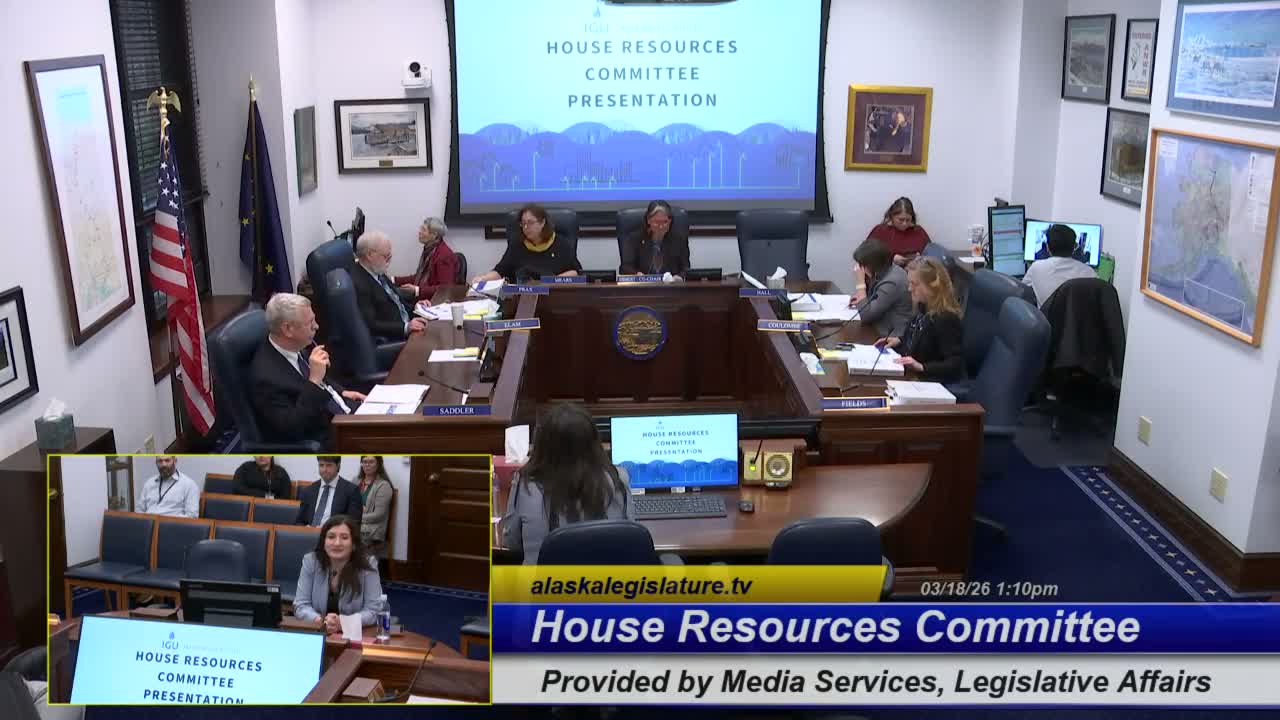
Interior Gas Utility told the Alaska House Resources Committee on March 18 that it has fully switched its supply to North Slope liquefied natural gas and signed two 20-year agreements for gas supply and liquefaction services.
"For the record, my name is Elena Sadat, and I, I reside in Fairbanks," Sadat said as she opened the presentation. Sadat, representing Interior Gas Utility, told lawmakers IGU moved from Cook Inlet supply to the North Slope with the first North Slope delivery in October and sustained deliveries beginning in December; she said IGU has received more than 5,000,000 gallons from the North Slope so far.
Why it matters: The shift changes IGU’s supply chain and logistics for the Fairbanks North Star Borough and affects storage, trucking, and rates. Sadat said the utility supports the Alaska LNG project but stressed Fairbanks will still require secure local supply and storage even if that larger project proceeds.
Key facts and figures
- Contracts: Sadat said IGU buys gas from Hillcorp North Slope LLC and receives liquefaction services from Harvest Midstream under separate 20-year agreements, with the contract term technically beginning July 1, 2026.
- Storage and capacity: IGU operates three LNG storage facilities (two in Fairbanks, one in North Pole) with roughly 5.5 million gallons of capacity, which Sadat described as more than 30 days of design storage for peak cold conditions.
- Customers and infrastructure: IGU serves a little over 3,600 customers across two independent distribution systems (Fairbanks and North Pole) with about 150 miles of mainline in Fairbanks and about 90 miles in North Pole. Connecting the two systems is a stated priority and the utility described the project as shovel-ready and seeking funding.
- Trucking and logistics: The utility reported an average of about six truck deliveries per day during the winter supply period, each carrying roughly 14,000 gallons of LNG. Sadat said the harvest facility will modulate production seasonally to match demand and storage constraints.
- Conversion costs and assistance: IGU said it does not collect comprehensive conversion-cost data but cited typical industry estimates: an average burner conversion costs about $7,500 with assistance of roughly $3,500; a full new boiler ranges $20,000–$30,000 with assistance near $9,100. Some assistance is administered from an EPA-targeted airshed grant routed through the Department of Environmental Conservation and the Fairbanks North Star Borough and carries a deed restriction on the property that limits future use of solid-fuel heating devices.
- Rates: Sadat said IGU’s current residential tariff in Fairbanks is a little under $25 per MCF, about twice the Southcentral rate but still cheaper on an equivalent-energy basis than delivered heating oil.
- Buildout costs and penetration: Sadat estimated roughly $350,000 per mile as a ballpark cost to extend mainline distribution and said gas penetration is about 35% of homes with access to IGU main lines in Fairbanks (about 15% in North Pole).
- Financing and regulation: Sadat told the committee IGU is not economically regulated by the RCA and described the utility’s accounting approach (no depreciation recovered in rates). She referenced a bond covenant requiring a 1.35 debt-coverage ratio, a $10,000,000 bond, and a $139,000,000 loan identified in testimony as from "ADA," plus a small commercial loan for the utility’s building. Sadat also said IGU’s mothballed Big Lake (Titan) liquefaction facility remains owned by IGU but is not operational and the purchase loan currently carries a long deferment followed by interest-only periods.
Committee exchanges and policy priorities
Committee members pressed IGU on pipeline age and condition, tariff design for a proposed AK LNG spur line, integration with DOT road projects, and replication of small liquefaction models for remote communities. Sadat described IGU pipe as relatively new and HDPE construction, called the system a "100-year asset," and said the utility aims to be included in DOT and municipal road projects to reduce incremental distribution costs.
Sadat said IGU supports construction of a spur line to connect to the Alaska LNG project and favors a tariff approach that would pool in-state demand so costs are not borne solely by Fairbanks/North Pole customers. She also listed IGU’s 2026 legislative priorities: support for the Alaska LNG spur, a tariff that spreads in-state charges uniformly, measures to lower household/business conversion costs, capital funding for mainline extensions, and additional Dalton Highway maintenance to support trucking logistics.
Quotes
"We are a municipally owned utility," Sadat said, explaining IGU is an instrumentality of the Fairbanks North Star Borough. "We have a service territory of the Greater Fairbanks area… We have about 3,600… customers currently."
On contracts: "We get our gas from Hillcorp North Slope LLC, and then we receive liquefaction services from Harvest Midstream… Both of those are our 20-year contracts."
On conversion costs: "For a burner change out … customers pay on average about $7,500 and the assistance … is about $3,500. For a new boiler is between $20 and $30,000 and the assistance … is about $9,100."
What the committee will watch next
No formal votes were taken. Committee members asked for more detailed engineering and cost estimates for full buildout per mile, and IGU offered to share engineering details with legislators' offices. The committee scheduled future meetings that include consideration of HJR 44 and a series of other hearings.
Ending
The committee did not take action on legislation at this meeting. Cochiar Representative Divert thanked Sadat for the presentation and adjourned the House Resources Committee at 2:02 p.m.
"For the record, my name is Elena Sadat, and I, I reside in Fairbanks," Sadat said as she opened the presentation. Sadat, representing Interior Gas Utility, told lawmakers IGU moved from Cook Inlet supply to the North Slope with the first North Slope delivery in October and sustained deliveries beginning in December; she said IGU has received more than 5,000,000 gallons from the North Slope so far.
Why it matters: The shift changes IGU’s supply chain and logistics for the Fairbanks North Star Borough and affects storage, trucking, and rates. Sadat said the utility supports the Alaska LNG project but stressed Fairbanks will still require secure local supply and storage even if that larger project proceeds.
Key facts and figures
- Contracts: Sadat said IGU buys gas from Hillcorp North Slope LLC and receives liquefaction services from Harvest Midstream under separate 20-year agreements, with the contract term technically beginning July 1, 2026.
- Storage and capacity: IGU operates three LNG storage facilities (two in Fairbanks, one in North Pole) with roughly 5.5 million gallons of capacity, which Sadat described as more than 30 days of design storage for peak cold conditions.
- Customers and infrastructure: IGU serves a little over 3,600 customers across two independent distribution systems (Fairbanks and North Pole) with about 150 miles of mainline in Fairbanks and about 90 miles in North Pole. Connecting the two systems is a stated priority and the utility described the project as shovel-ready and seeking funding.
- Trucking and logistics: The utility reported an average of about six truck deliveries per day during the winter supply period, each carrying roughly 14,000 gallons of LNG. Sadat said the harvest facility will modulate production seasonally to match demand and storage constraints.
- Conversion costs and assistance: IGU said it does not collect comprehensive conversion-cost data but cited typical industry estimates: an average burner conversion costs about $7,500 with assistance of roughly $3,500; a full new boiler ranges $20,000–$30,000 with assistance near $9,100. Some assistance is administered from an EPA-targeted airshed grant routed through the Department of Environmental Conservation and the Fairbanks North Star Borough and carries a deed restriction on the property that limits future use of solid-fuel heating devices.
- Rates: Sadat said IGU’s current residential tariff in Fairbanks is a little under $25 per MCF, about twice the Southcentral rate but still cheaper on an equivalent-energy basis than delivered heating oil.
- Buildout costs and penetration: Sadat estimated roughly $350,000 per mile as a ballpark cost to extend mainline distribution and said gas penetration is about 35% of homes with access to IGU main lines in Fairbanks (about 15% in North Pole).
- Financing and regulation: Sadat told the committee IGU is not economically regulated by the RCA and described the utility’s accounting approach (no depreciation recovered in rates). She referenced a bond covenant requiring a 1.35 debt-coverage ratio, a $10,000,000 bond, and a $139,000,000 loan identified in testimony as from "ADA," plus a small commercial loan for the utility’s building. Sadat also said IGU’s mothballed Big Lake (Titan) liquefaction facility remains owned by IGU but is not operational and the purchase loan currently carries a long deferment followed by interest-only periods.
Committee exchanges and policy priorities
Committee members pressed IGU on pipeline age and condition, tariff design for a proposed AK LNG spur line, integration with DOT road projects, and replication of small liquefaction models for remote communities. Sadat described IGU pipe as relatively new and HDPE construction, called the system a "100-year asset," and said the utility aims to be included in DOT and municipal road projects to reduce incremental distribution costs.
Sadat said IGU supports construction of a spur line to connect to the Alaska LNG project and favors a tariff approach that would pool in-state demand so costs are not borne solely by Fairbanks/North Pole customers. She also listed IGU’s 2026 legislative priorities: support for the Alaska LNG spur, a tariff that spreads in-state charges uniformly, measures to lower household/business conversion costs, capital funding for mainline extensions, and additional Dalton Highway maintenance to support trucking logistics.
Quotes
"We are a municipally owned utility," Sadat said, explaining IGU is an instrumentality of the Fairbanks North Star Borough. "We have a service territory of the Greater Fairbanks area… We have about 3,600… customers currently."
On contracts: "We get our gas from Hillcorp North Slope LLC, and then we receive liquefaction services from Harvest Midstream… Both of those are our 20-year contracts."
On conversion costs: "For a burner change out … customers pay on average about $7,500 and the assistance … is about $3,500. For a new boiler is between $20 and $30,000 and the assistance … is about $9,100."
What the committee will watch next
No formal votes were taken. Committee members asked for more detailed engineering and cost estimates for full buildout per mile, and IGU offered to share engineering details with legislators' offices. The committee scheduled future meetings that include consideration of HJR 44 and a series of other hearings.
Ending
The committee did not take action on legislation at this meeting. Cochiar Representative Divert thanked Sadat for the presentation and adjourned the House Resources Committee at 2:02 p.m.
Don't Miss a Word: See the Full Meeting!
Go beyond summaries. Unlock every video, transcript, and key insight with a Founder Membership.
✓
Get instant access to full meeting videos
✓
Search and clip any phrase from complete transcripts
✓
Receive AI-powered summaries & custom alerts
✓
Enjoy lifetime, unrestricted access to government data
30-day money-back guarantee
