Senate Finance hearing flags serious shortfalls and parity concerns in school construction and maintenance funds
March 18, 2026 | 2026 Legislature Alaska, Alaska
This article was created by AI summarizing key points discussed. AI makes mistakes, so for full details and context, please refer to the video of the full meeting. Please report any errors so we can fix them. Report an error »
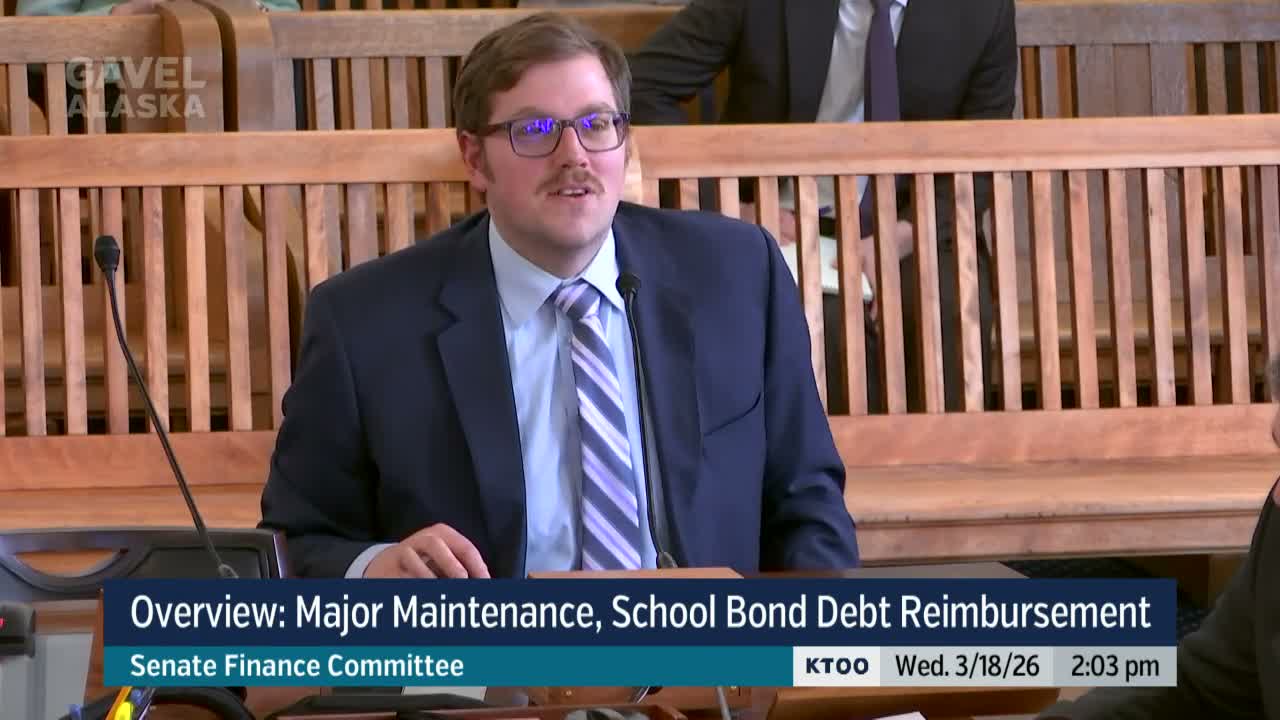
Anchorage — Legislative Finance told the Senate Finance Committee on March 18 that Alaska’s current mix of school construction and major maintenance funding is unlikely to keep pace with need and that program design can create parity problems for regional education attendance areas (REAAs).
Lehi Painter, director of Legislative Finance, outlined two distinct funding pathways: school bond debt reimbursement (a reimbursement model with a state share of roughly 40–50 percent depending on statutory standards) and school construction/major maintenance grant funds (upfront state cost shares that range from about 65–98 percent for REAAs and small municipal districts). "For the school construction grant fund, there’s 14 projects totaling $442,000,000 and for the major maintenance grant fund 103 projects costing $400,000,000," Painter said.
Painter warned that the REAA fund’s mechanics constrain how quickly large REAA projects can be funded. He cited a top REAA project of about $71.3 million that would require roughly five years to accumulate funding under current inflows and statutory constraints, and noted a statutory cap that limits unobligated REAA funds to $70 million at any time. "There's probably just not enough money going in the system right now to ever get through that list," Painter told senators.
The committee discussed parity concerns: scoring across the major maintenance list produces similar aggregate scores for higher‑ and lower‑cost‑share districts, but those results mask differences in how points are earned. Municipal districts that can bond independently tend to score higher in planning and cost‑estimate quality because they are further along in project development; REAAs more often score higher on emergency and life‑safety categories. Painter said when the Department of Education applies REAA funds to major maintenance and UGF is directed to municipal districts, the practical effect can deepen disparities.
Committee members pressed for more transparency on the age of projects on the lists and asked the Commissioner of Education to provide recommendations to adjust the process; senators raised health and safety examples (mold, leaking roofs) as reasons the committee should consider targeted deviations from the list.
Why it matters: The structure of state school funding affects whether urgent health and safety projects are addressed and how costs are distributed between state and local taxpayers. Several senators warned that unreliable funding and program mechanics could push deteriorating schools from maintenance tracks onto costlier construction lists.
What’s next: Committee members requested additional detail from the Department of Education on project ages and encouraged the commissioner to propose changes to improve parity and transparency; no formal action was taken at the hearing.
Lehi Painter, director of Legislative Finance, outlined two distinct funding pathways: school bond debt reimbursement (a reimbursement model with a state share of roughly 40–50 percent depending on statutory standards) and school construction/major maintenance grant funds (upfront state cost shares that range from about 65–98 percent for REAAs and small municipal districts). "For the school construction grant fund, there’s 14 projects totaling $442,000,000 and for the major maintenance grant fund 103 projects costing $400,000,000," Painter said.
Painter warned that the REAA fund’s mechanics constrain how quickly large REAA projects can be funded. He cited a top REAA project of about $71.3 million that would require roughly five years to accumulate funding under current inflows and statutory constraints, and noted a statutory cap that limits unobligated REAA funds to $70 million at any time. "There's probably just not enough money going in the system right now to ever get through that list," Painter told senators.
The committee discussed parity concerns: scoring across the major maintenance list produces similar aggregate scores for higher‑ and lower‑cost‑share districts, but those results mask differences in how points are earned. Municipal districts that can bond independently tend to score higher in planning and cost‑estimate quality because they are further along in project development; REAAs more often score higher on emergency and life‑safety categories. Painter said when the Department of Education applies REAA funds to major maintenance and UGF is directed to municipal districts, the practical effect can deepen disparities.
Committee members pressed for more transparency on the age of projects on the lists and asked the Commissioner of Education to provide recommendations to adjust the process; senators raised health and safety examples (mold, leaking roofs) as reasons the committee should consider targeted deviations from the list.
Why it matters: The structure of state school funding affects whether urgent health and safety projects are addressed and how costs are distributed between state and local taxpayers. Several senators warned that unreliable funding and program mechanics could push deteriorating schools from maintenance tracks onto costlier construction lists.
What’s next: Committee members requested additional detail from the Department of Education on project ages and encouraged the commissioner to propose changes to improve parity and transparency; no formal action was taken at the hearing.
View the Full Meeting & All Its Details
This article offers just a summary. Unlock complete video, transcripts, and insights as a Founder Member.
✓
Watch full, unedited meeting videos
✓
Search every word spoken in unlimited transcripts
✓
AI summaries & real-time alerts (all government levels)
✓
Permanent access to expanding government content
30-day money-back guarantee
