Labor officials defend 406 Jobs plan and say unemployment trust fund is healthy
March 18, 2026 | 2026 Legislature MT, Montana
This article was created by AI summarizing key points discussed. AI makes mistakes, so for full details and context, please refer to the video of the full meeting. Please report any errors so we can fix them. Report an error »
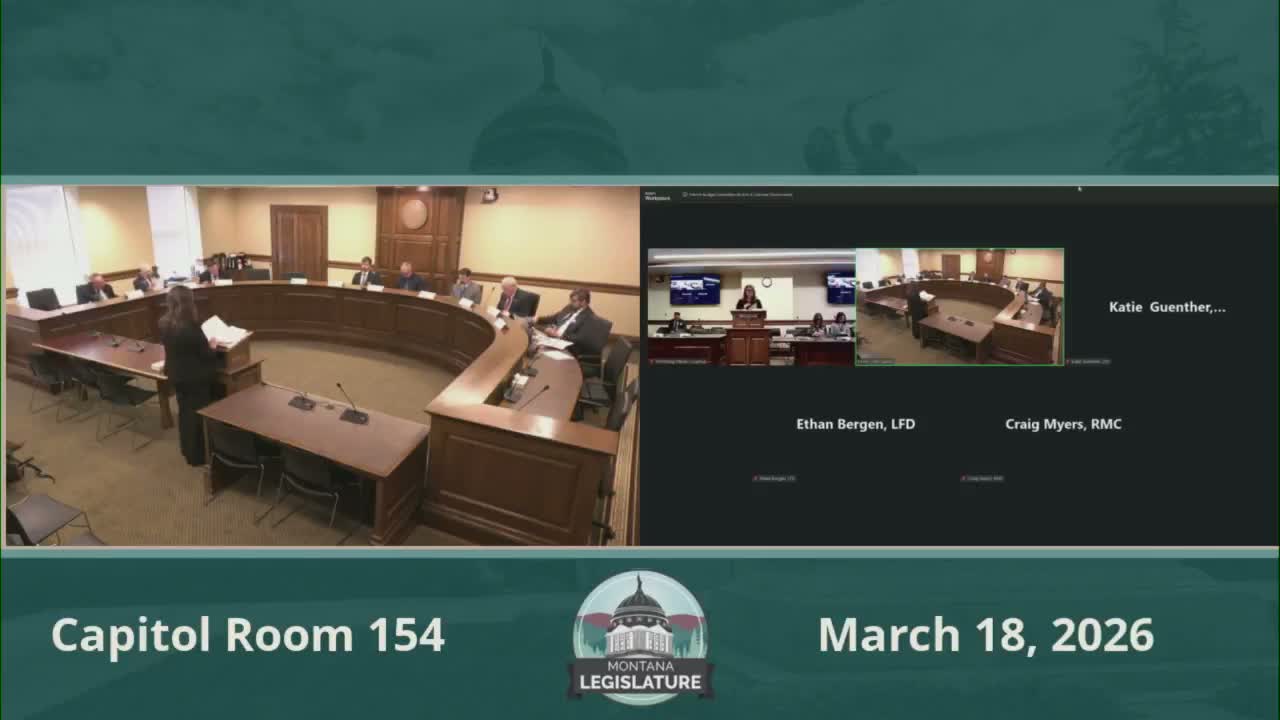
Department of Labor & Industry officials gave a detailed quarterly financial and program update focused on workforce initiatives, program outcomes and budget authority.
The department described the 406 Jobs executive-order strategy as a cross-agency effort to fill critical vacancies and tie education to careers; early actions include a registered apprenticeship for teachers, five new registered pathways and a plan to deliver a Year 1 report to the governor and the legislature in November 2026. The department also highlighted House Bill 718 work to stand up an office of reentry and described efforts to embed job-service staff in pre-release centers.
On financing and operations, committee staff reported the department's non-budgeted proprietary authority (including the unemployment-insurance trust) totals in the low hundreds of millions; in committee testimony the labor commissioner said the unemployment trust fund held "over $677,000,000" as of mid-March and that recent tax-rate reductions saved Montana employers about $32 million in the first year. Commissioner also said actuarial work underpinned rate decisions and the department plans another actuarial review in two years.
Officials outlined job service operations (18 offices, ~128 FTE) and program outcomes: roughly 9,000–10,000 workers served annually by Wagner-Peyser services, 400–450 adults in WIOA adult programs, and high placement rates for dislocated workers (84% employed on program exit). The department noted constrained WIOA funding (~$6M annually), which limits capacity for more-intensive training slots that cost roughly $5,000–$8,000 per participant.
Lawmakers asked about vacancy savings and HB13 contingency language. Budget staff (Amy Susano) explained typical vacancy-savings assumptions (4%–5%), how agencies can apply for contingency funds when vacancies do not materialize, and typical uses (retirement/leave payouts). DLI said it holds some positions for vacancy savings and that, across the agency, about 52 positions were actively being refilled while 10 were held for vacancy savings at the time of testimony.
Committee members also asked about occupational-licensing reform. DLI said a licensing-task force (created by executive order) is meeting statewide with subcommittees and public meetings; a report is due Sept. 2. The department said it is coordinating with DPHHS to deploy a large rural health-transformation federal grant (an anticipated ~$20M/year flow to DLI under an MOU for subinitiative 1), and that an AmeriCorps-related budget shift will support service contracts across agencies.
On AI and operations, the commissioner said the department is assessing AI's impact, building internal fluency, and ensuring human oversight and data protections before deploying generative tools internally.
No formal committee action was taken; members asked for follow-up materials including recruitment-and-retention fund applicants and vacancy detail.
The department described the 406 Jobs executive-order strategy as a cross-agency effort to fill critical vacancies and tie education to careers; early actions include a registered apprenticeship for teachers, five new registered pathways and a plan to deliver a Year 1 report to the governor and the legislature in November 2026. The department also highlighted House Bill 718 work to stand up an office of reentry and described efforts to embed job-service staff in pre-release centers.
On financing and operations, committee staff reported the department's non-budgeted proprietary authority (including the unemployment-insurance trust) totals in the low hundreds of millions; in committee testimony the labor commissioner said the unemployment trust fund held "over $677,000,000" as of mid-March and that recent tax-rate reductions saved Montana employers about $32 million in the first year. Commissioner also said actuarial work underpinned rate decisions and the department plans another actuarial review in two years.
Officials outlined job service operations (18 offices, ~128 FTE) and program outcomes: roughly 9,000–10,000 workers served annually by Wagner-Peyser services, 400–450 adults in WIOA adult programs, and high placement rates for dislocated workers (84% employed on program exit). The department noted constrained WIOA funding (~$6M annually), which limits capacity for more-intensive training slots that cost roughly $5,000–$8,000 per participant.
Lawmakers asked about vacancy savings and HB13 contingency language. Budget staff (Amy Susano) explained typical vacancy-savings assumptions (4%–5%), how agencies can apply for contingency funds when vacancies do not materialize, and typical uses (retirement/leave payouts). DLI said it holds some positions for vacancy savings and that, across the agency, about 52 positions were actively being refilled while 10 were held for vacancy savings at the time of testimony.
Committee members also asked about occupational-licensing reform. DLI said a licensing-task force (created by executive order) is meeting statewide with subcommittees and public meetings; a report is due Sept. 2. The department said it is coordinating with DPHHS to deploy a large rural health-transformation federal grant (an anticipated ~$20M/year flow to DLI under an MOU for subinitiative 1), and that an AmeriCorps-related budget shift will support service contracts across agencies.
On AI and operations, the commissioner said the department is assessing AI's impact, building internal fluency, and ensuring human oversight and data protections before deploying generative tools internally.
No formal committee action was taken; members asked for follow-up materials including recruitment-and-retention fund applicants and vacancy detail.
Don't Miss a Word: See the Full Meeting!
Go beyond summaries. Unlock every video, transcript, and key insight with a Founder Membership.
✓
Get instant access to full meeting videos
✓
Search and clip any phrase from complete transcripts
✓
Receive AI-powered summaries & custom alerts
✓
Enjoy lifetime, unrestricted access to government data
30-day money-back guarantee
