Senate committee hears detailed presentation on SB 275 to expand AGDC oversight, require disclosures and impose new gas-related taxes
March 13, 2026 | 2026 Legislature Alaska, Alaska
This article was created by AI summarizing key points discussed. AI makes mistakes, so for full details and context, please refer to the video of the full meeting. Please report any errors so we can fix them. Report an error »
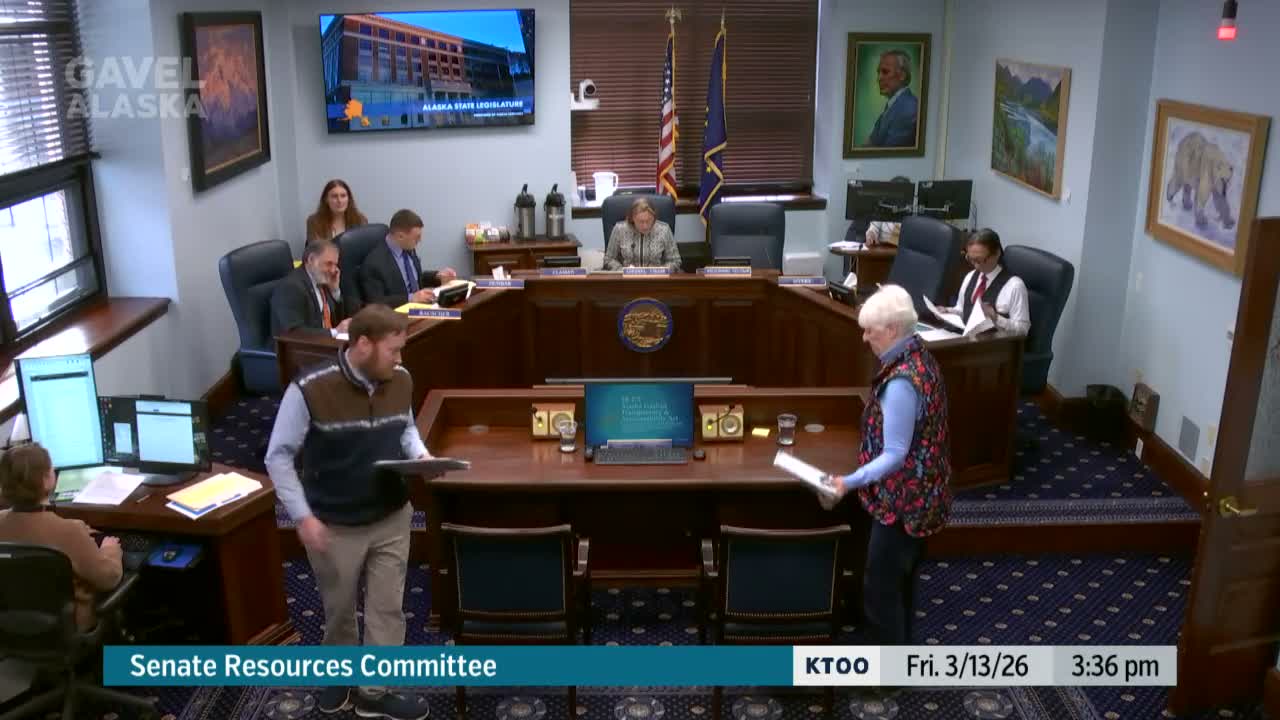
The Senate Resources Committee heard an initial presentation and extensive questioning on Senate Bill 275, the Alaska Gas Line Transparency and Accountability Act, on March 13. Ben Goltz, intern to Chair Giesel, summarized the bill’s goals: increase legislative oversight of the Alaska Gas Line Development Corporation (AGDC), improve access to confidential information, preserve the state’s option to take an equity stake in gas projects, and introduce revenue measures to protect state fiscal interest.
Senate Majority Legal Counsel Sonia Kawasaki delivered a sectional overview and walked the committee through governance, disclosure and fiscal provisions. Key provisions Kawasaki described include annual operational and performance audits of AGDC; explicit authority for individual legislators and staff to sign nondisclosure agreements (NDAs) and to receive redacted or waived documents for legislative review; a public online database of owners/investors/lenders and gas purchasers when involvement meets or exceeds $2,000,000; a requirement that AGDC notify the legislature when a partnering entity with at least a 10% share experiences a significant ownership change; and a prohibition on AGDC forming legal relationships with foreign entities without legislative authorization.
The bill also addresses fiscal protections. Kawasaki said SB275 would (1) eliminate the ability to deduct gas lease expenditures against oil production taxes (a form of "decoupling" intended to protect state tax revenue), (2) prevent producers from unilaterally electing to pay production tax in kind when doing so would harm state revenue — instead the Department of Revenue commissioner would make a written determination presented to the legislature — (3) require DOR and DNR to establish and publish a reasonably prevailing value for production and royalties so low negotiated wellhead prices cannot be used to suppress the tax base, (4) impose a 9.4% tax on S corporations and LLCs’ income over $5,000,000 for businesses engaged in natural gas pipeline activities, and (5) levy a $0.15 per thousand cubic feet surcharge on LNG processing (excluding small plants ~50 million cubic feet capacity). Kawasaki also proposed that AGDC-negotiated revenue be separately accounted for in a separate fund.
Committee members pressed for specifics. Senator Dunbar and others asked whether AGDC’s oversight role would continue after construction if Alaska declined to purchase full equity; AGDC’s Matt Kissinger (calling in from Anchorage) explained AGDC holds a 25% stake in the parent vehicle (8 Star Alaska LLC) and that direct governance over each subproject (pipeline, carbon capture, Nikiski LNG) depends on AGDC retaining equity in each subproject. Kissinger said "Our 25% share of 8 Star Alaska LLC is not dilutable," but clarified that the state’s direct equity in each subproject could depend on participation in subsequent capital raises; he described project financing assumptions (high debt share) and framed the AGDC participation as a 5%–25% participation range applied at capital-raise events.
Senator Dunbar and others raised the scale of required investment: a 5% floor on AGDC participation (applied to the equity portion) could still require billions of dollars in some hypothetical capital structures. Senators pressed on whether private Alaskans could invest and whether pooled Alaskan investment would provide legislative oversight; Kissinger described an AGDC vehicle intended to aggregate Alaskan participation and said aggregate participation would be used to reach the minimum participation threshold.
Constitutional and procedural issues also surfaced. Senator Myers noted an attorney general opinion raising separation-of-powers concerns about authorizing the legislature to approve contracts; Kawasaki and witnesses cited existing statutory precedents in Alaska law where legislative approval of certain contracts or dispositions is required and argued the legislature routinely enacts statutes that enable such approvals. Kawasaki referenced statutory examples discussed in committee testimony and noted the drafting team’s view that the proposed approval mechanisms were not unprecedented.
On valuation and revenue, Kawasaki said the Department of Revenue would be asked to publish a written rationale for a prevailing value and to ensure production tax is assessed even if an individually negotiated price appears to be low. Kawasaki warned the committee that the Permanent Fund could lose growth if royalties are undersold and said the fiscal provisions would require financial modeling.
Committee members also questioned nondisclosure enforcement (what penalties apply if a legislator violates an NDA) and the practicality of timeframes in the bill (for example, the 180-day window to exercise an option to acquire project interest). Chair Giesel and others noted the 180-day period may need adjustment because it presents timing and sessional logistics challenges.
No committee vote was taken on SB275; Chair Giesel set the bill aside for further work and indicated the committee will continue consideration at the next meeting. The committee thanked Department of Revenue and AGDC participants and adjourned at 5:07 p.m.
Why it matters: The bill addresses governance, transparency and fiscal protections for a proposed gas line project that could involve very large capital flows and long-term revenue implications for Alaska, including potential effects on royalties and the Permanent Fund.
Next steps: SB275 will return to the committee for further testimony and modeling; a presentation by Gaffney Klein is scheduled for the following Wednesday.
Senate Majority Legal Counsel Sonia Kawasaki delivered a sectional overview and walked the committee through governance, disclosure and fiscal provisions. Key provisions Kawasaki described include annual operational and performance audits of AGDC; explicit authority for individual legislators and staff to sign nondisclosure agreements (NDAs) and to receive redacted or waived documents for legislative review; a public online database of owners/investors/lenders and gas purchasers when involvement meets or exceeds $2,000,000; a requirement that AGDC notify the legislature when a partnering entity with at least a 10% share experiences a significant ownership change; and a prohibition on AGDC forming legal relationships with foreign entities without legislative authorization.
The bill also addresses fiscal protections. Kawasaki said SB275 would (1) eliminate the ability to deduct gas lease expenditures against oil production taxes (a form of "decoupling" intended to protect state tax revenue), (2) prevent producers from unilaterally electing to pay production tax in kind when doing so would harm state revenue — instead the Department of Revenue commissioner would make a written determination presented to the legislature — (3) require DOR and DNR to establish and publish a reasonably prevailing value for production and royalties so low negotiated wellhead prices cannot be used to suppress the tax base, (4) impose a 9.4% tax on S corporations and LLCs’ income over $5,000,000 for businesses engaged in natural gas pipeline activities, and (5) levy a $0.15 per thousand cubic feet surcharge on LNG processing (excluding small plants ~50 million cubic feet capacity). Kawasaki also proposed that AGDC-negotiated revenue be separately accounted for in a separate fund.
Committee members pressed for specifics. Senator Dunbar and others asked whether AGDC’s oversight role would continue after construction if Alaska declined to purchase full equity; AGDC’s Matt Kissinger (calling in from Anchorage) explained AGDC holds a 25% stake in the parent vehicle (8 Star Alaska LLC) and that direct governance over each subproject (pipeline, carbon capture, Nikiski LNG) depends on AGDC retaining equity in each subproject. Kissinger said "Our 25% share of 8 Star Alaska LLC is not dilutable," but clarified that the state’s direct equity in each subproject could depend on participation in subsequent capital raises; he described project financing assumptions (high debt share) and framed the AGDC participation as a 5%–25% participation range applied at capital-raise events.
Senator Dunbar and others raised the scale of required investment: a 5% floor on AGDC participation (applied to the equity portion) could still require billions of dollars in some hypothetical capital structures. Senators pressed on whether private Alaskans could invest and whether pooled Alaskan investment would provide legislative oversight; Kissinger described an AGDC vehicle intended to aggregate Alaskan participation and said aggregate participation would be used to reach the minimum participation threshold.
Constitutional and procedural issues also surfaced. Senator Myers noted an attorney general opinion raising separation-of-powers concerns about authorizing the legislature to approve contracts; Kawasaki and witnesses cited existing statutory precedents in Alaska law where legislative approval of certain contracts or dispositions is required and argued the legislature routinely enacts statutes that enable such approvals. Kawasaki referenced statutory examples discussed in committee testimony and noted the drafting team’s view that the proposed approval mechanisms were not unprecedented.
On valuation and revenue, Kawasaki said the Department of Revenue would be asked to publish a written rationale for a prevailing value and to ensure production tax is assessed even if an individually negotiated price appears to be low. Kawasaki warned the committee that the Permanent Fund could lose growth if royalties are undersold and said the fiscal provisions would require financial modeling.
Committee members also questioned nondisclosure enforcement (what penalties apply if a legislator violates an NDA) and the practicality of timeframes in the bill (for example, the 180-day window to exercise an option to acquire project interest). Chair Giesel and others noted the 180-day period may need adjustment because it presents timing and sessional logistics challenges.
No committee vote was taken on SB275; Chair Giesel set the bill aside for further work and indicated the committee will continue consideration at the next meeting. The committee thanked Department of Revenue and AGDC participants and adjourned at 5:07 p.m.
Why it matters: The bill addresses governance, transparency and fiscal protections for a proposed gas line project that could involve very large capital flows and long-term revenue implications for Alaska, including potential effects on royalties and the Permanent Fund.
Next steps: SB275 will return to the committee for further testimony and modeling; a presentation by Gaffney Klein is scheduled for the following Wednesday.
Don't Miss a Word: See the Full Meeting!
Go beyond summaries. Unlock every video, transcript, and key insight with a Founder Membership.
✓
Get instant access to full meeting videos
✓
Search and clip any phrase from complete transcripts
✓
Receive AI-powered summaries & custom alerts
✓
Enjoy lifetime, unrestricted access to government data
30-day money-back guarantee
