Committee begins consideration of SB 64; sponsors and Division of Elections debate ballot-tracking, cure rules and rural liaison
March 16, 2026 | 2026 Legislature Alaska, Alaska
This article was created by AI summarizing key points discussed. AI makes mistakes, so for full details and context, please refer to the video of the full meeting. Please report any errors so we can fix them. Report an error »
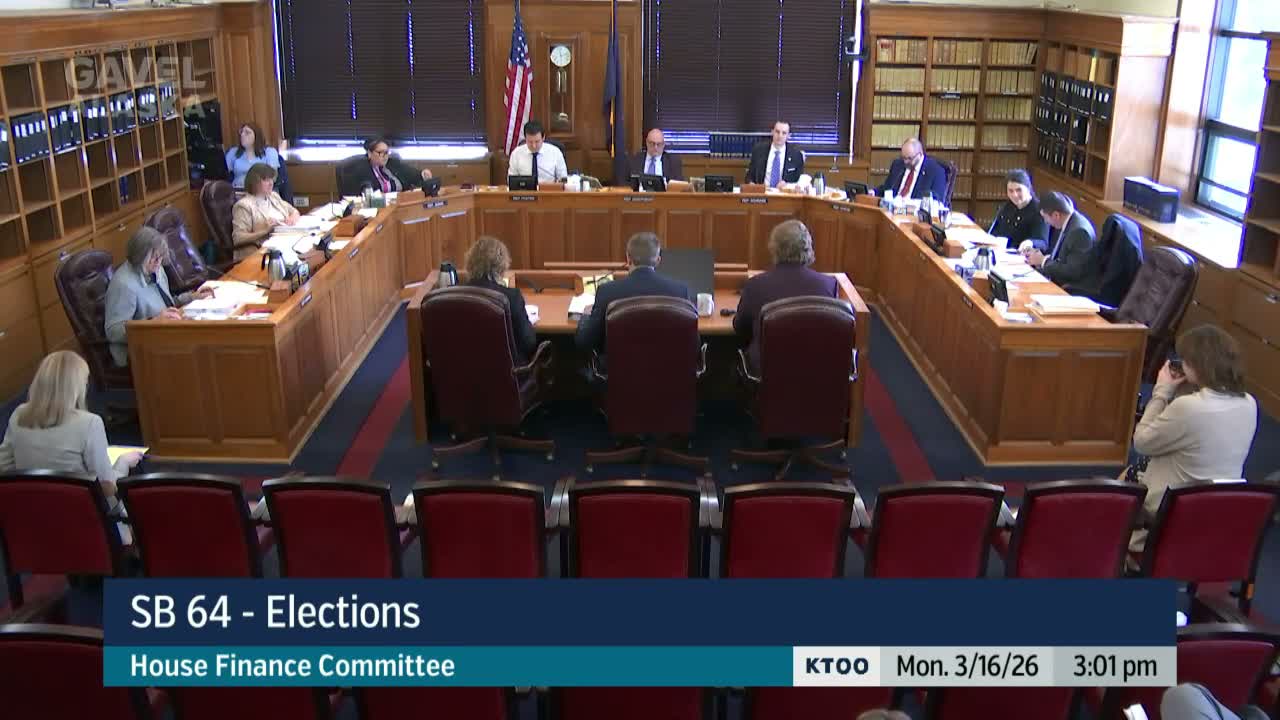
The House Finance Committee on March 16 began consideration of SB 64, an elections bill that would add ballot-tracking, a rural community liaison and new ballot-cure procedures aimed at reducing absentee-ballot disenfranchisement.
David Dunsmore, staff to Senator Wolikowski (the bill sponsor), summarized sectional changes and said the most substantial changes in the current draft occur in mid- and late-numbered sections; the bill removes an earlier section 30, adds transitional provisions permitting the Division of Elections to begin procurement and adopt regulations before some provisionseffective dates, and staggers effective dates (some immediate, others 01/01/2027).
Carol Beecher, director of the Division of Elections, told the committee the division can implement many elements but flagged ballot-tracking and the cure provisions (CURE) as the most difficult to implement quickly without added resources. Beecher said the division already offers a MyVoter portal where voters can see when a ballot was sent and when the division received it; the new bill would add more user-facing tracking, multifactor-style confirmations and a cure workflow that, in some cases, allows voters to submit identifying information electronically to "cure" a ballot.
Sponsor Wolikowski and his staff framed the bill as a bipartisan compromise that improves access for rural and military voters and bolsters integrity by pairing tracking with cure procedures. Key sponsor provisions described on the record include: a rural community liaison to work with tribes and municipalities on absentee/early voting and staffing; ballot-tracking and multifactor authentication so voters can confirm whether a ballot was requested, mailed and received; and a ballot-cure sequence requiring the division to attempt to contact the voter (phone/text/email) within 24 hours of a rejection and to send a mailed notice within 48 hours (but not later than five days).
Committee members raised repeated concerns about rural equity: Beecher explained that Alaskas mail routing (Anchorage as a hub) and long transit times make a 10-day cure window challenging for many remote voters. Members asked whether the liaison and electronic cure options would be sufficient; the sponsor pointed to expanded pre-processing (beginning 12 days before the election), abbreviated lists of ballots that typically need curing (sponsor estimated ~500to 1,000 ballots per election), the option for voters to request ballots 45 days in advance and postage-paid envelopes as mitigations.
Members also asked whether division employees could be covered by new criminal definitions in section 27; Beecher said employees must follow the law and would be subject to it but deferred questions about criminal enforcement to legal counsel.
The committee set an amendment deadline for SB 64 on Thursday, March 19 at noon and set the bill aside for additional work; it did not take a final vote. The committee will reconvene March 17 and later consider operating-budget amendments and HB 52.
David Dunsmore, staff to Senator Wolikowski (the bill sponsor), summarized sectional changes and said the most substantial changes in the current draft occur in mid- and late-numbered sections; the bill removes an earlier section 30, adds transitional provisions permitting the Division of Elections to begin procurement and adopt regulations before some provisionseffective dates, and staggers effective dates (some immediate, others 01/01/2027).
Carol Beecher, director of the Division of Elections, told the committee the division can implement many elements but flagged ballot-tracking and the cure provisions (CURE) as the most difficult to implement quickly without added resources. Beecher said the division already offers a MyVoter portal where voters can see when a ballot was sent and when the division received it; the new bill would add more user-facing tracking, multifactor-style confirmations and a cure workflow that, in some cases, allows voters to submit identifying information electronically to "cure" a ballot.
Sponsor Wolikowski and his staff framed the bill as a bipartisan compromise that improves access for rural and military voters and bolsters integrity by pairing tracking with cure procedures. Key sponsor provisions described on the record include: a rural community liaison to work with tribes and municipalities on absentee/early voting and staffing; ballot-tracking and multifactor authentication so voters can confirm whether a ballot was requested, mailed and received; and a ballot-cure sequence requiring the division to attempt to contact the voter (phone/text/email) within 24 hours of a rejection and to send a mailed notice within 48 hours (but not later than five days).
Committee members raised repeated concerns about rural equity: Beecher explained that Alaskas mail routing (Anchorage as a hub) and long transit times make a 10-day cure window challenging for many remote voters. Members asked whether the liaison and electronic cure options would be sufficient; the sponsor pointed to expanded pre-processing (beginning 12 days before the election), abbreviated lists of ballots that typically need curing (sponsor estimated ~500to 1,000 ballots per election), the option for voters to request ballots 45 days in advance and postage-paid envelopes as mitigations.
Members also asked whether division employees could be covered by new criminal definitions in section 27; Beecher said employees must follow the law and would be subject to it but deferred questions about criminal enforcement to legal counsel.
The committee set an amendment deadline for SB 64 on Thursday, March 19 at noon and set the bill aside for additional work; it did not take a final vote. The committee will reconvene March 17 and later consider operating-budget amendments and HB 52.
Don't Miss a Word: See the Full Meeting!
Go beyond summaries. Unlock every video, transcript, and key insight with a Founder Membership.
✓
Get instant access to full meeting videos
✓
Search and clip any phrase from complete transcripts
✓
Receive AI-powered summaries & custom alerts
✓
Enjoy lifetime, unrestricted access to government data
30-day money-back guarantee
