Alaska tribal health leaders urge Medicaid recognition for traditional healing, highlight workforce and rural access challenges
March 17, 2026 | 2026 Legislature Alaska, Alaska
This article was created by AI summarizing key points discussed. AI makes mistakes, so for full details and context, please refer to the video of the full meeting. Please report any errors so we can fix them. Report an error »
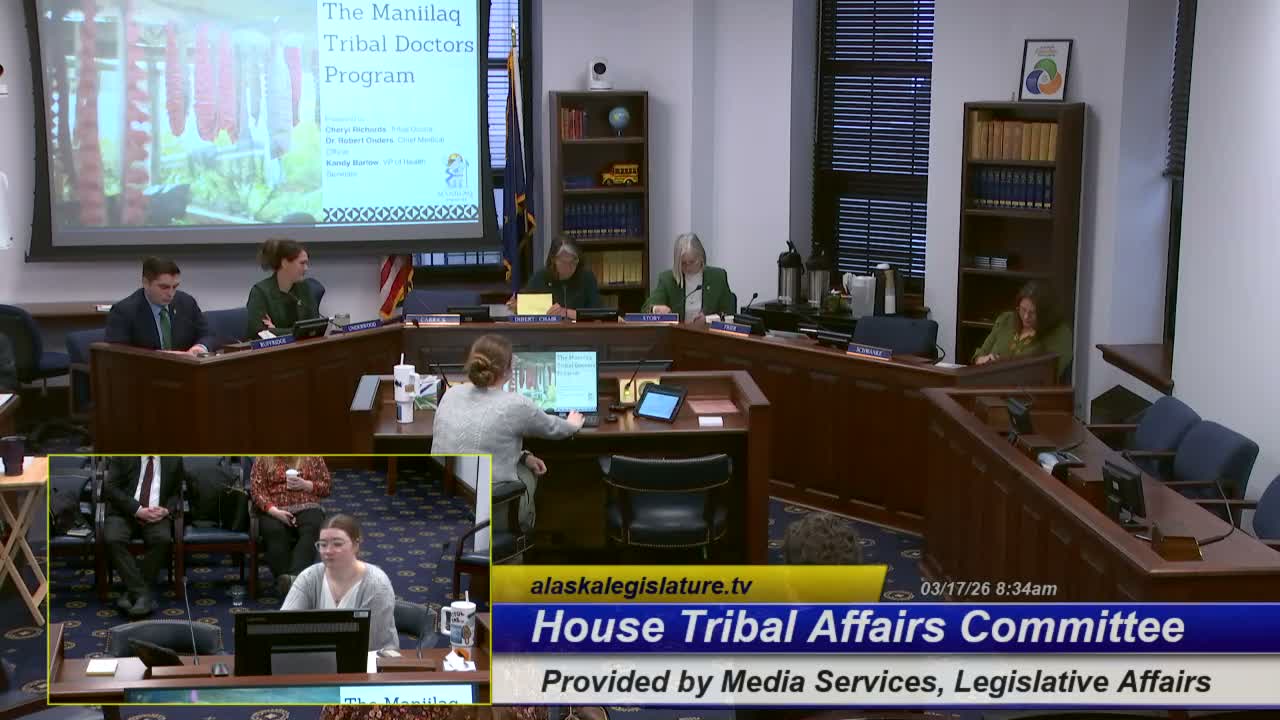
April Kyle, president and CEO of Southcentral Foundation, told the Alaska House Tribal Affairs Committee on March 17 that traditional healing is already integrated into her organization’s primary-care model and that the state has a timely opportunity to secure federal support to expand such services. "We have an opportunity that we haven't had before at a national level to, for states to apply and receive approval for waivers to add traditional healing services to state Medicaid plans," Kyle said during her presentation to the committee.
Kyle described Southcentral Foundation's apprenticeship pathway overseen by an elder council, noting the system recently conferred tribal doctor titles on two apprentices and that trainees move through three levels of training while continuing other work. She cited SCF program evaluation covering 1,409 people over three years that found statistically significant reductions in self-reported pain and declines in primary-care and emergency-department use after patients completed traditional-healing services.
Why it matters: Panelists told committee members that recognizing tribal doctors and traditional healing as reimbursable services would not only honor tribal sovereignty over care design but also could unlock federal funding. Kyle said that if the Alaska Medicaid state plan included tribal doctors as a provider type, services delivered by tribal organizations to Alaska Native people could be reimbursed at 100% federal matching funds (FMAP) to the state, a change she and others said would expand capacity without adding general-fund cost.
Manilik Association's Dr. Robert Anders and tribal doctor Cheryl Richards emphasized the practical value of tribal doctors in rural communities. Anders said the region operates a 17-bed critical-access hospital in Kotzebue that supports 11 village clinics and that many services are provided by traveling providers. "We try to bring services that we can do in the villages out there by traveling people out there," Anders said, describing the logistics and the high local demand for tribal doctors' services.
Richards, who travels to remote villages, described the clinic workflow and community outreach she uses — local VHF radio announcements and lists maintained at village clinics — and said she prioritizes elders and chronic-pain patients when she visits. "Some of those patients do require home visits, especially for the elderly," Richards said, underscoring the access gap in remote communities.
Panelists and legislators focused much of the committee discussion on workforce development. Southcentral Foundation and Manilik leaders described apprenticeship-style training that allows employees to spend time away from their regular jobs to explore traditional-healing roles and then enter paid apprenticeships; SCF's model involves cohorts and multi-level training with field supervision. Panelists said space constraints, turnover in the western-trained workforce and limited current reimbursement options constrain program growth.
On evidence and metrics, Jessica Jones, clinical operations director for Tlingit and Haida, said her division tracks program-level outcomes and success stories but lacks large-scale population statistics showing declines in suicide or substance-abuse rates. "We don't necessarily have mass statistics showing a decrease at this time, but we have the individual accounts of people that we've served," Jones told the committee, adding that grant reporting contributes some evaluative data.
Legislators asked about safeguards and design. Several members — including Representative Story — urged that any Medicaid waiver or reimbursement policy be developed with meaningful tribal consultation so that credentialing, scope-of-practice definitions and program requirements are set by Alaska Native communities rather than imposed by western regulatory models. April Kyle and Dr. Anders cautioned that a waiver could be both an opportunity and a risk: reimbursement would help expand training and services, but creating a regulatory structure that does not respect traditional practice could undermine the work.
What’s next: Representative Story recommended inviting officials from Arizona and other states that have incorporated traditional healing through Medicaid waivers to a future committee meeting to review implementation lessons. Chair Divert closed the hearing after the discussion and thanked the presenters.
The committee also handled a brief procedural item at the start of the meeting: Representative Freer nominated Representative Story as vice chair of the House Tribal Affairs Committee; with no objections, Story was seated as vice chair.
Sources and attributions in this report are limited to statements made during the March 17, 2026, House Tribal Affairs Committee hearing; quotes and claims are attributed to the speakers who made them on the record.
Kyle described Southcentral Foundation's apprenticeship pathway overseen by an elder council, noting the system recently conferred tribal doctor titles on two apprentices and that trainees move through three levels of training while continuing other work. She cited SCF program evaluation covering 1,409 people over three years that found statistically significant reductions in self-reported pain and declines in primary-care and emergency-department use after patients completed traditional-healing services.
Why it matters: Panelists told committee members that recognizing tribal doctors and traditional healing as reimbursable services would not only honor tribal sovereignty over care design but also could unlock federal funding. Kyle said that if the Alaska Medicaid state plan included tribal doctors as a provider type, services delivered by tribal organizations to Alaska Native people could be reimbursed at 100% federal matching funds (FMAP) to the state, a change she and others said would expand capacity without adding general-fund cost.
Manilik Association's Dr. Robert Anders and tribal doctor Cheryl Richards emphasized the practical value of tribal doctors in rural communities. Anders said the region operates a 17-bed critical-access hospital in Kotzebue that supports 11 village clinics and that many services are provided by traveling providers. "We try to bring services that we can do in the villages out there by traveling people out there," Anders said, describing the logistics and the high local demand for tribal doctors' services.
Richards, who travels to remote villages, described the clinic workflow and community outreach she uses — local VHF radio announcements and lists maintained at village clinics — and said she prioritizes elders and chronic-pain patients when she visits. "Some of those patients do require home visits, especially for the elderly," Richards said, underscoring the access gap in remote communities.
Panelists and legislators focused much of the committee discussion on workforce development. Southcentral Foundation and Manilik leaders described apprenticeship-style training that allows employees to spend time away from their regular jobs to explore traditional-healing roles and then enter paid apprenticeships; SCF's model involves cohorts and multi-level training with field supervision. Panelists said space constraints, turnover in the western-trained workforce and limited current reimbursement options constrain program growth.
On evidence and metrics, Jessica Jones, clinical operations director for Tlingit and Haida, said her division tracks program-level outcomes and success stories but lacks large-scale population statistics showing declines in suicide or substance-abuse rates. "We don't necessarily have mass statistics showing a decrease at this time, but we have the individual accounts of people that we've served," Jones told the committee, adding that grant reporting contributes some evaluative data.
Legislators asked about safeguards and design. Several members — including Representative Story — urged that any Medicaid waiver or reimbursement policy be developed with meaningful tribal consultation so that credentialing, scope-of-practice definitions and program requirements are set by Alaska Native communities rather than imposed by western regulatory models. April Kyle and Dr. Anders cautioned that a waiver could be both an opportunity and a risk: reimbursement would help expand training and services, but creating a regulatory structure that does not respect traditional practice could undermine the work.
What’s next: Representative Story recommended inviting officials from Arizona and other states that have incorporated traditional healing through Medicaid waivers to a future committee meeting to review implementation lessons. Chair Divert closed the hearing after the discussion and thanked the presenters.
The committee also handled a brief procedural item at the start of the meeting: Representative Freer nominated Representative Story as vice chair of the House Tribal Affairs Committee; with no objections, Story was seated as vice chair.
Sources and attributions in this report are limited to statements made during the March 17, 2026, House Tribal Affairs Committee hearing; quotes and claims are attributed to the speakers who made them on the record.
Don't Miss a Word: See the Full Meeting!
Go beyond summaries. Unlock every video, transcript, and key insight with a Founder Membership.
✓
Get instant access to full meeting videos
✓
Search and clip any phrase from complete transcripts
✓
Receive AI-powered summaries & custom alerts
✓
Enjoy lifetime, unrestricted access to government data
30-day money-back guarantee
