Senate hearing: climate-smart ag programs delivered measurable GHG and water benefits but face tight GGRF funding
March 17, 2026 | California State Senate, Senate, Legislative, California
This article was created by AI summarizing key points discussed. AI makes mistakes, so for full details and context, please refer to the video of the full meeting. Please report any errors so we can fix them. Report an error »
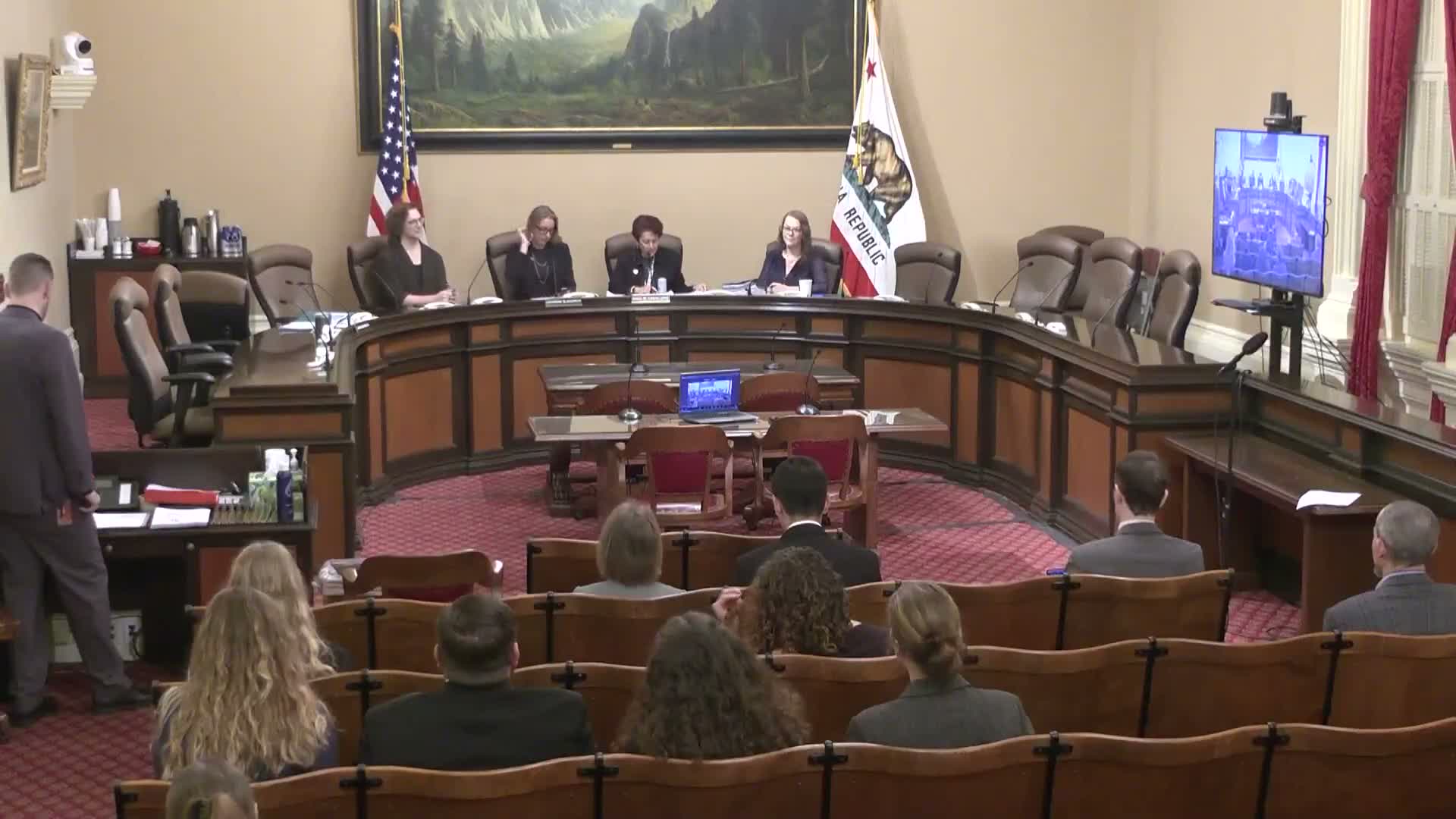
A joint informational hearing of the California State Senate Agriculture Committee and the Senate Environmental Quality Committee on March 19 examined how cap‑and‑invest dollars have been used to support climate‑smart agriculture programs and whether those investments can be sustained.
Virginia Jamieson, Deputy Secretary for Climate and Working Lands at the California Department of Food and Agriculture, told the committees that CDFA’s portfolio has received roughly $727,000,000 over the past decade for flagship programs including the Healthy Soils Program, the State Water Efficiency and Enhancement Program (SWEET), the Alternative Manure Management Program (AMP), and dairy digester research and development. Jamieson said those programs have delivered an estimated 31,000,000 metric tons of CO2 equivalent reductions, “approximately equivalent to removing 7,100,000 cars from the road,” and about 1,600,000 acre‑feet of water savings.
"Climate smart agriculture is not just a side project, it's central to California's ability to produce food, sustain rural communities, and lead globally," Jamieson said, adding that CDFA and the California Air Resources Board (CARB) use model‑based quantification methodologies to estimate GHG reductions.
Helen Kerstein of the Legislative Analyst’s Office provided context on the state budget and cap‑and‑invest (cap and invest) reauthorization. Kerstein said the extension rearranged GGRF allocations, gave certain priorities (including a high‑priority pot cited by the legislature), and changed some percentage allocations into set amounts that may be proportionally reduced if revenues fall short. "Projections suggest that GGRF may remain lean," she said, and recommended additional program‑level evaluation to verify the scale and cost‑effectiveness of claimed benefits.
Panelists and committee members emphasized that many agricultural programs remain oversubscribed. Jamieson said programs have seen demand outstrip supply—some by 161% to 876%—and CDFA has spent about $44,000,000 on embedded technical assistance to help farmers adopt new practices. She also noted recent Proposition 4 allocations that include two rounds of Healthy Soils (~$65 million), one round of SWEET (~$40 million), and a regional farm equipment sharing program (~$15 million).
Legislators pressed witnesses on measurement and verification. Jamieson said CDFA works in coordination with CARB on model‑based quantification approaches. Kerstein told senators that in the state inventory agriculture accounts for roughly 8% of reported GHG emissions but cautioned that many emissions related to natural and working lands are not fully captured in the inventory.
Why it matters: witnesses said the combination of emission reductions, water savings and local air‑quality co‑benefits make the programs an attractive use of public funds, but limited and uncertain GGRF revenues mean the Legislature must set priorities and potentially direct additional evaluation or reporting requirements. The CDFA also said it will publish a climate resilience strategy for agriculture by the end of the month and offered to brief members on next steps.
What’s next: committee members asked for studies and papers cited during testimony and signaled continued work on which agricultural climate programs to prioritize in constrained budget cycles. No formal votes or lawmaking actions took place at the hearing.
Virginia Jamieson, Deputy Secretary for Climate and Working Lands at the California Department of Food and Agriculture, told the committees that CDFA’s portfolio has received roughly $727,000,000 over the past decade for flagship programs including the Healthy Soils Program, the State Water Efficiency and Enhancement Program (SWEET), the Alternative Manure Management Program (AMP), and dairy digester research and development. Jamieson said those programs have delivered an estimated 31,000,000 metric tons of CO2 equivalent reductions, “approximately equivalent to removing 7,100,000 cars from the road,” and about 1,600,000 acre‑feet of water savings.
"Climate smart agriculture is not just a side project, it's central to California's ability to produce food, sustain rural communities, and lead globally," Jamieson said, adding that CDFA and the California Air Resources Board (CARB) use model‑based quantification methodologies to estimate GHG reductions.
Helen Kerstein of the Legislative Analyst’s Office provided context on the state budget and cap‑and‑invest (cap and invest) reauthorization. Kerstein said the extension rearranged GGRF allocations, gave certain priorities (including a high‑priority pot cited by the legislature), and changed some percentage allocations into set amounts that may be proportionally reduced if revenues fall short. "Projections suggest that GGRF may remain lean," she said, and recommended additional program‑level evaluation to verify the scale and cost‑effectiveness of claimed benefits.
Panelists and committee members emphasized that many agricultural programs remain oversubscribed. Jamieson said programs have seen demand outstrip supply—some by 161% to 876%—and CDFA has spent about $44,000,000 on embedded technical assistance to help farmers adopt new practices. She also noted recent Proposition 4 allocations that include two rounds of Healthy Soils (~$65 million), one round of SWEET (~$40 million), and a regional farm equipment sharing program (~$15 million).
Legislators pressed witnesses on measurement and verification. Jamieson said CDFA works in coordination with CARB on model‑based quantification approaches. Kerstein told senators that in the state inventory agriculture accounts for roughly 8% of reported GHG emissions but cautioned that many emissions related to natural and working lands are not fully captured in the inventory.
Why it matters: witnesses said the combination of emission reductions, water savings and local air‑quality co‑benefits make the programs an attractive use of public funds, but limited and uncertain GGRF revenues mean the Legislature must set priorities and potentially direct additional evaluation or reporting requirements. The CDFA also said it will publish a climate resilience strategy for agriculture by the end of the month and offered to brief members on next steps.
What’s next: committee members asked for studies and papers cited during testimony and signaled continued work on which agricultural climate programs to prioritize in constrained budget cycles. No formal votes or lawmaking actions took place at the hearing.
View the Full Meeting & All Its Details
This article offers just a summary. Unlock complete video, transcripts, and insights as a Founder Member.
✓
Watch full, unedited meeting videos
✓
Search every word spoken in unlimited transcripts
✓
AI summaries & real-time alerts (all government levels)
✓
Permanent access to expanding government content
30-day money-back guarantee
