Lawmakers press Cal OES on delayed Next Generation 9-1-1 as vendors and analysts disagree over statewide plan
March 17, 2026 | California State Assembly, House, Legislative, California
This article was created by AI summarizing key points discussed. AI makes mistakes, so for full details and context, please refer to the video of the full meeting. Please report any errors so we can fix them. Report an error »
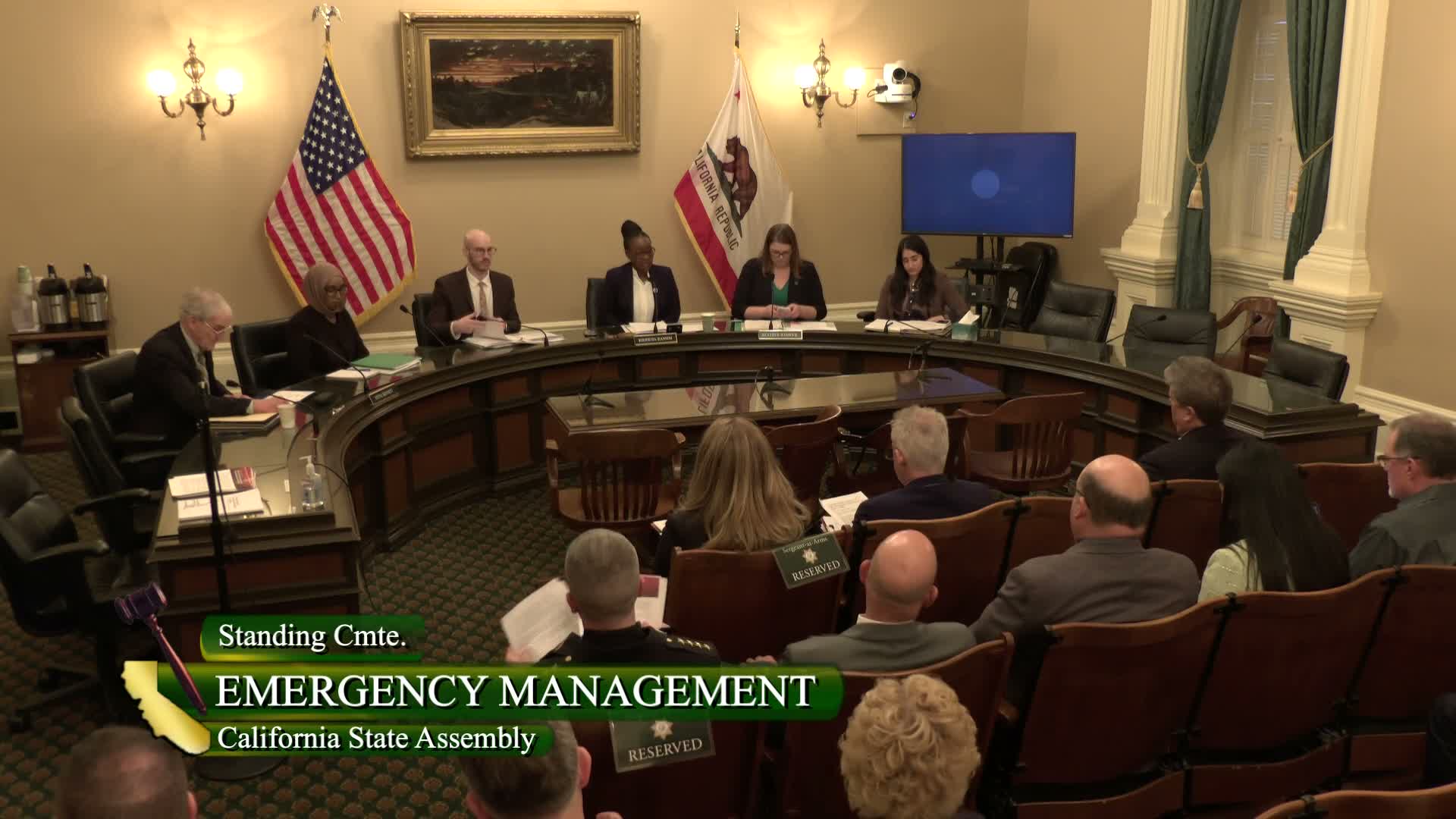
Chair Ransom convened the California State Assembly Emergency Management Committee to examine delays and a recent shift in strategy for the state's Next Generation 9-1-1 (NG9-1-1) program, pressing officials and vendors to explain what went wrong and how to move forward.
Steve Yarbrough, deputy director of public safety communications at the California Office of Emergency Services (Cal OES), told the committee that early regional rollouts produced trouble tickets showing misrouted and dropped calls and degraded audio. He said Cal OES paused further transitions to reassess the architecture and is proposing a single statewide provider model aligned with National Emergency Number Association (NENA) best practices. "Our strategy is updating to reflect the lessons that we've learned from early deployment and aligns California system with national standards," Yarbrough said, and he cited a 99.999% uptime target as the performance metric for the eventual statewide partner.
Heather Gonzales, principal fiscal and policy analyst at the Legislative Analyst's Office (LAO), urged caution. The LAO's written assessment and testimony noted the project is overdue, future budget needs are unclear and key trade-offs have not been documented. "We recommend that the legislature temporarily pause forward movement on this project while it gathers information necessary to either increase confidence in the plan that OES has proposed or enable it to work towards an alternative that the legislature prefers," Gonzales said. LAO recommended independent technical review options, quarterly fiscal reports and monthly progress updates until legacy 9-1-1 is decommissioned.
Members pressed Cal OES on accountability, costs and safety. Yarbrough said the state has paid roughly $450 million in service fees to date, that about 23 public safety answering points (PSAPs) have completed voice transitions, and that legacy systems still carry most voice traffic. Asked whether the transition has resulted in any deaths attributable to the migration, Yarbrough said: "I don't know that of an instance that can be attributed specifically to the transition." He said pandemic disruptions and supply-chain problems slowed deployment and that a full transition to a single statewide provider is currently projected by Cal OES for 2030.
Regional vendors urged the committee not to discard the work already done. Don Ferguson, chief executive officer of NGA 9-1-1, said a detailed analysis of early incidents showed 79% were tied to legacy alignment, carrier delivery, PSAP procedures or training rather than the regional vendor. "The decision to pause has placed the entire state at risk as people are forced to rely on the failing legacy 9-1-1 system," Ferguson said, arguing the regional architecture provided geographic diversity and multiple failover options.
Frank Hall of Synergent Technologies and Jim Carlson of Lumen echoed that the regional deployments were designed for California s geography and natural-disaster exposure, urged careful engineering evaluations and welcomed technical oversight but warned that dismantling regional systems would be costly. Jason Bivens of Atos, which currently provides statewide core services and backup, emphasized Atos s role delivering text-to-911 and location services and said the statewide backbone has carried live traffic successfully.
Frontline PSAP operators and advisory-board members also testified. Chief Andrew White of the Martinez Police Department, a member of the state 9-1-1 advisory board, and Casey Young of the California chapter of the National Emergency Number Association (CalNENA) described operational pain points during early deployments: unscheduled testing during peak hours, dropped or misrouted calls, audio problems and confusion about who to contact when issues arose. Chief White said the advisory board lacks authority and earlier changes in project leadership complicated continuity. "Modernizing 9-1-1 is not optional, but neither is getting it right," he said.
A member of the public, Steven Sprague, urged transparency and cited advisory-board outage figures reported to the committee, arguing the legacy network has experienced far more outages than the NG9-1-1 components during the period cited.
What happens next: the LAO recommended a temporary pause while the legislature obtains independent technical analysis and clearer fiscal estimates; Cal OES said it is drafting a procurement and expects to present plans during upcoming budget windows. Lawmakers signaled skepticism about rapid implementation without stronger oversight mechanisms and clearer answers on cost, vendor management and how operators on the ground will be supported during additional transitions.
The committee did not take formal action at the hearing; members said they will continue oversight and seek more detailed fiscal and technical reviews before the state moves to a single-provider architecture.
Steve Yarbrough, deputy director of public safety communications at the California Office of Emergency Services (Cal OES), told the committee that early regional rollouts produced trouble tickets showing misrouted and dropped calls and degraded audio. He said Cal OES paused further transitions to reassess the architecture and is proposing a single statewide provider model aligned with National Emergency Number Association (NENA) best practices. "Our strategy is updating to reflect the lessons that we've learned from early deployment and aligns California system with national standards," Yarbrough said, and he cited a 99.999% uptime target as the performance metric for the eventual statewide partner.
Heather Gonzales, principal fiscal and policy analyst at the Legislative Analyst's Office (LAO), urged caution. The LAO's written assessment and testimony noted the project is overdue, future budget needs are unclear and key trade-offs have not been documented. "We recommend that the legislature temporarily pause forward movement on this project while it gathers information necessary to either increase confidence in the plan that OES has proposed or enable it to work towards an alternative that the legislature prefers," Gonzales said. LAO recommended independent technical review options, quarterly fiscal reports and monthly progress updates until legacy 9-1-1 is decommissioned.
Members pressed Cal OES on accountability, costs and safety. Yarbrough said the state has paid roughly $450 million in service fees to date, that about 23 public safety answering points (PSAPs) have completed voice transitions, and that legacy systems still carry most voice traffic. Asked whether the transition has resulted in any deaths attributable to the migration, Yarbrough said: "I don't know that of an instance that can be attributed specifically to the transition." He said pandemic disruptions and supply-chain problems slowed deployment and that a full transition to a single statewide provider is currently projected by Cal OES for 2030.
Regional vendors urged the committee not to discard the work already done. Don Ferguson, chief executive officer of NGA 9-1-1, said a detailed analysis of early incidents showed 79% were tied to legacy alignment, carrier delivery, PSAP procedures or training rather than the regional vendor. "The decision to pause has placed the entire state at risk as people are forced to rely on the failing legacy 9-1-1 system," Ferguson said, arguing the regional architecture provided geographic diversity and multiple failover options.
Frank Hall of Synergent Technologies and Jim Carlson of Lumen echoed that the regional deployments were designed for California s geography and natural-disaster exposure, urged careful engineering evaluations and welcomed technical oversight but warned that dismantling regional systems would be costly. Jason Bivens of Atos, which currently provides statewide core services and backup, emphasized Atos s role delivering text-to-911 and location services and said the statewide backbone has carried live traffic successfully.
Frontline PSAP operators and advisory-board members also testified. Chief Andrew White of the Martinez Police Department, a member of the state 9-1-1 advisory board, and Casey Young of the California chapter of the National Emergency Number Association (CalNENA) described operational pain points during early deployments: unscheduled testing during peak hours, dropped or misrouted calls, audio problems and confusion about who to contact when issues arose. Chief White said the advisory board lacks authority and earlier changes in project leadership complicated continuity. "Modernizing 9-1-1 is not optional, but neither is getting it right," he said.
A member of the public, Steven Sprague, urged transparency and cited advisory-board outage figures reported to the committee, arguing the legacy network has experienced far more outages than the NG9-1-1 components during the period cited.
What happens next: the LAO recommended a temporary pause while the legislature obtains independent technical analysis and clearer fiscal estimates; Cal OES said it is drafting a procurement and expects to present plans during upcoming budget windows. Lawmakers signaled skepticism about rapid implementation without stronger oversight mechanisms and clearer answers on cost, vendor management and how operators on the ground will be supported during additional transitions.
The committee did not take formal action at the hearing; members said they will continue oversight and seek more detailed fiscal and technical reviews before the state moves to a single-provider architecture.
Don't Miss a Word: See the Full Meeting!
Go beyond summaries. Unlock every video, transcript, and key insight with a Founder Membership.
✓
Get instant access to full meeting videos
✓
Search and clip any phrase from complete transcripts
✓
Receive AI-powered summaries & custom alerts
✓
Enjoy lifetime, unrestricted access to government data
30-day money-back guarantee
