Heated debate in Nebraska Senate over bill to allow private generation for very large industrial loads
March 17, 2026 | 2026 Legislature NE, Nebraska
This article was created by AI summarizing key points discussed. AI makes mistakes, so for full details and context, please refer to the video of the full meeting. Please report any errors so we can fix them. Report an error »
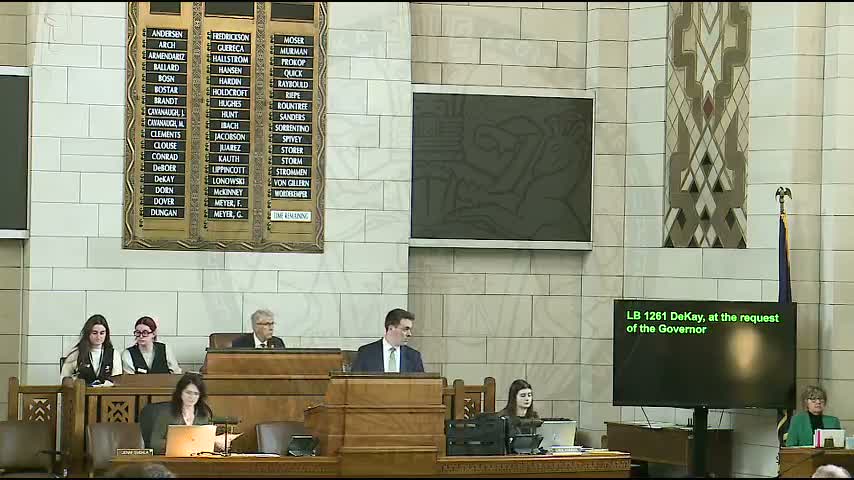
Senator DeKay introduced LB 12‑61 as a narrowly drawn statute to let privately owned generation serve very large industrial loads — defined in the bill as customers requiring more than 1,000 megawatts — under contractual arrangements that preserve public‑power retail rights and include a five‑year sunset. "LB 12 61 provides a narrow, carefully defined exception in the statute that allows private companies to make large capital commitments," DeKay said, arguing the change could reduce financial risk to public power utilities and speed project timelines when equipment lead times are measured in years.
Floor debate was sharply divided. Opponents, led by Senator Conrad, said the measure represents a fundamental and potentially irreversible erosion of Nebraska's public‑power model and warned it functionally benefits specific private projects. "What is contained in LB 12 61 is not guardrails to protect public power, but an erosion of public power," Conrad said, calling for more study and transparency.
Supporters responded that the bill includes guardrails — co‑location, public‑power review board approval processes, contractual obligations and a sunset — and that it is designed to preserve public‑power retail authority while allowing private capital for projects that otherwise sit behind long component lead times. Senators asked about tax consequences, impacts on water and natural‑gas markets, and the potential for special‑interest carve‑outs; supporters said those are matters for the contractual and public‑power review processes.
Senator Conrad signaled and began to prosecute a priority motion to indefinitely postpone the bill, and floor debate continued without resolution. The Legislature adjourned after prolonged debate; proponents and opponents signaled further litigation of issues in committee and on the floor would continue.
Floor debate was sharply divided. Opponents, led by Senator Conrad, said the measure represents a fundamental and potentially irreversible erosion of Nebraska's public‑power model and warned it functionally benefits specific private projects. "What is contained in LB 12 61 is not guardrails to protect public power, but an erosion of public power," Conrad said, calling for more study and transparency.
Supporters responded that the bill includes guardrails — co‑location, public‑power review board approval processes, contractual obligations and a sunset — and that it is designed to preserve public‑power retail authority while allowing private capital for projects that otherwise sit behind long component lead times. Senators asked about tax consequences, impacts on water and natural‑gas markets, and the potential for special‑interest carve‑outs; supporters said those are matters for the contractual and public‑power review processes.
Senator Conrad signaled and began to prosecute a priority motion to indefinitely postpone the bill, and floor debate continued without resolution. The Legislature adjourned after prolonged debate; proponents and opponents signaled further litigation of issues in committee and on the floor would continue.
View the Full Meeting & All Its Details
This article offers just a summary. Unlock complete video, transcripts, and insights as a Founder Member.
✓
Watch full, unedited meeting videos
✓
Search every word spoken in unlimited transcripts
✓
AI summaries & real-time alerts (all government levels)
✓
Permanent access to expanding government content
30-day money-back guarantee
