State partners report marked green crab expansion and sustained trapping in 2025
March 18, 2026 | Board Council Commission Agencies , Executive, Washington
This article was created by AI summarizing key points discussed. AI makes mistakes, so for full details and context, please refer to the video of the full meeting. Please report any errors so we can fix them. Report an error »
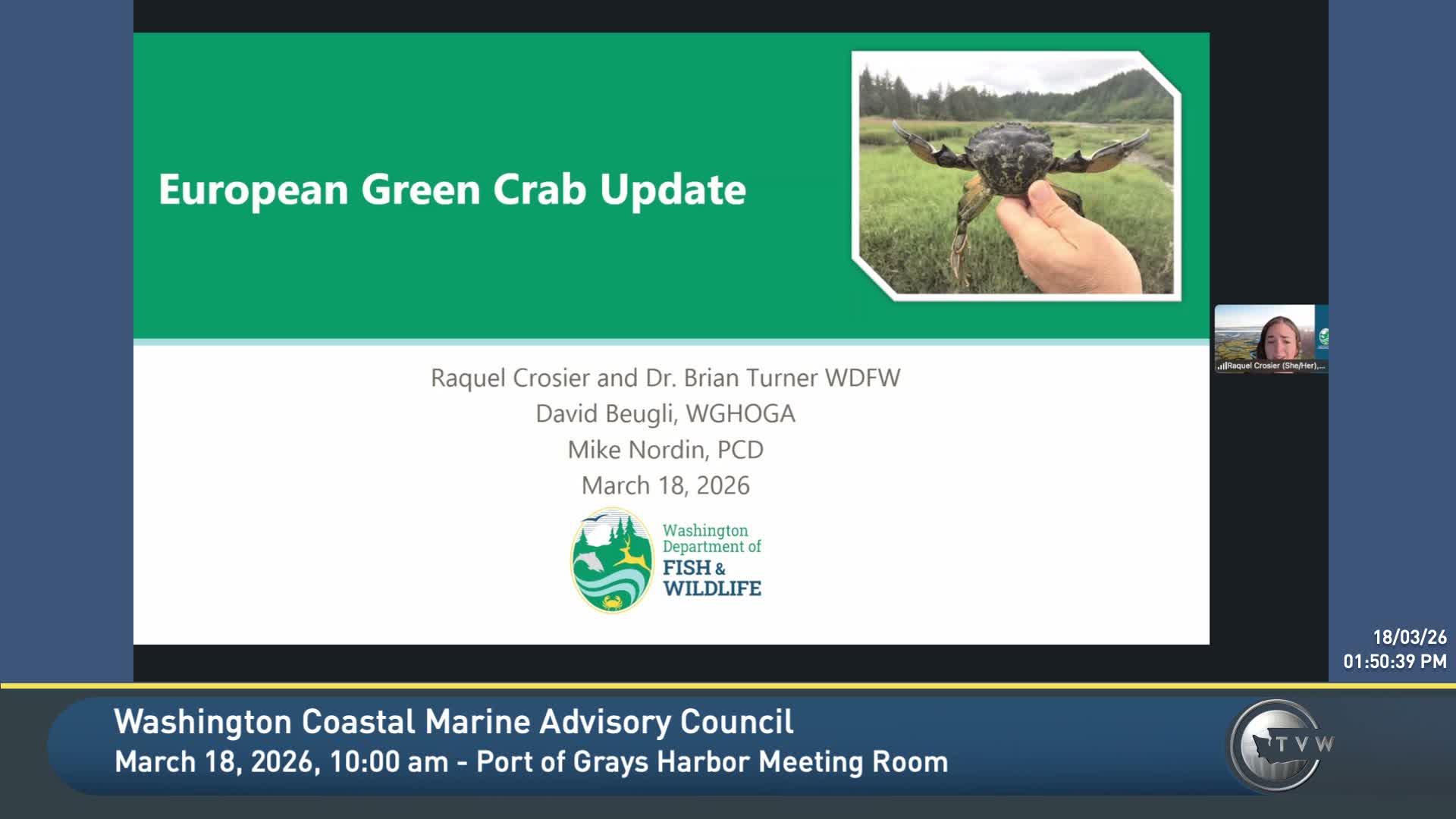
State and local partners told WICMAC on March 18 that 2025 brought both expansion and intensified removal efforts for European green crab. Raquel Crozier (WA Dept. Fish & Wildlife) said partners removed 1,096,200 green crab in 2025 and more than 3,000,000 since the emergency proclamation began; the 2025 season saw increases in parts of Puget Sound, Hood Canal and upriver in the Columbia.
“Trapping is essentially our only tool,” Dr. Brian Turner said, outlining efforts to refine trapping efficiency and study impacts. Turner summarized research into potential future tools — from gene drives (still at genome‑mapping stages) to pheromones and biological control — and cautioned that most alternative controls remain years away or pose unacceptable non‑target risks.
Local harvesters and growers reported large trapping operations in Willapa Bay and Grays Harbor: partners removed about 620,000 crabs from Willapa Bay in 2025 and roughly 42,000 from Grays Harbor (reported trap landings), with growers deploying hundreds of traps and receiving reimbursement for trapping effort and boat costs from state programs. David Begley (Willapa/Grays Harbor oyster growers) highlighted observed seed‑bag damage and a small number of clam predation signatures consistent with crab predation; he said growers are intensifying trapping around vulnerable infrastructure.
Funding and coordination: Presenters said state funds support much of the statewide program but noted budget pressure and the need for federal appropriations. WDFW and partner groups said they’re preparing an appropriations request for fiscal 2027 that would seek funding through BIA invasive species grants, National Wildlife Refuge and USGS research support, and USDA resources to support growers.
Quotes: “We have over 50 organizations participating in green crab trapping and hundreds of individuals doing this work,” Raquel Crozier said. Dr. Turner cautioned that gene‑drive options, if ever feasible, are more than a decade away.
Next steps: WDFW and partners will continue trapping, invest in trap‑efficiency research and seek federal funding to expand coastal trapping capacity and scientific study of ecological and economic impacts. The council agreed to circulate the presentation and consider continued coordination at the June meeting.
Provenance: The council’s green crab briefing and discussion are drawn from WDFW and presenter slides and Q&A during SEG 3440–3960 and partner reports through SEG 3880–4016.
“Trapping is essentially our only tool,” Dr. Brian Turner said, outlining efforts to refine trapping efficiency and study impacts. Turner summarized research into potential future tools — from gene drives (still at genome‑mapping stages) to pheromones and biological control — and cautioned that most alternative controls remain years away or pose unacceptable non‑target risks.
Local harvesters and growers reported large trapping operations in Willapa Bay and Grays Harbor: partners removed about 620,000 crabs from Willapa Bay in 2025 and roughly 42,000 from Grays Harbor (reported trap landings), with growers deploying hundreds of traps and receiving reimbursement for trapping effort and boat costs from state programs. David Begley (Willapa/Grays Harbor oyster growers) highlighted observed seed‑bag damage and a small number of clam predation signatures consistent with crab predation; he said growers are intensifying trapping around vulnerable infrastructure.
Funding and coordination: Presenters said state funds support much of the statewide program but noted budget pressure and the need for federal appropriations. WDFW and partner groups said they’re preparing an appropriations request for fiscal 2027 that would seek funding through BIA invasive species grants, National Wildlife Refuge and USGS research support, and USDA resources to support growers.
Quotes: “We have over 50 organizations participating in green crab trapping and hundreds of individuals doing this work,” Raquel Crozier said. Dr. Turner cautioned that gene‑drive options, if ever feasible, are more than a decade away.
Next steps: WDFW and partners will continue trapping, invest in trap‑efficiency research and seek federal funding to expand coastal trapping capacity and scientific study of ecological and economic impacts. The council agreed to circulate the presentation and consider continued coordination at the June meeting.
Provenance: The council’s green crab briefing and discussion are drawn from WDFW and presenter slides and Q&A during SEG 3440–3960 and partner reports through SEG 3880–4016.
View the Full Meeting & All Its Details
This article offers just a summary. Unlock complete video, transcripts, and insights as a Founder Member.
✓
Watch full, unedited meeting videos
✓
Search every word spoken in unlimited transcripts
✓
AI summaries & real-time alerts (all government levels)
✓
Permanent access to expanding government content
30-day money-back guarantee
