WA529 committee approves year‑round enrollment, removes program refund penalties and simplifies refund and conversion rules
March 18, 2026 | Board Council Commission Agencies , Executive, Washington
This article was created by AI summarizing key points discussed. AI makes mistakes, so for full details and context, please refer to the video of the full meeting. Please report any errors so we can fix them. Report an error »
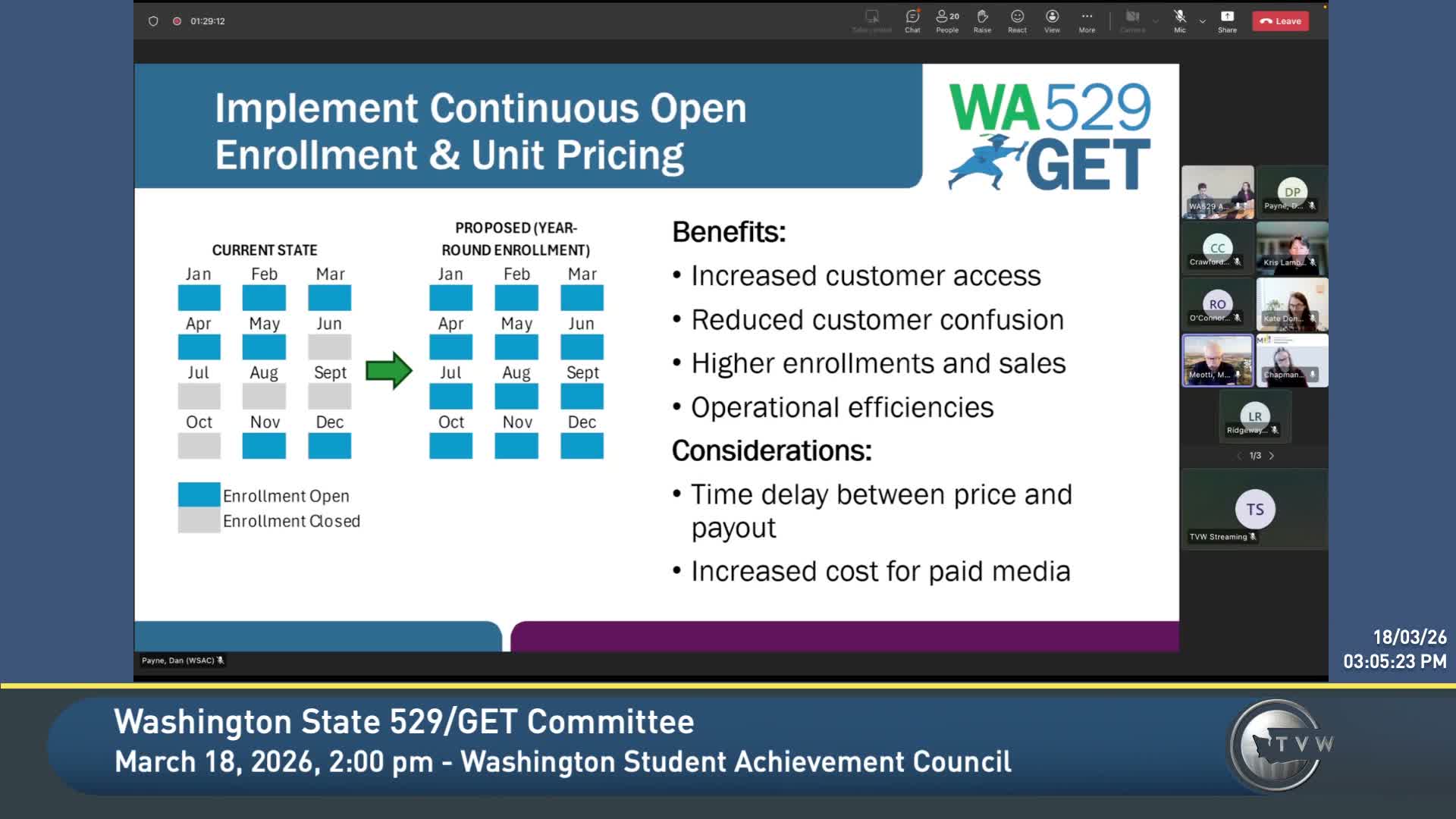
The WA529 GET Committee on March 18 voted unanimously to implement four policy changes intended to boost enrollment, simplify participant rules and improve customer experience.
The committee, chaired by Michael Miotti, directed staff to move forward with continuous open enrollment and continuous unit pricing, ending the program’s long‑standing summer closure. Linda Ridgeway, GET director, said staff recommended the change to reduce customer confusion and smooth operational workloads, while flagging an actuarial timing risk between price adoption and payout valuation. “One of the key risks we identified … is the timing delay between the unit price adoption and the payout valuation,” Ridgeway said. Staff told the committee they would consult the Office of the State Actuary and report back if significant concerns emerge.
In the same package of actions the committee eliminated the program‑imposed 10% refund penalty and associated cancellation and monthly maintenance fees, aligning GET policy with federal tax penalties and broader 529‑industry practice. Ridgeway said the program penalty predates the federal penalty and that removing it would reduce annual revenue by about $400,000, based on recent collections. “These fees appear overly punitive, particularly for account owners who have used the program appropriately,” she said.
The committee also approved a simplification of refund and cancellation options, reducing nine legacy refund types to a six‑option set. The proposal would remove a six‑month cancellation limit and consolidate several nonqualified refund types into a single nonqualified distribution option that carries a two‑year wait requirement; death, disability, scholarship and bankruptcy options would remain in place.
Finally, the committee approved expanding the lump‑sum conversion opportunity so that existing custom monthly plan accounts that have not taken distributions may convert to lump‑sum units. Staff said the change would affect roughly 2,100 accounts and could create roughly $4.6 million in additional program liability if those conversions occur. Luke (staff) described the change as an effort to treat paid‑in custom monthly savers more consistently with savers who purchased lump sums: "This is intended to right‑size this population who had a confluence of events that reduced their purchasing power," he said.
All four motions were made, seconded and carried unanimously by voice vote. Committee members pressed staff and vendors for follow‑up detail on implementation timing, actuarial implications and communications to account owners. Committee chair Michael Miotti emphasized that staff would retain the ability to convene an emergency meeting and take corrective steps if a rapid change in tuition or market conditions warranted it.
Why it matters: together, the changes are designed to lower barriers to opening and managing GET accounts and improve customer clarity. They also carry measurable fiscal and operational effects: staff estimated a near‑term revenue reduction of about $400,000 per year from eliminating program penalties, and an estimated $4.6 million of additional conversion liability. Ridgeway told the committee the program was in a strong funded position in recent valuations, but said staff would bring updated actuarial analysis as they refine implementation.
Next steps: staff will consult with the Office of the State Actuary on pricing and timing risks, return with more detailed cost and operational plans at future meetings, and implement the changes in a phased approach the committee authorized. The committee’s next regular meeting is expected in June.
The committee, chaired by Michael Miotti, directed staff to move forward with continuous open enrollment and continuous unit pricing, ending the program’s long‑standing summer closure. Linda Ridgeway, GET director, said staff recommended the change to reduce customer confusion and smooth operational workloads, while flagging an actuarial timing risk between price adoption and payout valuation. “One of the key risks we identified … is the timing delay between the unit price adoption and the payout valuation,” Ridgeway said. Staff told the committee they would consult the Office of the State Actuary and report back if significant concerns emerge.
In the same package of actions the committee eliminated the program‑imposed 10% refund penalty and associated cancellation and monthly maintenance fees, aligning GET policy with federal tax penalties and broader 529‑industry practice. Ridgeway said the program penalty predates the federal penalty and that removing it would reduce annual revenue by about $400,000, based on recent collections. “These fees appear overly punitive, particularly for account owners who have used the program appropriately,” she said.
The committee also approved a simplification of refund and cancellation options, reducing nine legacy refund types to a six‑option set. The proposal would remove a six‑month cancellation limit and consolidate several nonqualified refund types into a single nonqualified distribution option that carries a two‑year wait requirement; death, disability, scholarship and bankruptcy options would remain in place.
Finally, the committee approved expanding the lump‑sum conversion opportunity so that existing custom monthly plan accounts that have not taken distributions may convert to lump‑sum units. Staff said the change would affect roughly 2,100 accounts and could create roughly $4.6 million in additional program liability if those conversions occur. Luke (staff) described the change as an effort to treat paid‑in custom monthly savers more consistently with savers who purchased lump sums: "This is intended to right‑size this population who had a confluence of events that reduced their purchasing power," he said.
All four motions were made, seconded and carried unanimously by voice vote. Committee members pressed staff and vendors for follow‑up detail on implementation timing, actuarial implications and communications to account owners. Committee chair Michael Miotti emphasized that staff would retain the ability to convene an emergency meeting and take corrective steps if a rapid change in tuition or market conditions warranted it.
Why it matters: together, the changes are designed to lower barriers to opening and managing GET accounts and improve customer clarity. They also carry measurable fiscal and operational effects: staff estimated a near‑term revenue reduction of about $400,000 per year from eliminating program penalties, and an estimated $4.6 million of additional conversion liability. Ridgeway told the committee the program was in a strong funded position in recent valuations, but said staff would bring updated actuarial analysis as they refine implementation.
Next steps: staff will consult with the Office of the State Actuary on pricing and timing risks, return with more detailed cost and operational plans at future meetings, and implement the changes in a phased approach the committee authorized. The committee’s next regular meeting is expected in June.
View the Full Meeting & All Its Details
This article offers just a summary. Unlock complete video, transcripts, and insights as a Founder Member.
✓
Watch full, unedited meeting videos
✓
Search every word spoken in unlimited transcripts
✓
AI summaries & real-time alerts (all government levels)
✓
Permanent access to expanding government content
30-day money-back guarantee
