GET marketing ramps up CTV and SMS; State Investment Board reports strong returns as committee considers faith‑based investment RFI
March 18, 2026 | Board Council Commission Agencies , Executive, Washington
This article was created by AI summarizing key points discussed. AI makes mistakes, so for full details and context, please refer to the video of the full meeting. Please report any errors so we can fix them. Report an error »
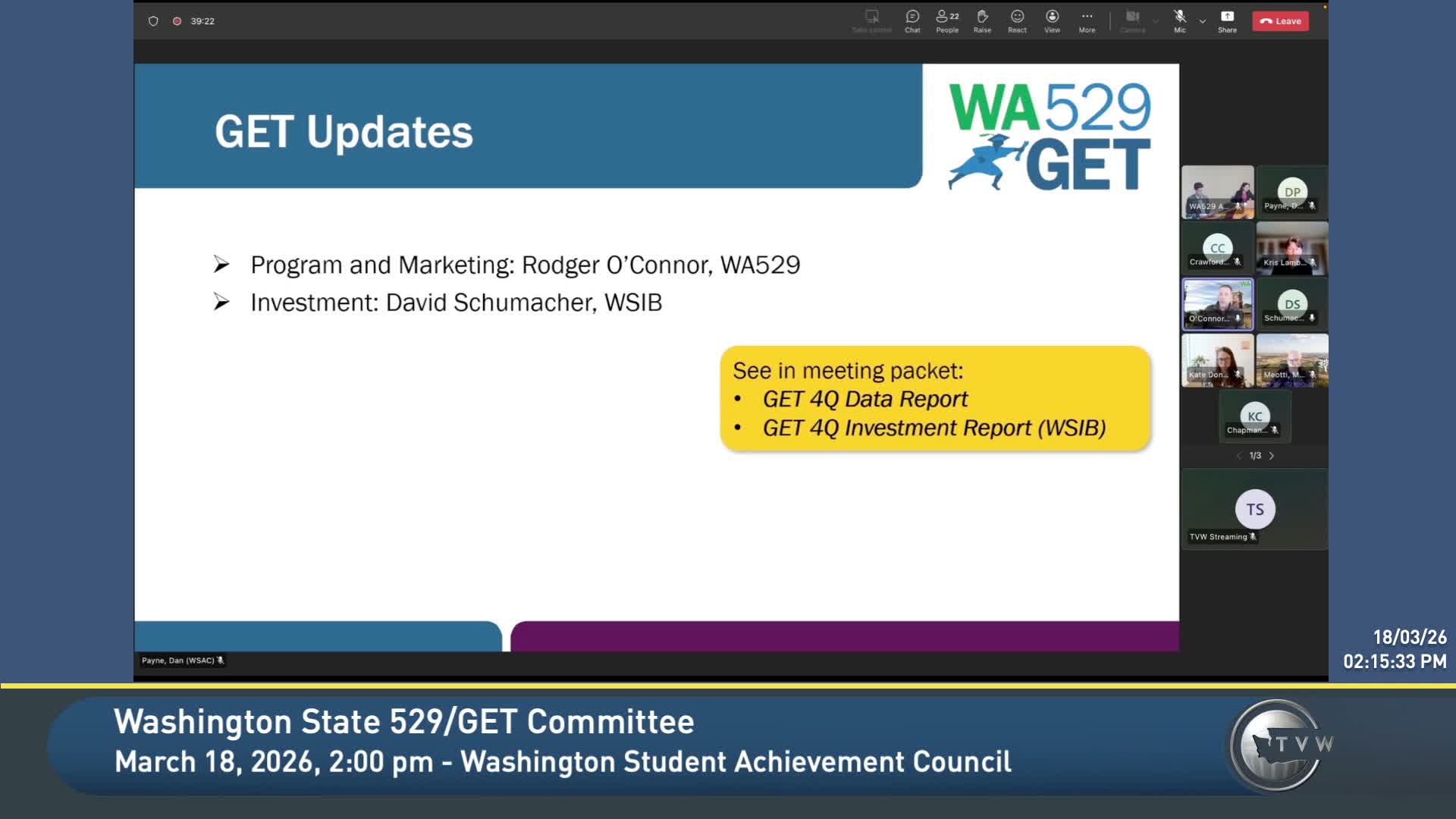
Program and investment managers briefed the WA529 GET Committee on March 18 on marketing initiatives, operational fixes and investment performance, and discussed next steps for evaluating faith‑based or values‑aligned investment options.
Roger O’Connor, GET associate director for marketing and communications, told the committee the program was close to launching an event‑based SMS notification service for account owners and has completed accessibility fixes on the WA529 website to meet an April 26 compliance deadline. O’Connor highlighted a move toward digital channels and said the GET team tested a promo code system and incentive promotions. “For the first three months of the enrollment year … we’ve driven more than 46,000 visits to the WA529 website with more than 12,000 conversions,” he said, and cited earlier promotions that produced 181 new accounts (Save 50/Get 50) and 262 accounts during a holiday promo.
David Schumacher of the State Investment Board presented the investment update: total GET market value is approaching $1.9 billion and recent performance has been strong, with a one‑year return the board characterized as roughly 14% and long‑term returns in the 11%–12% range for longer horizons. Schumacher also described the fund’s 40% allocation to global equity and 60% to fixed income and discussed how fair‑value pricing can produce short‑term performance dispersion in non‑U.S. funds.
TIAA representatives described marketing tactics that helped drive December results — the vendor noted 902 new accounts in December — and said they will expand connected TV (CTV) and predictive analytics. TIAA’s marketing lead said CTV audiences were 9–13 times more likely to convert when paired with other digital touchpoints and said the firm is piloting an AI‑driven customer data platform to support personalized outreach.
On a separate track, staff summarized responses to a January Request for Information on faith‑based and values‑aligned investment options. Three firms responded (Nikita Investment Group, Denar Standard, and Barnes Thornburg). Staff recommended further market‑demand assessment, creation of a formal process and investment‑policy framework for considering new options, and noted practical limits including a statutory 50‑basis‑point cap on investment option fees and a constrained administrative budget while the fund works to recover a ~$928,000 administrative deficit. Committee members directed staff to proceed toward an RFP and emphasized that market‑demand data should be part of the procurement scope.
Why it matters: the marketing and operations changes seek to improve customer experience and enrollment conversion; investment performance and the fund’s funded status inform the committee’s tolerance for product change. The RFI signals potential future product diversification but staff warned about statutory fee caps and procurement costs.
Next steps: staff will continue accessibility fixes and the SMS roll‑out, TIAA will report on marketing results at the June meeting, and staff will draft an RFP that includes market‑demand assessment for committee review before any contractual commitment.
Roger O’Connor, GET associate director for marketing and communications, told the committee the program was close to launching an event‑based SMS notification service for account owners and has completed accessibility fixes on the WA529 website to meet an April 26 compliance deadline. O’Connor highlighted a move toward digital channels and said the GET team tested a promo code system and incentive promotions. “For the first three months of the enrollment year … we’ve driven more than 46,000 visits to the WA529 website with more than 12,000 conversions,” he said, and cited earlier promotions that produced 181 new accounts (Save 50/Get 50) and 262 accounts during a holiday promo.
David Schumacher of the State Investment Board presented the investment update: total GET market value is approaching $1.9 billion and recent performance has been strong, with a one‑year return the board characterized as roughly 14% and long‑term returns in the 11%–12% range for longer horizons. Schumacher also described the fund’s 40% allocation to global equity and 60% to fixed income and discussed how fair‑value pricing can produce short‑term performance dispersion in non‑U.S. funds.
TIAA representatives described marketing tactics that helped drive December results — the vendor noted 902 new accounts in December — and said they will expand connected TV (CTV) and predictive analytics. TIAA’s marketing lead said CTV audiences were 9–13 times more likely to convert when paired with other digital touchpoints and said the firm is piloting an AI‑driven customer data platform to support personalized outreach.
On a separate track, staff summarized responses to a January Request for Information on faith‑based and values‑aligned investment options. Three firms responded (Nikita Investment Group, Denar Standard, and Barnes Thornburg). Staff recommended further market‑demand assessment, creation of a formal process and investment‑policy framework for considering new options, and noted practical limits including a statutory 50‑basis‑point cap on investment option fees and a constrained administrative budget while the fund works to recover a ~$928,000 administrative deficit. Committee members directed staff to proceed toward an RFP and emphasized that market‑demand data should be part of the procurement scope.
Why it matters: the marketing and operations changes seek to improve customer experience and enrollment conversion; investment performance and the fund’s funded status inform the committee’s tolerance for product change. The RFI signals potential future product diversification but staff warned about statutory fee caps and procurement costs.
Next steps: staff will continue accessibility fixes and the SMS roll‑out, TIAA will report on marketing results at the June meeting, and staff will draft an RFP that includes market‑demand assessment for committee review before any contractual commitment.
View the Full Meeting & All Its Details
This article offers just a summary. Unlock complete video, transcripts, and insights as a Founder Member.
✓
Watch full, unedited meeting videos
✓
Search every word spoken in unlimited transcripts
✓
AI summaries & real-time alerts (all government levels)
✓
Permanent access to expanding government content
30-day money-back guarantee
