Assembly panel advances bill to make repeat ‘swatting’ a wobbler, allow victim compensation
March 17, 2026 | California State Assembly, House, Legislative, California
This article was created by AI summarizing key points discussed. AI makes mistakes, so for full details and context, please refer to the video of the full meeting. Please report any errors so we can fix them. Report an error »
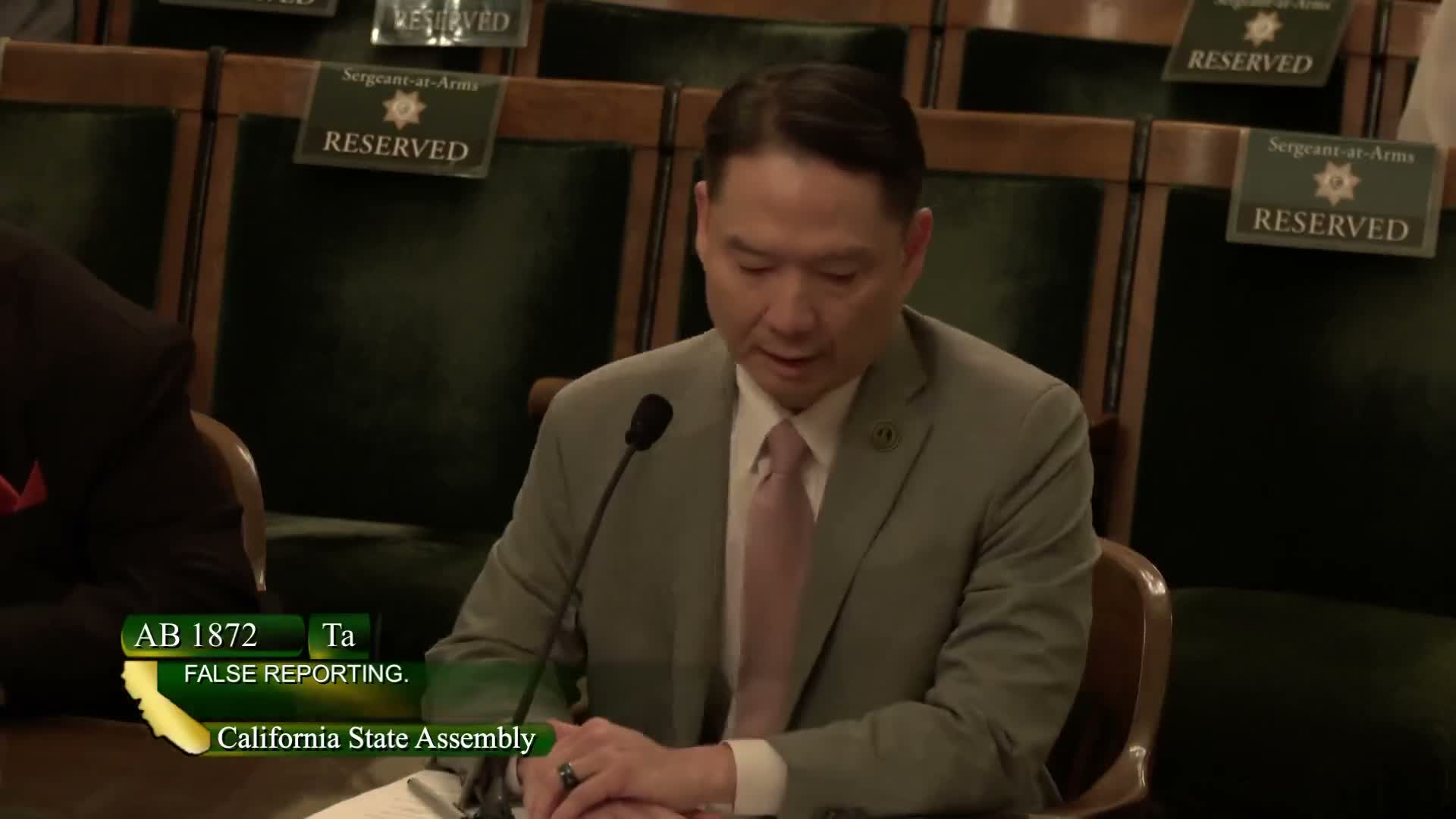
Assemblymember Ta introduced AB 18 72 on swatting, saying the bill targets adult repeat offenders who make false emergency reports that provoke armed responses and endanger civilians and first responders. "When our first responders show up to the site of a false report, people live at stake," Ta said during his opening presentation.
The measure would classify swatting as a "wobbler," allowing prosecutors to charge the conduct as a misdemeanor or a felony depending on circumstances, and would require perpetrators to compensate victims for property damage. Nicholas Bishop, a training officer and tactical dispatcher, told the committee the incidents place "significant stress on responders and victims" and cited recent high-profile targets including Disneyland and school closures.
Matty Hyatt of California Civil Liberties Advocates framed the problem as both public‑safety and constitutional: swatting can produce invasive searches carried out without warrants and endanger the Fourth Amendment rights of those targeted. "We see this as a Fourth Amendment issue," Hyatt said, while also urging that any enforcement tools be carefully tailored.
Opponents urged caution. Leslie Wolf, a deputy public defender representing Local 148, told the committee that existing statutes already criminalize willful false emergency reports and allow agencies to recover costs. She said elevating swatting to a wobbler risks exposing people with serious mental illness to felony penalties and prolonged custody. Amelia Rogers of the Ella Baker Center argued the bill focuses on punishment rather than prevention and warned fines and additional punishments often compound poverty and impede reentry.
After brief questions and a closing from the author, the committee carried a motion to pass AB 18 72 to the Appropriations Committee. The chair acknowledged the opposition’s concerns, noting mental-health diversion remains an option, but recommended moving the bill forward so it can be refined in further hearings.
AB 18 72 will next be considered by Appropriations, where fiscal effects and implementation details — including how prosecutors would apply the wobbler classification — are expected to be examined.
The measure would classify swatting as a "wobbler," allowing prosecutors to charge the conduct as a misdemeanor or a felony depending on circumstances, and would require perpetrators to compensate victims for property damage. Nicholas Bishop, a training officer and tactical dispatcher, told the committee the incidents place "significant stress on responders and victims" and cited recent high-profile targets including Disneyland and school closures.
Matty Hyatt of California Civil Liberties Advocates framed the problem as both public‑safety and constitutional: swatting can produce invasive searches carried out without warrants and endanger the Fourth Amendment rights of those targeted. "We see this as a Fourth Amendment issue," Hyatt said, while also urging that any enforcement tools be carefully tailored.
Opponents urged caution. Leslie Wolf, a deputy public defender representing Local 148, told the committee that existing statutes already criminalize willful false emergency reports and allow agencies to recover costs. She said elevating swatting to a wobbler risks exposing people with serious mental illness to felony penalties and prolonged custody. Amelia Rogers of the Ella Baker Center argued the bill focuses on punishment rather than prevention and warned fines and additional punishments often compound poverty and impede reentry.
After brief questions and a closing from the author, the committee carried a motion to pass AB 18 72 to the Appropriations Committee. The chair acknowledged the opposition’s concerns, noting mental-health diversion remains an option, but recommended moving the bill forward so it can be refined in further hearings.
AB 18 72 will next be considered by Appropriations, where fiscal effects and implementation details — including how prosecutors would apply the wobbler classification — are expected to be examined.
Don't Miss a Word: See the Full Meeting!
Go beyond summaries. Unlock every video, transcript, and key insight with a Founder Membership.
✓
Get instant access to full meeting videos
✓
Search and clip any phrase from complete transcripts
✓
Receive AI-powered summaries & custom alerts
✓
Enjoy lifetime, unrestricted access to government data
30-day money-back guarantee
