Sponsor and industry diverge over virtual‑currency kiosk restrictions; committee sets bill aside
March 13, 2026 | 2026 Legislature Alaska, Alaska
This article was created by AI summarizing key points discussed. AI makes mistakes, so for full details and context, please refer to the video of the full meeting. Please report any errors so we can fix them. Report an error »
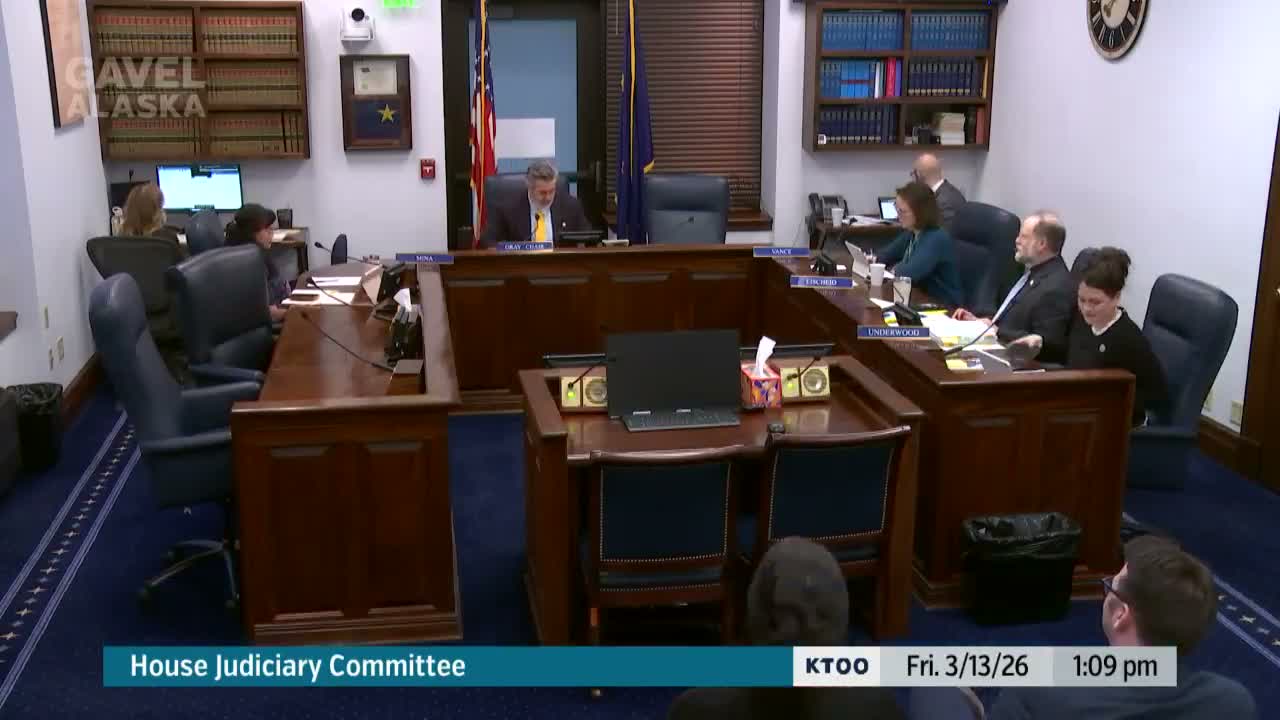
ANCHORAGE — Lawmakers on the House Judiciary Committee heard sharply different views March 13 on House Bill 324, which seeks to regulate virtual‑currency kiosks to reduce fraud.
Sponsor Representative Alexi Moore (District 28) told the committee she was grateful the bill was before the panel and said kiosks have caused "such an impact on our community right now and especially our elders." When asked by Representative Jubilee Underwood about the percentage of kiosk transactions that involve fraud, Moore answered that it is "between 90–93%." The chair and other members sought clarification of that figure.
Ethan McClelland, assistant director of government affairs at CoinFlip, testified online that CoinFlip "share[s] the goal" of protecting consumers but that HB 324 as drafted would amount to "a de facto ban on the industry." McClelland disputed the 90–93% figure, saying CoinFlip's internal data indicate fraud rates in "the low single digits," and he urged the committee to consider alternative, targeted protections.
McClelland recommended several changes: a hold on first‑time transactions to give customers time to realize they were scammed (he described a "cooling off" hold window of about 48–72 hours), a tiered transaction‑limit approach that sets lower limits for new customers and higher limits for returning customers (he said many states use $2,000 as a reporting threshold tied to federal suspicious activity reporting), and reconsideration of a 3% fee cap the bill would impose. "Operating a cryptocurrency kiosk is an extraordinarily expensive business," McClelland said; he warned a 3% fee cap could make the business unsustainable.
After the testimony the committee closed public testimony, set an amendment deadline for HB 324 of Wednesday, March 18 at 11:59 p.m., and set the bill aside to be taken up later.
Next steps: The sponsor and staff will coordinate on possible amendments ahead of the March 18 deadline.
Sponsor Representative Alexi Moore (District 28) told the committee she was grateful the bill was before the panel and said kiosks have caused "such an impact on our community right now and especially our elders." When asked by Representative Jubilee Underwood about the percentage of kiosk transactions that involve fraud, Moore answered that it is "between 90–93%." The chair and other members sought clarification of that figure.
Ethan McClelland, assistant director of government affairs at CoinFlip, testified online that CoinFlip "share[s] the goal" of protecting consumers but that HB 324 as drafted would amount to "a de facto ban on the industry." McClelland disputed the 90–93% figure, saying CoinFlip's internal data indicate fraud rates in "the low single digits," and he urged the committee to consider alternative, targeted protections.
McClelland recommended several changes: a hold on first‑time transactions to give customers time to realize they were scammed (he described a "cooling off" hold window of about 48–72 hours), a tiered transaction‑limit approach that sets lower limits for new customers and higher limits for returning customers (he said many states use $2,000 as a reporting threshold tied to federal suspicious activity reporting), and reconsideration of a 3% fee cap the bill would impose. "Operating a cryptocurrency kiosk is an extraordinarily expensive business," McClelland said; he warned a 3% fee cap could make the business unsustainable.
After the testimony the committee closed public testimony, set an amendment deadline for HB 324 of Wednesday, March 18 at 11:59 p.m., and set the bill aside to be taken up later.
Next steps: The sponsor and staff will coordinate on possible amendments ahead of the March 18 deadline.
Don't Miss a Word: See the Full Meeting!
Go beyond summaries. Unlock every video, transcript, and key insight with a Founder Membership.
✓
Get instant access to full meeting videos
✓
Search and clip any phrase from complete transcripts
✓
Receive AI-powered summaries & custom alerts
✓
Enjoy lifetime, unrestricted access to government data
30-day money-back guarantee
