Committee hears HJR 23 to bar use of Alaska's constitutional budget reserve in initial budgets
March 13, 2026 | 2026 Legislature Alaska, Alaska
This article was created by AI summarizing key points discussed. AI makes mistakes, so for full details and context, please refer to the video of the full meeting. Please report any errors so we can fix them. Report an error »
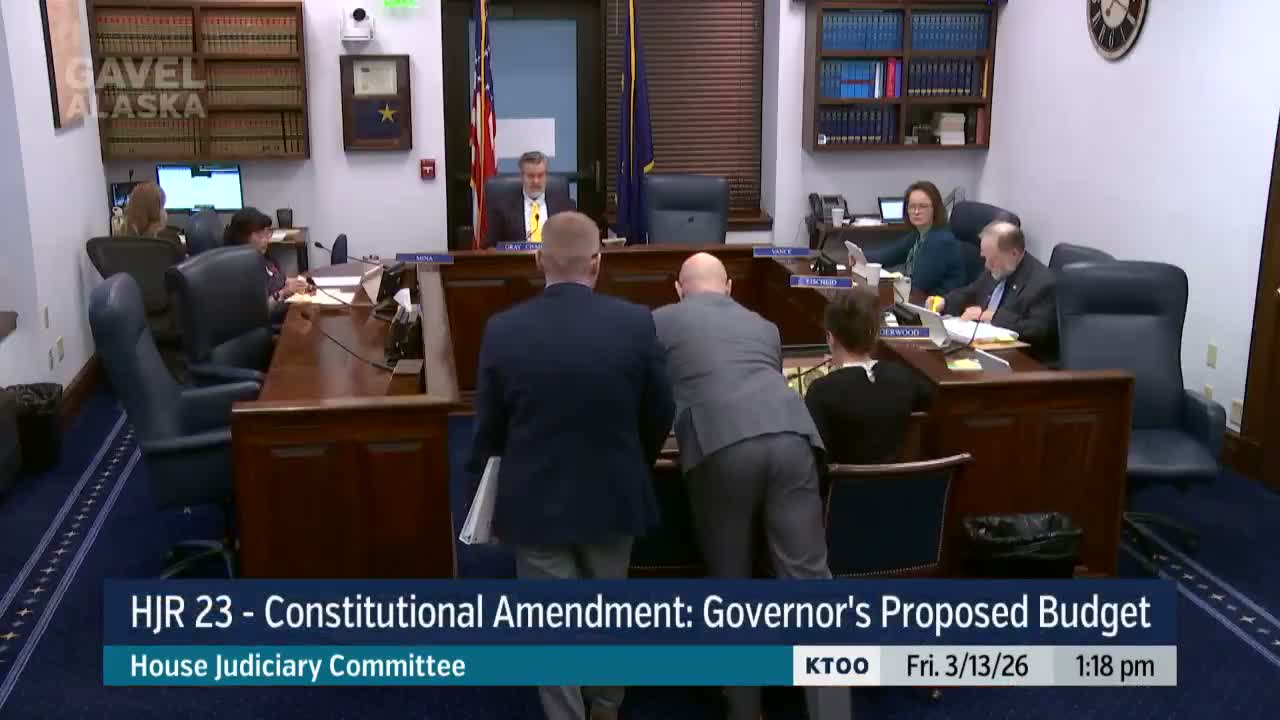
ANCHORAGE — The House Judiciary Committee held a first hearing March 13 on House Joint Resolution 23, which would ask voters to amend the Alaska Constitution so that the governor’s annual budget submission must balance without relying on money in the Constitutional Budget Reserve (CBR) established under section 17.
Sponsor Representative Jubilee Underwood (District 27) said HJR 23 is about "institutional design and long‑term stability," stressing that the resolution "does not set spending levels, it does not eliminate any programs and it does not raise any revenue." The measure would add language to Article 9, Section 12 of the Alaska Constitution to require that the executive branch’s December 15 budget submission show expenditures that do not exceed anticipated revenue and that anticipated revenue not include money in the CBR.
Buddy Witt, staff to Representative Underwood, reviewed the current constitutional text and statutory guidance (cited in committee materials as AS 37 0 7 0 2 0, the Alaska Budget Act) and said the sponsor’s intent is to force a budgeting process that begins with a fiscal plan rather than with numbers that rely on savings. The sponsor offered a friendly amendment to move the effective date to Jan. 1, 2027 to allow a newly elected executive time to prepare under the new constraint.
Rob Carpenter of Legislative Finance briefed members on reserve history. He said the CBR peaked in the 2000s when oil prices spiked — committee references included peak figures of roughly $12 billion (another committee reference cited $18 billion at peak) — and that the CBR balance was about $3 billion at the time of the hearing. Carpenter said the State Budget Reserve (SBR) has been fully utilized.
Legislative Legal Services counsel Marie Marks and Chief Counsel Megan Wallace told the committee the resolution as drafted explicitly excludes the constitutional budget reserve (the fund established under section 17) from anticipated revenue but does not specify a particular constitutional remedy or penalty if an executive submitted a budget that violated the provision. Marks and Wallace said the legislature could seek court action if necessary, but the draft contains no enforcement mechanism.
A member of the public, Mike Cohen of Wasilla, testified he supports the concept but expressed skepticism that the legislature would adhere to stricter fiscal rules and said voters need clear information about how the amendment would interact with existing mechanisms such as PFD/POMV rules.
Next steps: The committee set an amendment deadline for HJR 23 for Wednesday, March 18 at 11:59 p.m., offered a sponsor amendment to make the effective date Jan. 1, 2027, and set the resolution aside for further work.
Sponsor Representative Jubilee Underwood (District 27) said HJR 23 is about "institutional design and long‑term stability," stressing that the resolution "does not set spending levels, it does not eliminate any programs and it does not raise any revenue." The measure would add language to Article 9, Section 12 of the Alaska Constitution to require that the executive branch’s December 15 budget submission show expenditures that do not exceed anticipated revenue and that anticipated revenue not include money in the CBR.
Buddy Witt, staff to Representative Underwood, reviewed the current constitutional text and statutory guidance (cited in committee materials as AS 37 0 7 0 2 0, the Alaska Budget Act) and said the sponsor’s intent is to force a budgeting process that begins with a fiscal plan rather than with numbers that rely on savings. The sponsor offered a friendly amendment to move the effective date to Jan. 1, 2027 to allow a newly elected executive time to prepare under the new constraint.
Rob Carpenter of Legislative Finance briefed members on reserve history. He said the CBR peaked in the 2000s when oil prices spiked — committee references included peak figures of roughly $12 billion (another committee reference cited $18 billion at peak) — and that the CBR balance was about $3 billion at the time of the hearing. Carpenter said the State Budget Reserve (SBR) has been fully utilized.
Legislative Legal Services counsel Marie Marks and Chief Counsel Megan Wallace told the committee the resolution as drafted explicitly excludes the constitutional budget reserve (the fund established under section 17) from anticipated revenue but does not specify a particular constitutional remedy or penalty if an executive submitted a budget that violated the provision. Marks and Wallace said the legislature could seek court action if necessary, but the draft contains no enforcement mechanism.
A member of the public, Mike Cohen of Wasilla, testified he supports the concept but expressed skepticism that the legislature would adhere to stricter fiscal rules and said voters need clear information about how the amendment would interact with existing mechanisms such as PFD/POMV rules.
Next steps: The committee set an amendment deadline for HJR 23 for Wednesday, March 18 at 11:59 p.m., offered a sponsor amendment to make the effective date Jan. 1, 2027, and set the resolution aside for further work.
Don't Miss a Word: See the Full Meeting!
Go beyond summaries. Unlock every video, transcript, and key insight with a Founder Membership.
✓
Get instant access to full meeting videos
✓
Search and clip any phrase from complete transcripts
✓
Receive AI-powered summaries & custom alerts
✓
Enjoy lifetime, unrestricted access to government data
30-day money-back guarantee
