Governor Bob Ferguson signs two dozen bipartisan bills touching foster care, behavioral health, housing and labor
March 18, 2026 | Governor's Office - Boards & Commissions, Executive, Washington
This article was created by AI summarizing key points discussed. AI makes mistakes, so for full details and context, please refer to the video of the full meeting. Please report any errors so we can fix them. Report an error »
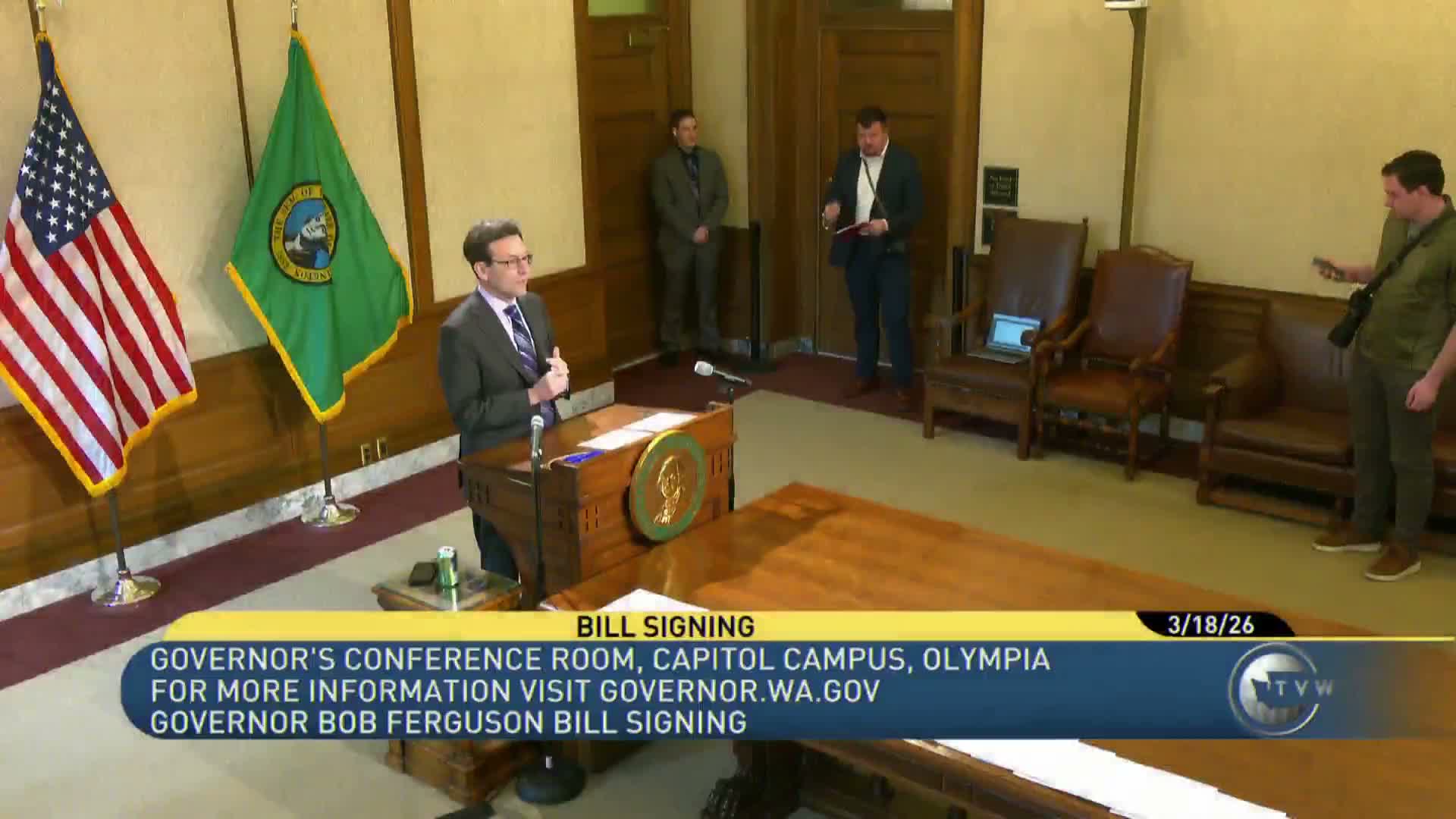
Governor Bob Ferguson signed about two dozen bipartisan bills at a ceremony at the state Capitol in Olympia, enacting measures that state officials said aim to improve services for foster youth, streamline public works, increase consumer protections and expand workers' rights.
Ferguson, the governor, introduced each measure, thanked sponsors and advocates, and posed for photographs with lawmakers and supporters after each signing. "Traffic stops, of course, can be stressful for everybody," Ferguson said as he signed House Bill 23-23, which creates a Department of Licensing "blue folder" program intended to help neurodivergent Washingtonians during traffic stops by standardizing documentation.
Why it matters: The package addresses a range of statewide concerns. Advocates described HB 25-05 as a stability measure for former foster youth by allowing approved foster parents to continue providing care without obtaining an adult family home license; Senate Bill 59-11 will stop the state from using certain Social Security benefits to pay for care for 18–21-year-olds in extended foster care, an action the governor said will allow "an estimated 80 young adults" to retain benefits. The bills also include measures to expand weatherization (HB 23-38), raise small-works roster thresholds for public projects (HB 24-20), and require disclosure of compliance information for residential rehabilitation centers (HB 23-50).
Other notable items signed included SB 57-20, which enacts the Uniform Consumer Debt Default Judgment Act in state law to improve information available to people facing default-judgment collection; SB 58-80, which authorizes jurisdictions to contract with certified private labs to reduce blood-analysis backlogs for DUI cases; and HB 15-70, which allows nonacademic student employees at Western Washington University to unionize and bargain collectively.
On labor and enforcement, the governor signed SB 63-02 to strengthen review by Labor and Industries of potential independent-contractor misclassification and SB 60-11 to allow Court of Appeals bailiffs to investigate and refer threats to local law enforcement. For transportation and infrastructure, SB 56-90 requires the state Department of Transportation to notify utility owners about planned fish-passage removal projects and maximize federal funds for relocations; HB 24-95 lets Seattle transportation officials impound vehicles blocking streetcar tracks to resume service more quickly.
Ferguson repeatedly credited bipartisan cooperation and advocacy by stakeholders and named prime sponsors during each signing. The event was largely ceremonial: the transcript records introductions, brief bill descriptions by the governor and photo opportunities after each signing, but not legislative debate or recorded votes during the ceremony.
What comes next: The bills were presented for signature and signed into law at the event; effective dates were not universally specified during the ceremony and may vary by statute. Several sponsors present received pens and photographs; staff and advocates joined many of the photo opportunities. The governor indicated some bills could take effect immediately while others require implementation steps by agencies.
Ferguson, the governor, introduced each measure, thanked sponsors and advocates, and posed for photographs with lawmakers and supporters after each signing. "Traffic stops, of course, can be stressful for everybody," Ferguson said as he signed House Bill 23-23, which creates a Department of Licensing "blue folder" program intended to help neurodivergent Washingtonians during traffic stops by standardizing documentation.
Why it matters: The package addresses a range of statewide concerns. Advocates described HB 25-05 as a stability measure for former foster youth by allowing approved foster parents to continue providing care without obtaining an adult family home license; Senate Bill 59-11 will stop the state from using certain Social Security benefits to pay for care for 18–21-year-olds in extended foster care, an action the governor said will allow "an estimated 80 young adults" to retain benefits. The bills also include measures to expand weatherization (HB 23-38), raise small-works roster thresholds for public projects (HB 24-20), and require disclosure of compliance information for residential rehabilitation centers (HB 23-50).
Other notable items signed included SB 57-20, which enacts the Uniform Consumer Debt Default Judgment Act in state law to improve information available to people facing default-judgment collection; SB 58-80, which authorizes jurisdictions to contract with certified private labs to reduce blood-analysis backlogs for DUI cases; and HB 15-70, which allows nonacademic student employees at Western Washington University to unionize and bargain collectively.
On labor and enforcement, the governor signed SB 63-02 to strengthen review by Labor and Industries of potential independent-contractor misclassification and SB 60-11 to allow Court of Appeals bailiffs to investigate and refer threats to local law enforcement. For transportation and infrastructure, SB 56-90 requires the state Department of Transportation to notify utility owners about planned fish-passage removal projects and maximize federal funds for relocations; HB 24-95 lets Seattle transportation officials impound vehicles blocking streetcar tracks to resume service more quickly.
Ferguson repeatedly credited bipartisan cooperation and advocacy by stakeholders and named prime sponsors during each signing. The event was largely ceremonial: the transcript records introductions, brief bill descriptions by the governor and photo opportunities after each signing, but not legislative debate or recorded votes during the ceremony.
What comes next: The bills were presented for signature and signed into law at the event; effective dates were not universally specified during the ceremony and may vary by statute. Several sponsors present received pens and photographs; staff and advocates joined many of the photo opportunities. The governor indicated some bills could take effect immediately while others require implementation steps by agencies.
View the Full Meeting & All Its Details
This article offers just a summary. Unlock complete video, transcripts, and insights as a Founder Member.
✓
Watch full, unedited meeting videos
✓
Search every word spoken in unlimited transcripts
✓
AI summaries & real-time alerts (all government levels)
✓
Permanent access to expanding government content
30-day money-back guarantee
