DNR bill proposing longer land contracts and removal of duplicate state refuge designations set aside for Fish & Game input
March 16, 2026 | 2026 Legislature Alaska, Alaska
This article was created by AI summarizing key points discussed. AI makes mistakes, so for full details and context, please refer to the video of the full meeting. Please report any errors so we can fix them. Report an error »
Christy Collas, director of the Division of Mining, Land and Water, told the Senate Resources Committee that SB224 bundles five changes to state land law intended to streamline land sales and make some parcels marketable for commercial use. “We want to move contracts from a 20 year contract to 30,” Collas said, adding that longer contracts should lower annual payments and make it easier for buyers to obtain bank financing.
Collas said the bill would also replace the term “foreclosure” with “termination,” update statutory organization, change when surveys are required for leases, repeal outdated state refuge listings for the Kenai Moose Range and the Kodiak area, and remove a 3‑acre Business Park Wetlands encumbrance in Midtown Anchorage that currently creates an annual maintenance burden for the department.
Committee counsel Christopher Orman, Department of Law, told members the repeal of state refuge listings would remove only the state overlay; federal refuge protections would remain in place. “The federal refuge can’t be taken away by this state legislation,” Orman said, explaining the state refuge listings were created in 1960 as a mirror of then‑federal footprints and now function largely as a statutory placeholder.
Bob Dole, director of Community and Economic Development for the Municipality of Anchorage, testified that the Business Park Wetlands parcel has become a nuisance: the nonprofit charged with its administration is defunct and the tract has become the site of trespass camps. “Conveying it back to the municipality will empower us to use our sources to take on this nuisance property and eliminate the nuisance,” Dole said.
Committee members pressed DNR staff on whether state lands within the listed refuges receive any active state management. Collas said in practice DNR does not actively manage those lands differently than other state lands and that Fish and Game manages wildlife; DNR staff said they plan to ask Fish and Game to appear at the next hearing to clarify management and any procedural requirements.
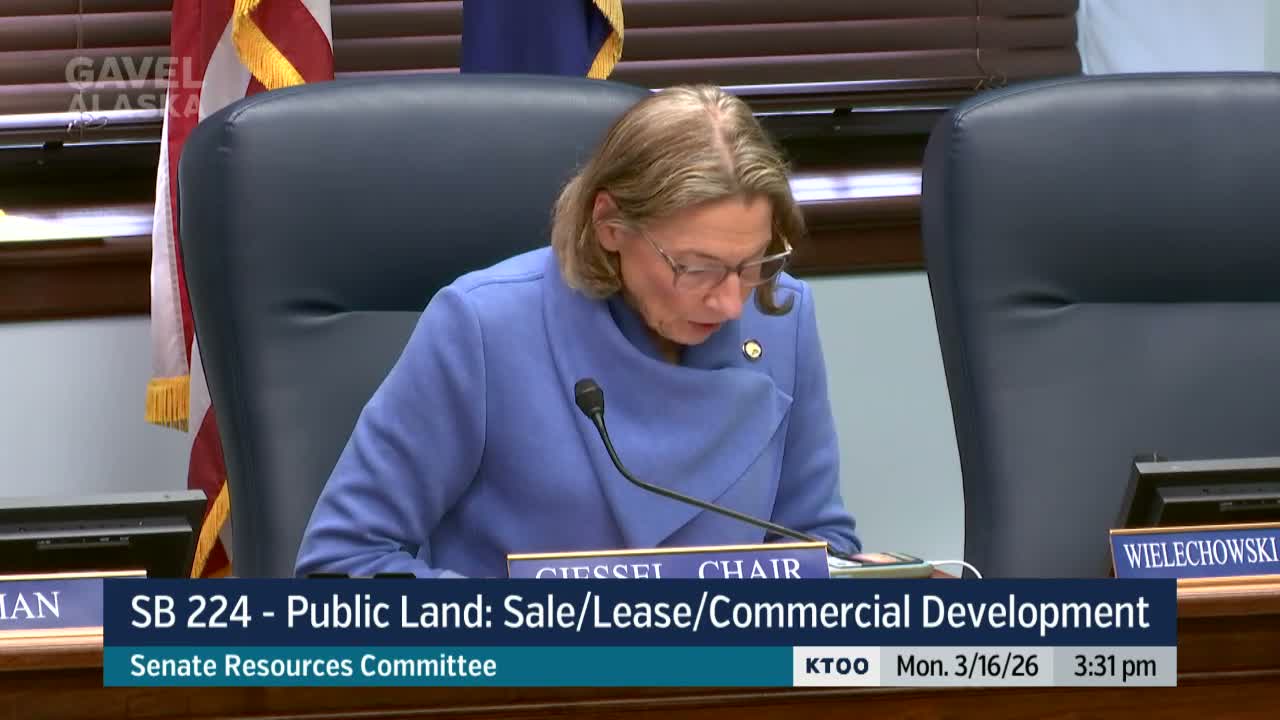
Chair Senator Giesel closed public testimony (none present) and set SB224 aside without setting an amendment deadline until the committee receives Fish and Game’s input. No committee vote was taken.
What’s next: DNR and the Department of Fish and Game will be asked to provide written clarification and, if possible, appear at the committee’s next hearing to explain how federal refuge boundary changes have been processed historically and what state tools would remain after repeal.
Collas said the bill would also replace the term “foreclosure” with “termination,” update statutory organization, change when surveys are required for leases, repeal outdated state refuge listings for the Kenai Moose Range and the Kodiak area, and remove a 3‑acre Business Park Wetlands encumbrance in Midtown Anchorage that currently creates an annual maintenance burden for the department.
Committee counsel Christopher Orman, Department of Law, told members the repeal of state refuge listings would remove only the state overlay; federal refuge protections would remain in place. “The federal refuge can’t be taken away by this state legislation,” Orman said, explaining the state refuge listings were created in 1960 as a mirror of then‑federal footprints and now function largely as a statutory placeholder.
Bob Dole, director of Community and Economic Development for the Municipality of Anchorage, testified that the Business Park Wetlands parcel has become a nuisance: the nonprofit charged with its administration is defunct and the tract has become the site of trespass camps. “Conveying it back to the municipality will empower us to use our sources to take on this nuisance property and eliminate the nuisance,” Dole said.
Committee members pressed DNR staff on whether state lands within the listed refuges receive any active state management. Collas said in practice DNR does not actively manage those lands differently than other state lands and that Fish and Game manages wildlife; DNR staff said they plan to ask Fish and Game to appear at the next hearing to clarify management and any procedural requirements.
Chair Senator Giesel closed public testimony (none present) and set SB224 aside without setting an amendment deadline until the committee receives Fish and Game’s input. No committee vote was taken.
What’s next: DNR and the Department of Fish and Game will be asked to provide written clarification and, if possible, appear at the committee’s next hearing to explain how federal refuge boundary changes have been processed historically and what state tools would remain after repeal.
Don't Miss a Word: See the Full Meeting!
Go beyond summaries. Unlock every video, transcript, and key insight with a Founder Membership.
✓
Get instant access to full meeting videos
✓
Search and clip any phrase from complete transcripts
✓
Receive AI-powered summaries & custom alerts
✓
Enjoy lifetime, unrestricted access to government data
30-day money-back guarantee
