Senate subcommittee carries over bill to codify childcare scholarship program amid funding concerns
March 18, 2026 | 2026 Legislative Meetings, South Carolina
This article was created by AI summarizing key points discussed. AI makes mistakes, so for full details and context, please refer to the video of the full meeting. Please report any errors so we can fix them. Report an error »
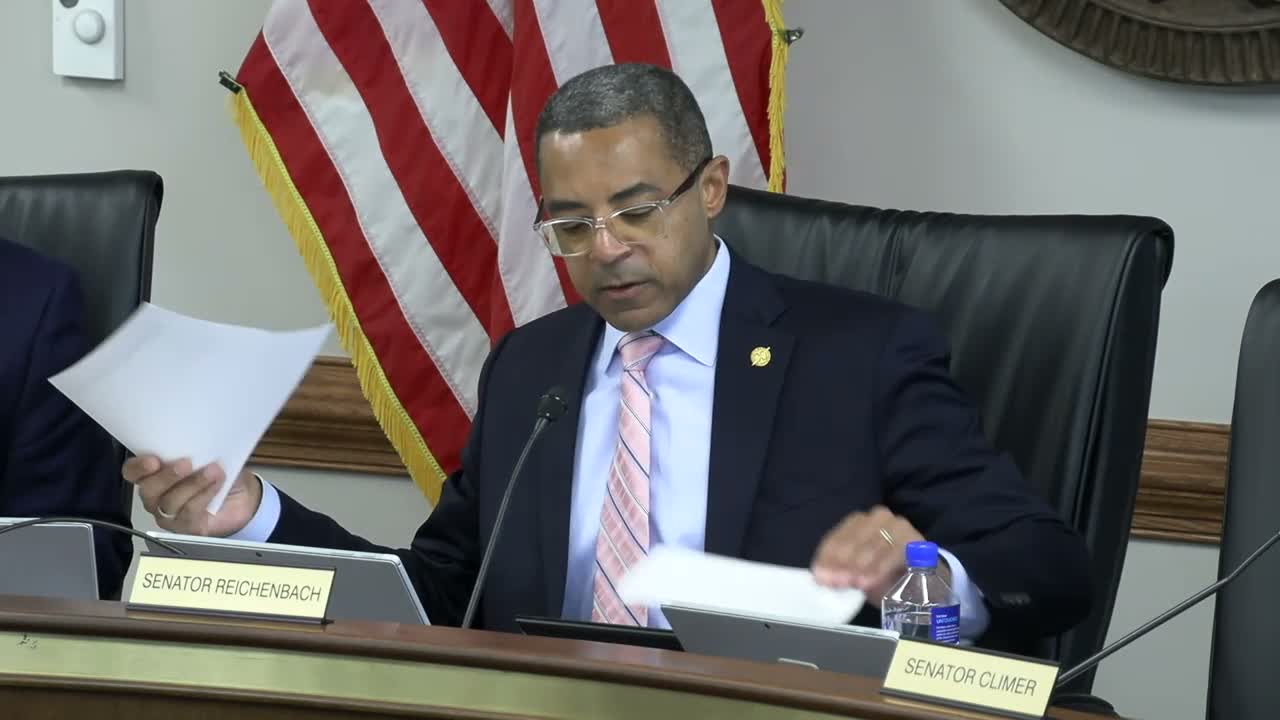
Senate Subcommittee on Child Welfare Chairman Senator Mike Rickenbaugh opened a Feb. 2026 hearing on Senate Bill 770, which would codify the state's childcare scholarship (voucher) program and expand eligibility, including for children of childcare workers. After testimony from advocates, providers and state officials, the committee voted by voice to carry the bill over for further consideration.
The bill sponsor, Senator Josh Kimbrell, said the measure largely mirrors a Kentucky law and aims to convert a program currently run by the Department of Social Services by regulation into state statute to create a more permanent structure. "What we're trying to do now is take what already, to some extent, is in practice, expand that, and make it statutory," Kimbrell said, adding the change would make it easier to support children of childcare workers and encourage a larger workforce.
Supporters from business and advocacy groups described the bill as a pragmatic step to address both affordability and workforce shortages. "Childcare policy is complex, but no single bill will solve this problem," said Sarah Curran, executive director of South Carolinians for Common Sense, who urged refinements to co-pay rules to avoid unintended costs for the lowest-income families. Ron Garner of Spartanburg Inc. said childcare is "not only a family issue" but a workforce and economic-competitiveness issue for the state.
Several witnesses welcomed the policy goal but warned S.770 lacks a sustainable funding plan. Ashley Lito, chief strategy officer for the Women's Rights and Empowerment Network (Wren), said Wren "cannot support 770 as currently written" because expanding eligibility without recurring funding risks encouraging applications the state cannot afford and could destabilize providers who rely on scholarship participation.
Conley Ann Ragley of the South Carolina Department of Social Services provided the committee with fiscal and program context. Ragley said the state currently contributes about $14 million in recurring funds annually to the scholarship program and, with that, draws roughly $150'$160 million in federal Child Care and Development Fund (CCDF) dollars. She said the scholarship program served 22,252 children in February 2026 and estimated that the bill's new eligibility definitions could add roughly 11,843 children who are not currently eligible. Ragley warned that some of the bill's added categories could not be paid for with CCDF dollars and therefore would require state funds if adopted.
Not all testimony was favorable. Amanda Hovis, a grassroots leader from Spartanburg, argued the measure risks expanding the welfare system and raised a federal compliance concern, citing "section 98.56" and warning that certain federal funds prohibit use for sectarian worship or instruction; she said the bill should be clearer about funding sources and compliance. Several senators echoed the point that codifying eligibility without appropriations could create an unfunded mandate, recalling earlier statutory commissions that were never funded and therefore never operationalized.
Committee members asked about Kentucky's experience and the scale of state investment there; the sponsor and witnesses said Kentucky had put substantial state dollars behind its package in addition to federal grants. Ragley clarified that Kentucky's expansion included meaningful recurring state investments and tobacco-settlement funding; she cautioned the committee that South Carolina's current CCDF rules constrain what federal funds may cover and that additional eligible categories under S.770 would likely require new state dollars.
In a procedural motion as the legislature prepared to convene, a senator moved that S.770 be carried over; the motion was seconded and passed by voice vote with proxies counted, and the committee adjourned. The bill will return for further vetting, including the fiscal implications and co-pay calculations that witnesses and DSS urged the panel to address.
The subcommittee hearing combined personal testimony from parents and providers, policy context from advocacy groups and business leaders, and technical funding guidance from DSS. Committee members signaled support for the bill's aims but asked for more detail on recurring funding sources, co-pay impacts on the lowest-income families, and compliance with federal CCDF rules before advancing the measure.
The bill sponsor, Senator Josh Kimbrell, said the measure largely mirrors a Kentucky law and aims to convert a program currently run by the Department of Social Services by regulation into state statute to create a more permanent structure. "What we're trying to do now is take what already, to some extent, is in practice, expand that, and make it statutory," Kimbrell said, adding the change would make it easier to support children of childcare workers and encourage a larger workforce.
Supporters from business and advocacy groups described the bill as a pragmatic step to address both affordability and workforce shortages. "Childcare policy is complex, but no single bill will solve this problem," said Sarah Curran, executive director of South Carolinians for Common Sense, who urged refinements to co-pay rules to avoid unintended costs for the lowest-income families. Ron Garner of Spartanburg Inc. said childcare is "not only a family issue" but a workforce and economic-competitiveness issue for the state.
Several witnesses welcomed the policy goal but warned S.770 lacks a sustainable funding plan. Ashley Lito, chief strategy officer for the Women's Rights and Empowerment Network (Wren), said Wren "cannot support 770 as currently written" because expanding eligibility without recurring funding risks encouraging applications the state cannot afford and could destabilize providers who rely on scholarship participation.
Conley Ann Ragley of the South Carolina Department of Social Services provided the committee with fiscal and program context. Ragley said the state currently contributes about $14 million in recurring funds annually to the scholarship program and, with that, draws roughly $150'$160 million in federal Child Care and Development Fund (CCDF) dollars. She said the scholarship program served 22,252 children in February 2026 and estimated that the bill's new eligibility definitions could add roughly 11,843 children who are not currently eligible. Ragley warned that some of the bill's added categories could not be paid for with CCDF dollars and therefore would require state funds if adopted.
Not all testimony was favorable. Amanda Hovis, a grassroots leader from Spartanburg, argued the measure risks expanding the welfare system and raised a federal compliance concern, citing "section 98.56" and warning that certain federal funds prohibit use for sectarian worship or instruction; she said the bill should be clearer about funding sources and compliance. Several senators echoed the point that codifying eligibility without appropriations could create an unfunded mandate, recalling earlier statutory commissions that were never funded and therefore never operationalized.
Committee members asked about Kentucky's experience and the scale of state investment there; the sponsor and witnesses said Kentucky had put substantial state dollars behind its package in addition to federal grants. Ragley clarified that Kentucky's expansion included meaningful recurring state investments and tobacco-settlement funding; she cautioned the committee that South Carolina's current CCDF rules constrain what federal funds may cover and that additional eligible categories under S.770 would likely require new state dollars.
In a procedural motion as the legislature prepared to convene, a senator moved that S.770 be carried over; the motion was seconded and passed by voice vote with proxies counted, and the committee adjourned. The bill will return for further vetting, including the fiscal implications and co-pay calculations that witnesses and DSS urged the panel to address.
The subcommittee hearing combined personal testimony from parents and providers, policy context from advocacy groups and business leaders, and technical funding guidance from DSS. Committee members signaled support for the bill's aims but asked for more detail on recurring funding sources, co-pay impacts on the lowest-income families, and compliance with federal CCDF rules before advancing the measure.
View the Full Meeting & All Its Details
This article offers just a summary. Unlock complete video, transcripts, and insights as a Founder Member.
✓
Watch full, unedited meeting videos
✓
Search every word spoken in unlimited transcripts
✓
AI summaries & real-time alerts (all government levels)
✓
Permanent access to expanding government content
30-day money-back guarantee
