Senate panel advances SB 868 to standardize and expand plug‑in ‘balcony’ solar amid safety debate
March 17, 2026 | California State Senate, Senate, Legislative, California
This article was created by AI summarizing key points discussed. AI makes mistakes, so for full details and context, please refer to the video of the full meeting. Please report any errors so we can fix them. Report an error »
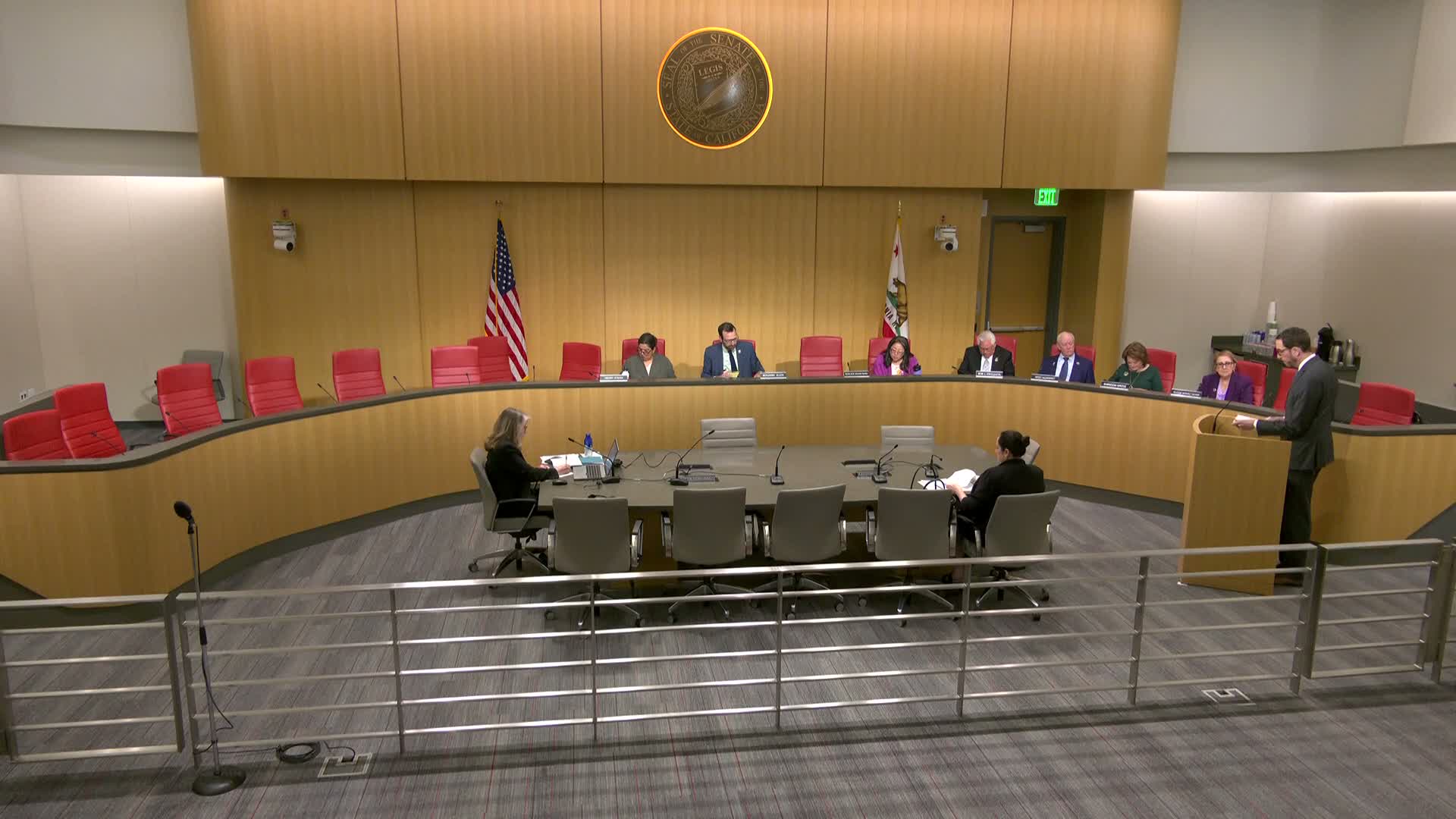
Senators advanced SB 868, the ‘‘plug‑and‑play’’ or so‑called balcony solar bill, after a hearing that juxtaposed affordability arguments from the bill’s author and environmental advocates with safety concerns from electrical workers, firefighters and utilities.
Senator Wiener, the bill’s author, said the measure would give renters and owners of small homes a low‑cost way to reduce monthly electricity bills. "This is fundamentally about giving people the ability to lower their electric bills," he said, and said he accepted committee amendments to reference the National Electrical Code and to require a simple online notification form for utilities.
Bernadette Del Quiero, senior vice president at Environmental Working Group California, told the committee the kits come as a ready‑to‑sell package and estimated a 400‑watt unit could save a household about $250 a year. "You can pull one off the shelf, bring it home, in less than an hour, set it up, plug it in and start saving," she said.
Opponents pressed safety and process concerns. Osha Ashworth, a longtime electrical inspector, warned that older home wiring, incompatible GFCIs and some legacy panels pose shock and fire hazards if products are plugged into existing circuits without appropriate inspection. "This bill does not ensure safe installation, maintenance, or inspection standards," Ashworth said, urging the committee not to move the bill as drafted.
Scott Wedge, representing the California State Association of Electrical Workers and the California Coalition of Utility Employees, told senators the Legislature has not previously adopted building standards in statute and urged the committee to allow the Building Standards Commission and California Electrical Code (CEC) process to vet any changes. He and other opponents said the bill, as drafted, could short‑circuit the CEC’s multiagency review.
A technical witness, Pete Jackson of UL Solutions and a former Bakersfield chief electrical inspector, summarized UL Solutions’ 2025 white paper and an outline of investigation labeled UL 3,700 that addresses identified risks: overcurrent on circuits with two sources, GFCI compatibility and touch safety. Jackson said a product certified to UL 3,700 would mitigate those risks but emphasized that UL product standards should align with installation rules enforced locally.
Senators spent considerable time debating whether the bill should reference the NEC, the CEC, or both. The author accepted committee amendments that require compliance with the National Electrical Code and indicated willingness to amend later to include California Electrical Code alignment; several opponents signaled they would withdraw opposition if that change were made.
The committee voted to pass the bill as amended to Senate Judiciary. The record shows the committee holding the roll and reporting SB 868 passed as amended to the next committee.
Senator Wiener, the bill’s author, said the measure would give renters and owners of small homes a low‑cost way to reduce monthly electricity bills. "This is fundamentally about giving people the ability to lower their electric bills," he said, and said he accepted committee amendments to reference the National Electrical Code and to require a simple online notification form for utilities.
Bernadette Del Quiero, senior vice president at Environmental Working Group California, told the committee the kits come as a ready‑to‑sell package and estimated a 400‑watt unit could save a household about $250 a year. "You can pull one off the shelf, bring it home, in less than an hour, set it up, plug it in and start saving," she said.
Opponents pressed safety and process concerns. Osha Ashworth, a longtime electrical inspector, warned that older home wiring, incompatible GFCIs and some legacy panels pose shock and fire hazards if products are plugged into existing circuits without appropriate inspection. "This bill does not ensure safe installation, maintenance, or inspection standards," Ashworth said, urging the committee not to move the bill as drafted.
Scott Wedge, representing the California State Association of Electrical Workers and the California Coalition of Utility Employees, told senators the Legislature has not previously adopted building standards in statute and urged the committee to allow the Building Standards Commission and California Electrical Code (CEC) process to vet any changes. He and other opponents said the bill, as drafted, could short‑circuit the CEC’s multiagency review.
A technical witness, Pete Jackson of UL Solutions and a former Bakersfield chief electrical inspector, summarized UL Solutions’ 2025 white paper and an outline of investigation labeled UL 3,700 that addresses identified risks: overcurrent on circuits with two sources, GFCI compatibility and touch safety. Jackson said a product certified to UL 3,700 would mitigate those risks but emphasized that UL product standards should align with installation rules enforced locally.
Senators spent considerable time debating whether the bill should reference the NEC, the CEC, or both. The author accepted committee amendments that require compliance with the National Electrical Code and indicated willingness to amend later to include California Electrical Code alignment; several opponents signaled they would withdraw opposition if that change were made.
The committee voted to pass the bill as amended to Senate Judiciary. The record shows the committee holding the roll and reporting SB 868 passed as amended to the next committee.
Don't Miss a Word: See the Full Meeting!
Go beyond summaries. Unlock every video, transcript, and key insight with a Founder Membership.
✓
Get instant access to full meeting videos
✓
Search and clip any phrase from complete transcripts
✓
Receive AI-powered summaries & custom alerts
✓
Enjoy lifetime, unrestricted access to government data
30-day money-back guarantee
