Nebraska senators spar over pay raises for constitutional officers as budget gap looms
March 17, 2026 | 2026 Legislature NE, Nebraska
This article was created by AI summarizing key points discussed. AI makes mistakes, so for full details and context, please refer to the video of the full meeting. Please report any errors so we can fix them. Report an error »
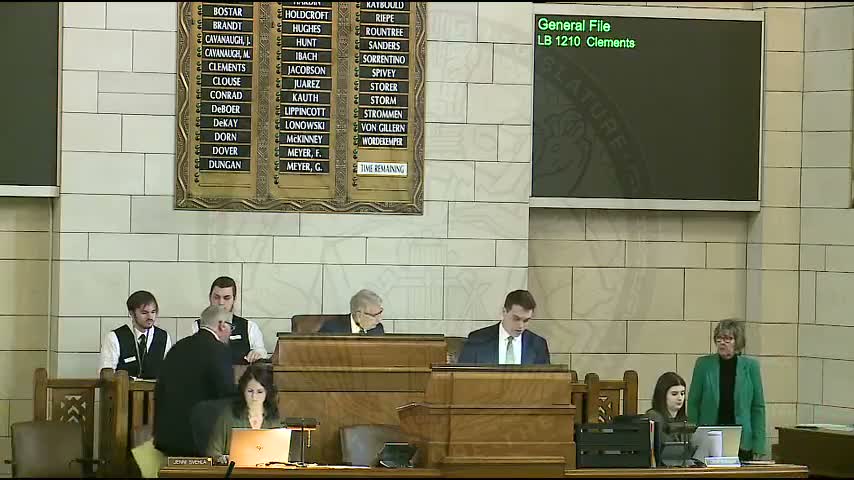
Lincoln — Nebraska senators spent a large portion of the floor session debating whether to adjust the salaries of the state’s constitutional officers, advancing LB 12-10 to E & R initial after lengthy remarks and roll-call votes.
Senator John Clemens, sponsor of the bill and author of floor amendment AM2661, said the measure would change salaries effective Jan. 1, 2027, so the increases would apply to the officers elected in November 2026 and not to current officeholders. Clemens said he used a 1.3% annual inflation factor to limit the increase and estimated the half-year cost to the current budget would be $97,500, with an annualized impact of about $195,000 thereafter.
"It has been 20 years since these salaries were changed in Nebraska," Clemens said, arguing that the modest increase would help attract and retain qualified officials who oversee large budgets and staff.
Opponents focused on timing and fiscal priorities. Speaker Arch and several other senators said the state faces a structural budget deficit and that this was not the time to add recurring costs. "We are in a budget crisis right now," Speaker Arch said, urging a "no" vote on the bill as currently timed.
Senator Conrad offered an amendment, AM2690, to strip raises for all constitutional officers except the state auditor and to single out the auditor for an increase; Conrad argued the auditor’s office had demonstrated a clear, performance-based case for higher pay. That motion failed on the floor.
Several senators pressed both policy and process concerns: some said the shell-bill tactic (using an appropriations committee shell to carry substantive language) reduced transparency, while backers said a floor compromise could be found on select file.
After recorded voting and a temporary call of the chamber to secure senators for the tally, the body voted to advance LB 12-10 to E & R initial. The clerk recorded 34 ayes and 4 nays on advancement. The bill will be considered on select file, where senators said they plan to continue negotiations and possible amendments.
The session transcript shows a mix of procedural and substantive arguments: proponents stressed parity with surrounding states and recruitment needs; opponents emphasized recent sweeps of trust funds and proposed revenue or spending trade-offs to cover any pay increases. No appropriation to take effect before January 2027 was enacted on the floor during this session.
Senator John Clemens, sponsor of the bill and author of floor amendment AM2661, said the measure would change salaries effective Jan. 1, 2027, so the increases would apply to the officers elected in November 2026 and not to current officeholders. Clemens said he used a 1.3% annual inflation factor to limit the increase and estimated the half-year cost to the current budget would be $97,500, with an annualized impact of about $195,000 thereafter.
"It has been 20 years since these salaries were changed in Nebraska," Clemens said, arguing that the modest increase would help attract and retain qualified officials who oversee large budgets and staff.
Opponents focused on timing and fiscal priorities. Speaker Arch and several other senators said the state faces a structural budget deficit and that this was not the time to add recurring costs. "We are in a budget crisis right now," Speaker Arch said, urging a "no" vote on the bill as currently timed.
Senator Conrad offered an amendment, AM2690, to strip raises for all constitutional officers except the state auditor and to single out the auditor for an increase; Conrad argued the auditor’s office had demonstrated a clear, performance-based case for higher pay. That motion failed on the floor.
Several senators pressed both policy and process concerns: some said the shell-bill tactic (using an appropriations committee shell to carry substantive language) reduced transparency, while backers said a floor compromise could be found on select file.
After recorded voting and a temporary call of the chamber to secure senators for the tally, the body voted to advance LB 12-10 to E & R initial. The clerk recorded 34 ayes and 4 nays on advancement. The bill will be considered on select file, where senators said they plan to continue negotiations and possible amendments.
The session transcript shows a mix of procedural and substantive arguments: proponents stressed parity with surrounding states and recruitment needs; opponents emphasized recent sweeps of trust funds and proposed revenue or spending trade-offs to cover any pay increases. No appropriation to take effect before January 2027 was enacted on the floor during this session.
Don't Miss a Word: See the Full Meeting!
Go beyond summaries. Unlock every video, transcript, and key insight with a Founder Membership.
✓
Get instant access to full meeting videos
✓
Search and clip any phrase from complete transcripts
✓
Receive AI-powered summaries & custom alerts
✓
Enjoy lifetime, unrestricted access to government data
30-day money-back guarantee
