Arizona Senate Republican caucus reviews consent calendar, pulls several education and public-safety bills
March 17, 2026 | 2026 Legislature Arizona, Arizona
This article was created by AI summarizing key points discussed. AI makes mistakes, so for full details and context, please refer to the video of the full meeting. Please report any errors so we can fix them. Report an error »
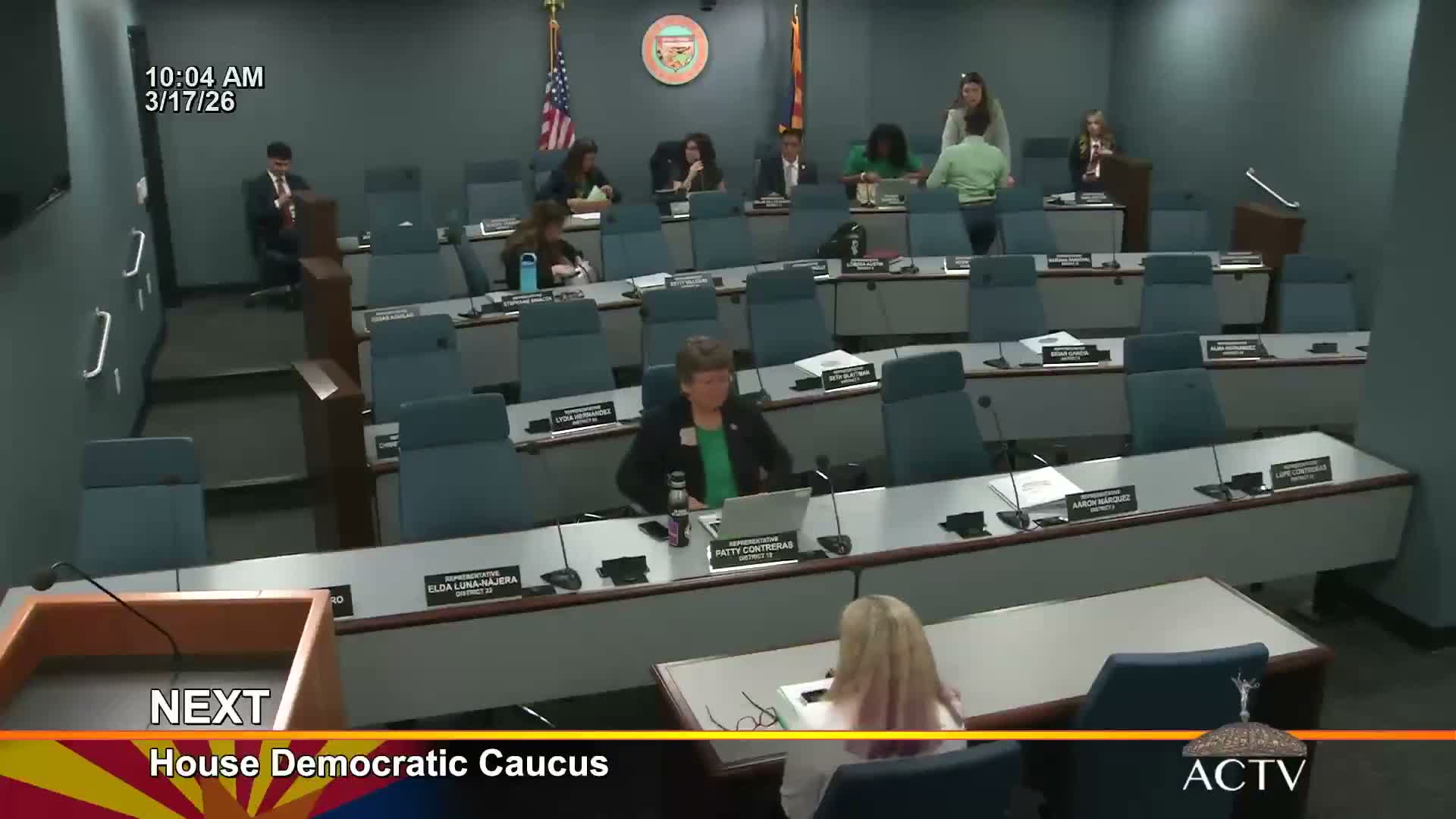
The Arizona Senate Republican caucus met March 17 at the State Capitol to review the consent calendar and pulled a number of bills for further consideration, drawing debate on education, public-safety and administrative matters.
The chair opened the meeting by running through dozens of consent items, and members repeatedly asked for specific bills to be removed for fuller debate. "None of these bills do anything to make Arizona more affordable," the chair said while urging members not to conflate the consent calendar with budget priorities. "None of these bills help our public schools," the chair added, calling some items "a waste of our time." (Chair)
Among the measures removed from consent were bills that increase criminal penalties for exposing minors to sexually explicit material and that would apply to school and public libraries. Speaker Israel presented SB 14-35, which would make referring students to certain explicit material a classified felony and increase penalties; Leader raised a rules-office concern tied to an undefined term in the bill that could create due-process issues. "The rules attorney had constitutional issues with this because it uses the word 'facilitate' but doesn't define it," the Leader said, noting potential vagueness. (Israel; Leader)
Education-focused bills prompted several members to question policy effects and implementation. Mike Lynn, who presented SB 11-66, said the bill would allow accommodation schools to offer high-school equivalency instruction to younger students and those over 16; several members worried it could truncate students' high-school experience. "I don't think we should be offering eleventh graders a way out of a full high school experience," Lynn said, while other members argued the change could help youth who are unhoused, in juvenile detention or otherwise on their own. Lynn said he would follow up on questions about eligibility and funding. (Mike Lynn)
The caucus also pulled SB 17-41, which would require school districts and charter governing bodies to allow released-time religious instruction during school hours, set provider requirements, and permit districts to award academic credit and count the time toward average-daily-membership calculations. Members asked to discuss the measure offline. (Mike Lynn)
Public-safety and campus-safety measures drew pointed objections. Speaker Yamini described SB 10-68, which would bar university governing boards from enforcing policies that prohibit possession of a concealed weapon by a valid permit-holder on campus; members said universities were opposed and raised safety concerns, asking to remove the bill from consent. (Yamini)
Other pulled items included SB 10-55 (requiring immediate ICE/CBP notification when law enforcement arrests a person unlawfully present in the U.S.), a bill expanding the state's alignment of controlled-substance scheduling with federal FDA/DEA actions, and multiple procedural or technical bills addressing agency guidance posting, burial-cost caps, and memoranda of understanding between the Department of Child Safety and Indian tribes. Several presenters said they would be available to answer follow-up questions or supply clarifying language. (Saliana; Noah; Becca)
Throughout the meeting, members asked for precise clarifications the bills did not yet provide in the caucus packet, including who would pay for independent medical evaluators in mental-health proceedings, the funding structure for accommodation schools, and whether certain bills had previously been vetoed by the governor. Presenters frequently answered that they would "look into that" or follow up with language checks rather than committing to immediate answers. (Magali; Mike Lynn)
The caucus ended by announcing internal items and adjourned into a brief closed caucus with guests asked to leave. Several members scheduled offline conversations to resolve constitutional or implementation questions before the measures return to broader committee or chamber consideration.
The chair opened the meeting by running through dozens of consent items, and members repeatedly asked for specific bills to be removed for fuller debate. "None of these bills do anything to make Arizona more affordable," the chair said while urging members not to conflate the consent calendar with budget priorities. "None of these bills help our public schools," the chair added, calling some items "a waste of our time." (Chair)
Among the measures removed from consent were bills that increase criminal penalties for exposing minors to sexually explicit material and that would apply to school and public libraries. Speaker Israel presented SB 14-35, which would make referring students to certain explicit material a classified felony and increase penalties; Leader raised a rules-office concern tied to an undefined term in the bill that could create due-process issues. "The rules attorney had constitutional issues with this because it uses the word 'facilitate' but doesn't define it," the Leader said, noting potential vagueness. (Israel; Leader)
Education-focused bills prompted several members to question policy effects and implementation. Mike Lynn, who presented SB 11-66, said the bill would allow accommodation schools to offer high-school equivalency instruction to younger students and those over 16; several members worried it could truncate students' high-school experience. "I don't think we should be offering eleventh graders a way out of a full high school experience," Lynn said, while other members argued the change could help youth who are unhoused, in juvenile detention or otherwise on their own. Lynn said he would follow up on questions about eligibility and funding. (Mike Lynn)
The caucus also pulled SB 17-41, which would require school districts and charter governing bodies to allow released-time religious instruction during school hours, set provider requirements, and permit districts to award academic credit and count the time toward average-daily-membership calculations. Members asked to discuss the measure offline. (Mike Lynn)
Public-safety and campus-safety measures drew pointed objections. Speaker Yamini described SB 10-68, which would bar university governing boards from enforcing policies that prohibit possession of a concealed weapon by a valid permit-holder on campus; members said universities were opposed and raised safety concerns, asking to remove the bill from consent. (Yamini)
Other pulled items included SB 10-55 (requiring immediate ICE/CBP notification when law enforcement arrests a person unlawfully present in the U.S.), a bill expanding the state's alignment of controlled-substance scheduling with federal FDA/DEA actions, and multiple procedural or technical bills addressing agency guidance posting, burial-cost caps, and memoranda of understanding between the Department of Child Safety and Indian tribes. Several presenters said they would be available to answer follow-up questions or supply clarifying language. (Saliana; Noah; Becca)
Throughout the meeting, members asked for precise clarifications the bills did not yet provide in the caucus packet, including who would pay for independent medical evaluators in mental-health proceedings, the funding structure for accommodation schools, and whether certain bills had previously been vetoed by the governor. Presenters frequently answered that they would "look into that" or follow up with language checks rather than committing to immediate answers. (Magali; Mike Lynn)
The caucus ended by announcing internal items and adjourned into a brief closed caucus with guests asked to leave. Several members scheduled offline conversations to resolve constitutional or implementation questions before the measures return to broader committee or chamber consideration.
View the Full Meeting & All Its Details
This article offers just a summary. Unlock complete video, transcripts, and insights as a Founder Member.
✓
Watch full, unedited meeting videos
✓
Search every word spoken in unlimited transcripts
✓
AI summaries & real-time alerts (all government levels)
✓
Permanent access to expanding government content
30-day money-back guarantee
