Program releases new $13.5–$15.2 billion cost range, targets 2028 bridge start and phased delivery
March 17, 2026 | Board Council Commission Agencies , Executive, Washington
This article was created by AI summarizing key points discussed. AI makes mistakes, so for full details and context, please refer to the video of the full meeting. Please report any errors so we can fix them. Report an error »
State transportation officials on Wednesday presented a newly validated cost estimate for the Interstate Bridge Replacement program, outlined a phased path to construction and said the program will seek additional funding and cost‑saving measures to close a multi‑hundred‑million‑dollar gap in the first phase.
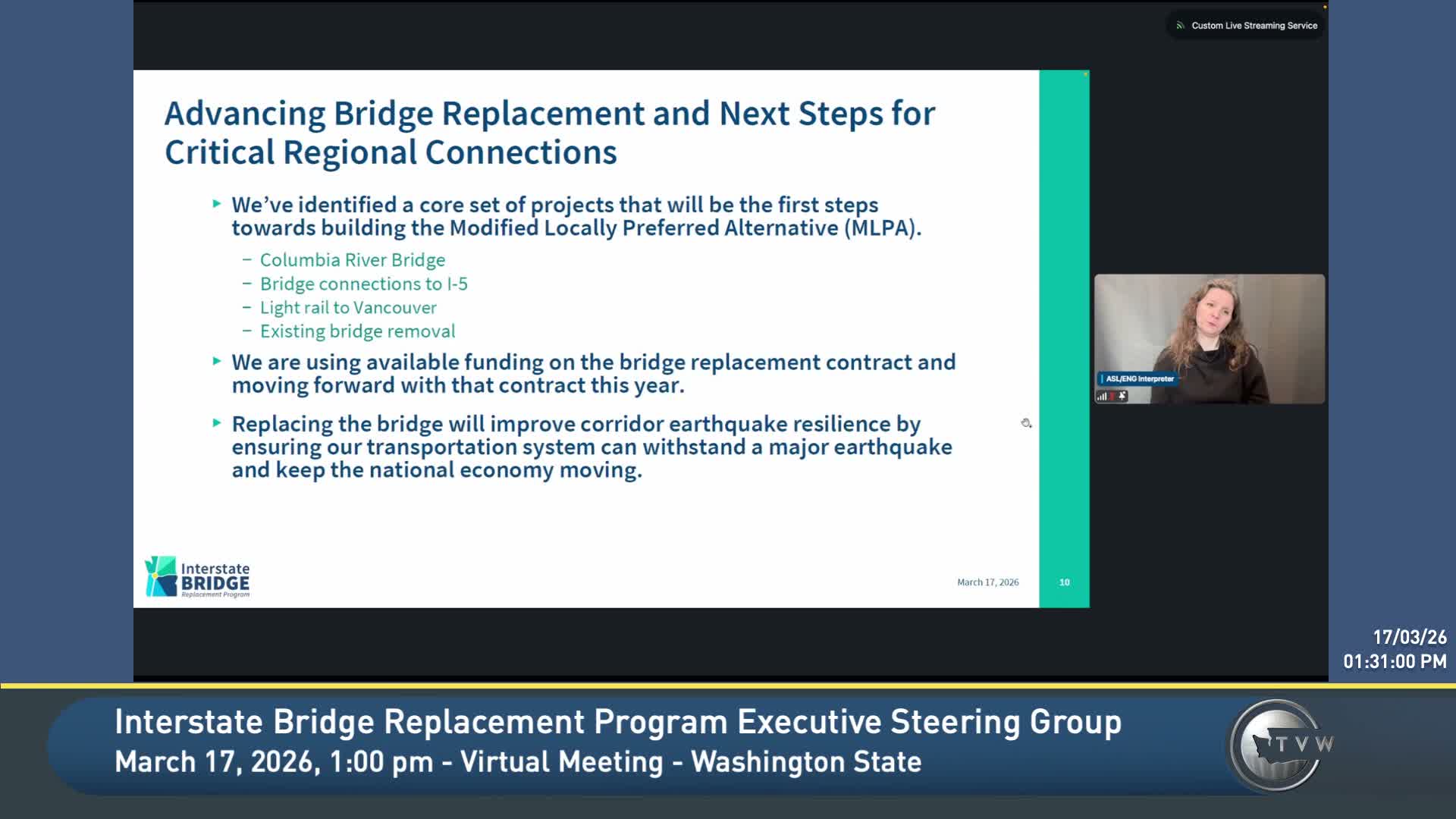
“We have 5 and a half billion dollars in available funding,” interim IVR program administrator Carly Francis said as she described the program’s core package: replacing the Columbia River bridges, connecting the new spans to I‑5, providing space for light rail and eventually removing the existing bridge.
That core package will be advanced as the initial, funded phase, Francis said. Alan Kiser, the program’s cost‑estimate risk lead, told the steering group the program’s new risk‑based estimate expresses a program range of $13,500,000,000 to $15,200,000,000 with a ‘‘likely’’ (70th percentile) cost of $14,400,000,000. Kiser said the later estimate reflects an 11‑year extension to the overall schedule, changes to bridge configuration and more detailed engineering and contract packaging.
Kiser explained that the 2026 estimate uses a program‑specific inflation forecast and a risk analysis that examined hundreds of potential uncertainties. ‘‘The base cost component is $7,800,000,000, the risk component is $4,200,000,000 and the escalation component is $2,400,000,000,’’ he said.
Program staff and the two state departments of transportation emphasized a phased approach. Washington Secretary of Transportation Julie Meredith said the program will move ‘‘step by step or phase by phase’’ and that staff plan to issue procurement documents this year, award a construction contract in 2027 and start bridge construction in 2028.
Finance lead Brent Baker detailed available and prospective funding. He said the program has awarded discretionary grants that include a $1.5 billion Bridge Investment Program grant and a $600 million MEGA grant, but only small portions of those awards have been obligated for design to date. The program is pursuing a $1 billion Federal Transit Administration Capital Investment Grant for light rail funding, which is not yet secured.
Baker said the cost to replace the bridge and connect it to I‑5 is currently estimated at $5.9 billion, and the committed funding total for the initial phase currently sums to about $5.45 billion—leaving an approximate $450 million funding gap. He described a suite of strategies under consideration to close the gap, including design refinements, value engineering, contract packaging, increased toll revenues subject to state policy, and pursuing additional federal discretionary grants.
Elected officials and regional partners welcomed the plan but pressed for clarity on timing and local benefits. Mayor Anne McInerney urged consistent public messaging that emphasizes Phase 1 details rather than the full‑program completion year quoted in some news coverage. Metro representative Juan Carlos Gonzalez asked how jobs and Oregon participation will be ensured during contracting; program staff said coordination and contracting assumptions are being developed with both states and regional partners.
Public commenters raised alternatives and urged prompt action. Bob Wertbad urged the program to reconsider an immersed‑tunnel option and argued it could cut costs; the program did not adopt that alternative at the meeting. Ron Arp, speaking for regional business groups, urged rapid advancement of construction packages and said eliminating an operable lift span reduced costs by roughly $1.7 billion, calling getting ‘‘concrete and steel in the ground’’ the best hedge against inflation.
Program staff listed near‑term milestones: publish the final supplemental environmental impact statement and obtain an amended Record of Decision, update the initial finance plan required by federal agencies, amend federal grant agreements by a September obligation deadline, and begin procurement steps (RFQ and RFP) this year. Staff said they expect light‑rail construction to start later, provided non‑CIG funding is committed and a successful FTA rating.
Carly Francis said the states remain committed to delivering the five‑mile program ‘‘over time’’ and pledged more frequent milestone updates as the program moves from planning to delivery. The steering‑group meeting concluded with staff reiterating that additional work is needed to align grants, finalize the initial finance plan and close the first‑phase funding gap.
Next procedural step: the program intends to publish procurement materials this year, pursue grant amendments and provide a progress update to the executive steering group this summer.
“We have 5 and a half billion dollars in available funding,” interim IVR program administrator Carly Francis said as she described the program’s core package: replacing the Columbia River bridges, connecting the new spans to I‑5, providing space for light rail and eventually removing the existing bridge.
That core package will be advanced as the initial, funded phase, Francis said. Alan Kiser, the program’s cost‑estimate risk lead, told the steering group the program’s new risk‑based estimate expresses a program range of $13,500,000,000 to $15,200,000,000 with a ‘‘likely’’ (70th percentile) cost of $14,400,000,000. Kiser said the later estimate reflects an 11‑year extension to the overall schedule, changes to bridge configuration and more detailed engineering and contract packaging.
Kiser explained that the 2026 estimate uses a program‑specific inflation forecast and a risk analysis that examined hundreds of potential uncertainties. ‘‘The base cost component is $7,800,000,000, the risk component is $4,200,000,000 and the escalation component is $2,400,000,000,’’ he said.
Program staff and the two state departments of transportation emphasized a phased approach. Washington Secretary of Transportation Julie Meredith said the program will move ‘‘step by step or phase by phase’’ and that staff plan to issue procurement documents this year, award a construction contract in 2027 and start bridge construction in 2028.
Finance lead Brent Baker detailed available and prospective funding. He said the program has awarded discretionary grants that include a $1.5 billion Bridge Investment Program grant and a $600 million MEGA grant, but only small portions of those awards have been obligated for design to date. The program is pursuing a $1 billion Federal Transit Administration Capital Investment Grant for light rail funding, which is not yet secured.
Baker said the cost to replace the bridge and connect it to I‑5 is currently estimated at $5.9 billion, and the committed funding total for the initial phase currently sums to about $5.45 billion—leaving an approximate $450 million funding gap. He described a suite of strategies under consideration to close the gap, including design refinements, value engineering, contract packaging, increased toll revenues subject to state policy, and pursuing additional federal discretionary grants.
Elected officials and regional partners welcomed the plan but pressed for clarity on timing and local benefits. Mayor Anne McInerney urged consistent public messaging that emphasizes Phase 1 details rather than the full‑program completion year quoted in some news coverage. Metro representative Juan Carlos Gonzalez asked how jobs and Oregon participation will be ensured during contracting; program staff said coordination and contracting assumptions are being developed with both states and regional partners.
Public commenters raised alternatives and urged prompt action. Bob Wertbad urged the program to reconsider an immersed‑tunnel option and argued it could cut costs; the program did not adopt that alternative at the meeting. Ron Arp, speaking for regional business groups, urged rapid advancement of construction packages and said eliminating an operable lift span reduced costs by roughly $1.7 billion, calling getting ‘‘concrete and steel in the ground’’ the best hedge against inflation.
Program staff listed near‑term milestones: publish the final supplemental environmental impact statement and obtain an amended Record of Decision, update the initial finance plan required by federal agencies, amend federal grant agreements by a September obligation deadline, and begin procurement steps (RFQ and RFP) this year. Staff said they expect light‑rail construction to start later, provided non‑CIG funding is committed and a successful FTA rating.
Carly Francis said the states remain committed to delivering the five‑mile program ‘‘over time’’ and pledged more frequent milestone updates as the program moves from planning to delivery. The steering‑group meeting concluded with staff reiterating that additional work is needed to align grants, finalize the initial finance plan and close the first‑phase funding gap.
Next procedural step: the program intends to publish procurement materials this year, pursue grant amendments and provide a progress update to the executive steering group this summer.
Don't Miss a Word: See the Full Meeting!
Go beyond summaries. Unlock every video, transcript, and key insight with a Founder Membership.
✓
Get instant access to full meeting videos
✓
Search and clip any phrase from complete transcripts
✓
Receive AI-powered summaries & custom alerts
✓
Enjoy lifetime, unrestricted access to government data
30-day money-back guarantee
